
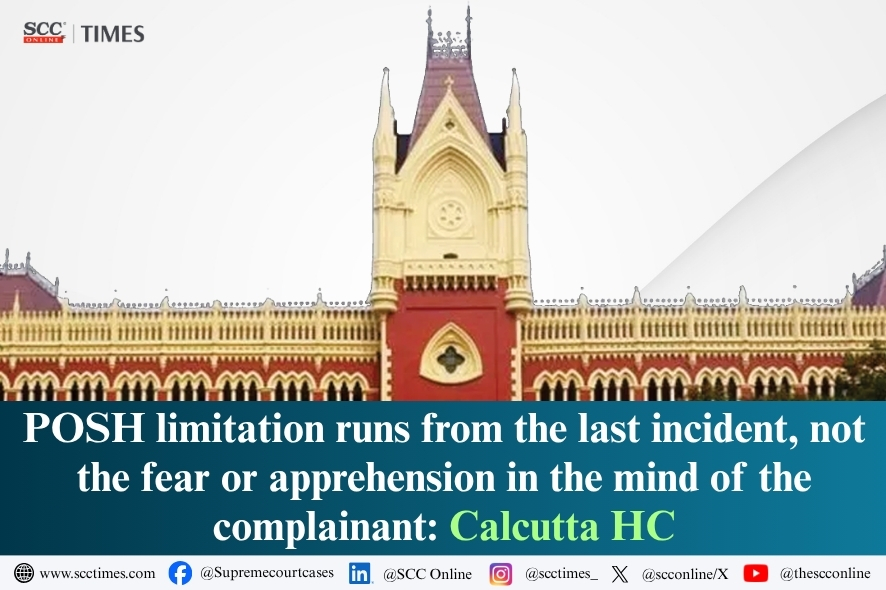
Calcutta HC: POSH Limitation From Last Incident, Fear No Excuse
Summary
- The Calcutta High Court ruled that the three-month limitation period for POSH Act complaints begins strictly from the last incident of sexual harassment.
- Subjective fear or apprehension in the complainant's mind does not extend this statutory deadline under Section 9 of the POSH Act.
- This decision arose from a case where a contractual employee alleged harassment between September 2021 and July 2022, but filed her complaint in January 2023 based on apprehension of future harm.
- The court upheld the strict application of limitation laws, distinguishing the case from precedents involving distinct, independent events after harassment.
Calcutta High Court Clarifies POSH Complaint Deadline
Crucially, the court determined that mere subjective fear or apprehension in the complainant's mind does not constitute a valid basis for extending this statutory deadline.
The Calcutta High Court has issued a significant ruling clarifying the strict application of the limitation period for complaints filed under the Sexual Harassment of Women at Workplace (Prevention, Prohibition and Redressal) Act, 2013 (POSH Act). A division bench comprising Justices Madhuresh Prasad and Prasenjit Biswas unequivocally stated that the three-month window for lodging a complaint, as stipulated by Section 9 of the Act, commences precisely from the date of the last reported incident of sexual harassment. Crucially, the court determined that mere subjective fear or apprehension in the complainant's mind does not constitute a valid basis for extending this statutory deadline.
This clarification arose from a writ petition challenging an order by the West Bengal Administrative Tribunal, which had previously set aside the findings of an Internal Complaints Committee (ICC). The underlying case involved a contractual Data Entry Operator (DEO) at the CID office in West Bengal, who alleged sexual harassment by a Deputy Superintendent of Police (DSP). The complainant reported instances of inappropriate physical contact, including touching her back and waist while she worked, occurring repeatedly between September 2021 and July 2022. Despite these allegations, no specific dates for these incidents were provided within that period.
Initially, the complainant remained silent, attributing her inaction to fear and compelling circumstances. The situation escalated after she was assigned to work under the same DSP within the SOG and homicide section. Upon seeing the DSP return to the CID office from leave, she developed an apprehension that she might again be posted under him and subjected to similar harassment. This apprehension prompted her to file a formal complaint on January 5, 2023. The ICC subsequently investigated the matter, found the allegations to be true, and recommended departmental action against the DSP for misconduct under applicable service rules. However, the DSP challenged these findings before the West Bengal Administrative Tribunal, which ultimately set aside the ICC's report, leading the State to petition the High Court.
Strict Interpretation of the POSH Act's Limitation Period
At the heart of the High Court's deliberation were two pivotal questions: whether the POSH complaint was time-barred by the statutory limitation, and whether the complaint merely reflected an apprehension in the complainant's mind rather than a fresh incident of harassment. The court's analysis centered on Section 9 of the POSH Act, which mandates that a complaint must be filed within three months of the last incident of sexual harassment. This provision is designed to ensure timely reporting and investigation of workplace sexual harassment.
The bench emphasized that the Act does not provide for an extension of this period based on a complainant's internal emotional state, such as fear or apprehension, if no new incident of harassment has occurred. This strict interpretation underscores the legislative intent behind the limitation period, aiming for prompt resolution of such sensitive matters. The court meticulously examined the timeline of events, noting the absence of any alleged incident of sexual harassment after July 2022, despite the complaint being lodged in January 2023.
Precedents Reinforce Timeliness in Harassment Complaints
In reaching its decision, the Calcutta High Court considered several significant judicial precedents. The respondent, the DSP, relied on a coordinate bench's decision in *Nirmal Kanti Chakraborti v. Vaneeta Patnaik* (2024 SCC OnLine Cal 11896), which had found a complaint filed more than three months after the last incident of sexual harassment to be unsustainable. This principle was further affirmed by the Supreme Court in *X8 v. Nirmal Kanti Chakrabarti* (2025 SCC OnLine SC 1964). Both these cases underscored the critical importance of adhering to the statutory limitation period.
The court also referenced the Supreme Court's ruling in *Popat Bahiru Govardhane v. LAO* (2013) 10 SCC 765, which firmly established that the law of limitation, while potentially harsh on individual parties, must be applied rigorously when prescribed by statute. While the State argued that the harassment was recurring and cited *X8 v. Nirmal Kanti Chakrabarti* and an Allahabad High Court decision in *Dr. Tapas Kumar Das v. Harish Chandra Research Institute* (2026 SCC OnLine All 4976), the Calcutta High Court distinguished the facts. It noted that in *X8*, the perpetrator's removal was a distinct, independent event following the last harassment incident, which the Supreme Court did not consider a recurring wrong. In the present case, the High Court found no comparable independent incident of sexual harassment after July 2022, only a subjective apprehension of future harm, thus rendering the complaint time-barred.
Practical Implications
This ruling clarifies that the POSH Act's 3-month limitation period runs strictly from the last incident of harassment, not subjective fear. Lawyers must advise clients on the critical importance of timely complaint filing and organizations must ensure robust reporting mechanisms to avoid time-barred challenges to ICC findings.
Source
How does this affect you?
Get an AI analysis of this article grounded in your jurisdictions, practice areas, and any policy documents you've uploaded to Wansom.
Finish Reading the Full Story and the Expert Analysis.
Get the latest legal & regulatory intelligence in India
Wansom is AI and can make mistakes.