
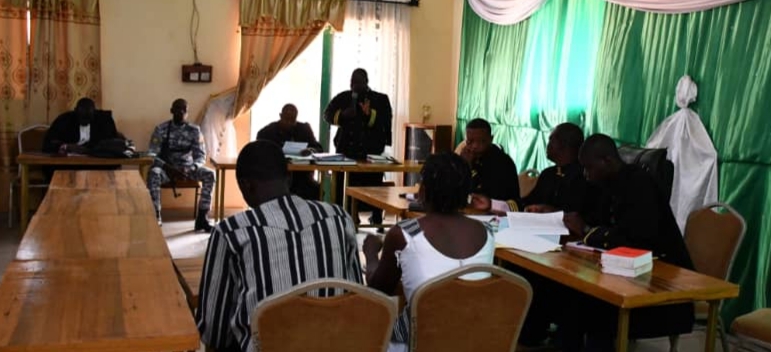
Burkina Faso: Solenzo Murder Trial Opens for 19 Accused
On Monday, November 9, 2026, in Solenzo, Burkina Faso, 12 of 19 accused individuals appeared before the Dédougou Grand Instance Court's criminal chamber for the opening of a circuit court trial concerning the murder of the chief of Solenzo canton, an event linked to a public demonstration on November 24, 2024. This "audience foraine" (circuit court session) of the Tribunal de Grande Instance (TGI) de Dédougou's criminal chamber was convened in Solenzo specifically to hear this single, significant case. The proceedings involve a substantial number of accused individuals, highlighting the gravity and potential complexity of the matter. The excerpt indicates that the trial has just commenced, and therefore, no outcome or specific rulings have been reported at this initial stage.
This development holds considerable legal significance for practitioners in Burkina Faso, particularly those involved in criminal law, public order, and community relations. The use of an "audience foraine" underscores the Burkinabè judiciary's commitment to ensuring access to justice, even in more remote areas, by bringing the court closer to the community where the alleged events transpired. The case itself, involving the murder of a traditional leader (canton chief) and its connection to a public demonstration, touches upon sensitive issues of public order, the authority of traditional institutions, and the state's capacity to maintain peace and security. The large number of accused individuals suggests a potentially widespread incident, which could have broader implications for social cohesion and governance.
The legal context for this trial is rooted in Burkina Faso's criminal justice system, where the Tribunal de Grande Instance (TGI) serves as a court of general jurisdiction, with its criminal chamber handling serious offenses such as murder. The "audience foraine" mechanism is a procedural adaptation designed to overcome geographical barriers and facilitate justice delivery, particularly in cases with numerous local witnesses or accused. This practice is enshrined in the country's judicial organization laws, aiming to enhance judicial efficiency and public confidence. The substantive law applicable would include provisions from the Burkinabè Penal Code concerning homicide, public disturbances, and potentially conspiracy or complicity, depending on the specific charges against each of the 19 accused. The role of a canton chief, while traditional, often carries significant social and administrative weight, making crimes against such figures particularly impactful.
The primary judicial body involved is the criminal chamber of the Tribunal de Grande Instance (TGI) de Dédougou, which is presiding over this circuit court session in Solenzo. The key individuals are the 19 accused, of whom 12 were present at the opening of the trial, facing charges related to the murder of the chief of Solenzo canton. The victim, the chief of Solenzo canton, represents a significant traditional authority figure. The events leading to the trial are linked to a public demonstration that occurred on November 24, 2024. The information is sourced from Sidwaya Burkina Faso, a local media outlet.
Attorneys and legal professionals in Burkina Faso should closely monitor the progression and eventual outcome of this trial. The case offers valuable insights into how the Burkinabè judiciary handles complex criminal matters involving multiple defendants, public unrest, and traditional leadership, especially within the framework of circuit court proceedings. Businesses operating in regions prone to social demonstrations or with strong traditional governance structures should take note of the judicial response to such incidents, as it can inform risk assessments and community engagement strategies. Understanding the practical application of "audiences foraines" and the procedural nuances of large-scale criminal trials will be crucial for legal strategy and client advice. The specific findings and sentences, once reported, will set important precedents regarding accountability for violence linked to public gatherings and crimes against traditional authorities.
How does this affect you?
Get an AI analysis of this article grounded in your jurisdictions, practice areas, and any policy documents you've uploaded to Wansom.
Finish Reading the Full Story and the Expert Analysis.
Get the latest legal & regulatory intelligence in Burkina Faso
Wansom is AI and can make mistakes.