
Burkina Faso: Loi Finances Rectificative 2026 Boosts Budgetary Savings 35.59%
Summary
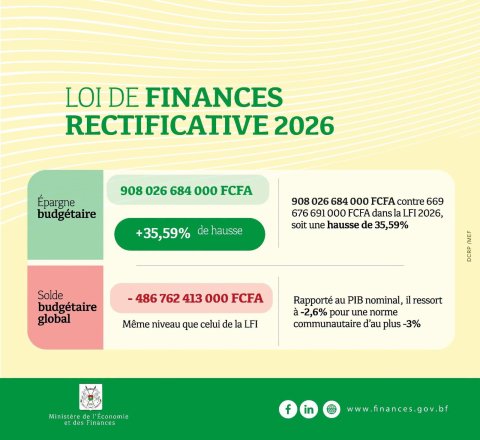
- Burkina Faso's revised 2026 budget projects budgetary savings of 908.03 billion CFA francs.
- This represents a 35.59% increase compared to the initial 2026 finance law's savings of 669.68 billion CFA francs.
- The overall budget deficit for 2026 remains stable at -486.76 billion CFA francs, identical to initial forecasts.
- Expressed as a percentage of nominal GDP, the deficit stands at -2.6%, which is below the community standard of -3%.
Key Revisions in Burkina Faso's 2026 Budget
Proactive legal counsel will be essential to navigate these updated fiscal realities effectively.
The government of Burkina Faso has unveiled significant adjustments to its financial framework for 2026 through the introduction of a new loi finances rectificative 2026. This updated fiscal blueprint details notable changes, particularly concerning the nation's projected budgetary savings. Under the provisions of this revised budget, the anticipated épargne budgétaire Burkina Faso for the year 2026 is now set at 908.03 billion CFA francs. This figure marks a substantial increase when juxtaposed with the initial projections outlined in the loi de finances initiale Burkina Faso, which had estimated savings at 669.68 billion CFA francs. The upward revision signifies a robust growth of 35.59% in the funds expected to be available to the state.
Despite this considerable enhancement in budgetary savings, the overall budget balance, which reflects the deficit budgétaire Burkina Faso 2026, shows consistency with earlier forecasts. The revised figures indicate a global budget deficit of -486.76 billion CFA francs. This specific amount precisely mirrors what was initially projected, suggesting that while the internal composition of public finances has shifted, the net fiscal position has been maintained. The stability of this deficit figure, even amidst rising savings, points to a carefully managed adjustment within the broader economic strategy.
Financial Context and Fiscal Prudence
The stability of the overall budget balance, notwithstanding the substantial increase in budgetary savings, highlights a deliberate approach to public financial management in Burkina Faso. When assessed in relation to the nominal Gross Domestic Product (GDP), the deficit budgétaire Burkina Faso 2026 stands at -2.6%. This percentage is particularly significant as it falls below the established community standard, which mandates a maximum deficit of -3%. Adherence to this regional fiscal benchmark underscores the nation's commitment to maintaining macroeconomic stability and responsible public spending practices, reflecting core principles of droit public financier Burkina Faso.
The notable growth in épargne budgétaire Burkina Faso, as detailed in the Burkina Faso budget révisé 2026, could be interpreted as an indicator of improved revenue collection or more efficient expenditure management across various sectors. Such an increase in available funds provides the government with enhanced flexibility for future investments or to address unforeseen economic challenges. The careful calibration of the loi finances rectificative 2026, ensuring that the overall deficit remains within acceptable limits, demonstrates a strategic effort to balance increased financial capacity with fiscal discipline.
Implications for Legal and Business Stakeholders
The promulgation of the Burkina Faso loi finances rectificative 2026 carries significant implications for various stakeholders, particularly those operating within the legal and business sectors. Lawyers advising clients with interests in Burkina Faso should meticulously review the detailed provisions of this revised finance law. The shifts in public finance priorities and economic projections, as evidenced by the increased épargne budgétaire Burkina Faso, could directly influence the landscape for public contracts, potentially altering government procurement opportunities or the terms of existing agreements.
Furthermore, the adjustments within the Burkina Faso budget révisé 2026 may have ramifications for tax obligations and investment strategies. Changes in revenue streams or expenditure allocations could lead to modifications in tax policies or incentives, necessitating a re-evaluation of financial planning for businesses. Understanding the nuances of this rectifying finance law is crucial for assessing potential impacts on corporate liabilities, investment climates, and overall compliance with the evolving framework of droit public financier Burkina Faso. Proactive legal counsel will be essential to navigate these updated fiscal realities effectively.
Practical Implications
The revised budget law for Burkina Faso in 2026 signals shifts in public finance priorities and economic projections. Lawyers advising clients with interests in Burkina Faso should review the detailed provisions of this rectifying finance law upon its final promulgation to assess potential impacts on public contracts, tax obligations, or investment strategies.
Source
How does this affect you?
Get an AI analysis of this article grounded in your jurisdictions, practice areas, and any policy documents you've uploaded to Wansom.
Finish Reading the Full Story and the Expert Analysis.
Get the latest legal & regulatory intelligence in Burkina Faso
Wansom is AI and can make mistakes.