
Burkina Faso: Loi de Finances Rectificative 2026 Adds 297 Billion FCFA to Budget
Summary
- Burkina Faso's 2026 budget has been revised, increasing total expenditures by approximately 297 billion FCFA.
- This revision is formalized through the country's loi de finances rectificative 2026.
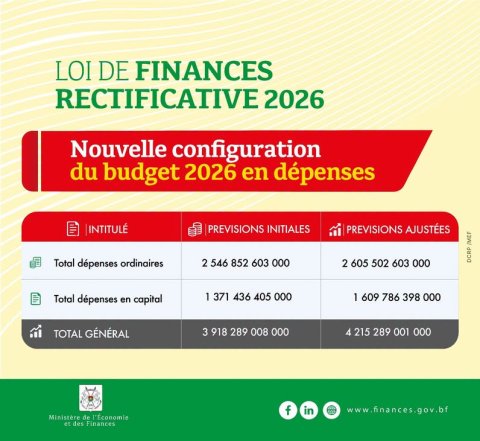
- Ordinary expenditures are set to rise by 58.65 billion FCFA, reaching 2,605.50 billion FCFA.
- Capital expenditures show a more significant increase, moving from 1,371.44 billion FCFA to 1,609.79 billion FCFA.
- The substantial increase in capital spending suggests potential new public procurement and infrastructure development opportunities.
Burkina Faso's Revised 2026 Budget
Lawyers advising businesses in Burkina Faso should note the significant increase in capital expenditures, which may signal new public procurement opportunities or infrastructure projects requiring legal counsel.
Burkina Faso's national budget for 2026 has undergone a significant revision, leading to an approximate increase of 297 billion FCFA in total expenditures. This adjustment is formally outlined within the framework of the country's loi de finances rectificative 2026, which serves to amend and update the initial financial projections for the upcoming fiscal year. The revised figures reflect a strategic recalibration of government spending priorities and economic forecasts.
The updated financial plan details specific changes across different categories of public spending. Ordinary expenditures, which typically cover recurrent costs such as salaries and operational expenses, are now projected to reach 2,605.50 billion FCFA. This represents an increase of 58.65 billion FCFA from the initial forecast of 2,546.85 billion FCFA. This upward adjustment in routine spending indicates a moderate expansion in the day-to-day operational capacity of the state.
More notably, capital expenditures have seen a considerably more substantial progression. These investments, which are typically allocated for infrastructure development, equipment acquisition, and other long-term projects, have been revised upwards from 1,371.44 billion FCFA to 1,609.79 billion FCFA. This significant increase in capital outlay underscores a potential governmental focus on development initiatives and strategic investments, signaling a shift towards enhancing the nation's productive capacity and public assets.
Legal and Regulatory Context
The mechanism for these budgetary changes is the loi de finances rectificative 2026, or amended finance law. This legal instrument is crucial in public financial management, allowing governments to adapt their fiscal plans mid-cycle or in response to new economic realities, unforeseen circumstances, or evolving policy objectives. Unlike an initial budget law, which sets the financial framework for the year ahead, a rectifying law specifically modifies previously approved provisions, ensuring the state's financial operations remain aligned with current needs and projections.
In Burkina Faso, the process of enacting such a revised budget involves parliamentary approval, ensuring that the changes to the Budget de l'État Burkina Faso are legally sanctioned and transparent. This legislative oversight is vital for maintaining fiscal discipline and accountability. The adoption of this amended finance law for 2026 signifies a formal acknowledgment by the Burkinabè authorities of the necessity to adjust the nation's financial trajectory, impacting various sectors and stakeholders operating within the country's economic landscape.
Implications for Public Spending and Economic Activity
The revised budget, particularly the substantial increase in capital expenditures, carries significant implications for economic activity and public procurement in Burkina Faso. The shift towards a more robust allocation for capital projects suggests an intent to stimulate growth through investment in physical assets, which can range from transportation networks and energy facilities to public buildings and technological infrastructure. This focus on long-term development spending often creates a ripple effect throughout the economy, generating demand for goods, services, and labor.
Lawyers advising businesses in Burkina Faso should note the significant increase in capital expenditures, which may signal new public procurement opportunities or infrastructure projects requiring legal counsel. Compliance officers should monitor how these budget revisions might influence regulatory enforcement or sector-specific funding. The overall increase in Dépenses publiques Burkina Faso 2026, especially in the capital segment, indicates a dynamic environment for businesses involved in construction, engineering, technology, and related services, necessitating careful attention to the evolving regulatory and contractual landscape.
Practical Implications
Lawyers advising businesses in Burkina Faso should note the significant increase in capital expenditures, which may signal new public procurement opportunities or infrastructure projects requiring legal counsel. Compliance officers should monitor how these budget revisions might influence regulatory enforcement or sector-specific funding.
Source
Source: Original reporting via Economie
How does this affect you?
Get an AI analysis of this article grounded in your jurisdictions, practice areas, and any policy documents you've uploaded to Wansom.
Finish Reading the Full Story and the Expert Analysis.
Get the latest legal & regulatory intelligence in Burkina Faso
Wansom is AI and can make mistakes.