
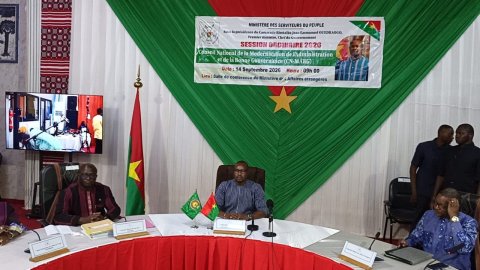
Burkina Faso CN-MABG: Administrative Transformation Progress Reviewed
Summary
- Burkina Faso's Conseil national de la Modernisation de l'administration et de la bonne gouvernance (CN-MABG) held its annual session on September 14, 2026, in Ouagadougou.
- Prime Minister Rimtalba Jean Emmanuel Ouédraogo presided over the meeting.
- The council reviewed the public administration's performance for 2025 and assessed ongoing reforms.
- Key orientations for the year 2027 were established during the session.
- The meeting highlighted Burkina Faso's commitment to accelerating administrative transformation and good governance.
Key Administrative Review Convenes
The sustained focus on administrative modernization and good governance in Burkina Faso, as evidenced by the CN-MABG's recent session, signals potential future changes in regulatory frameworks and government processes.
Burkina Faso's Conseil national de la Modernisation de l'administration et de la bonne gouvernance (CN-MABG) recently held its ordinary annual session in Ouagadougou on Monday, September 14, 2026. The high-level gathering, presided over by Prime Minister Rimtalba Jean Emmanuel Ouédraogo, underscored the nation's commitment to enhancing public sector efficiency and accountability. This pivotal meeting served as a critical forum for evaluating the progress and challenges within the country's administrative framework.
The agenda for the session was comprehensive, focusing on a retrospective analysis of the public administration's performance throughout the preceding year, 2025. Members of the council meticulously reviewed various metrics and outcomes, assessing the effectiveness of government operations and service delivery. This performance examination is a cornerstone of the ongoing Burkina Faso CN-MABG administrative transformation efforts, providing data-driven insights into areas requiring improvement.
Beyond the performance review, the council dedicated significant attention to assessing the status of various administrative reforms already underway. This involved a detailed stock-taking of initiatives designed to streamline processes, improve transparency, and foster good governance. Crucially, the session also looked forward, establishing the principal strategic orientations that will guide the public administration's work and reform agenda for the year 2027, setting a clear roadmap for future development.
Strategic Mandate for Good Governance
The Conseil national de la Modernisation de l'administration et de la bonne gouvernance (CN-MABG) stands as a central pillar in Burkina Faso's overarching strategy for administrative modernization and the promotion of good governance. Its annual sessions, such as the one held on September 14, 2026, are not merely procedural but represent a concerted national effort to systematically improve the functioning of the state apparatus. The presence and leadership of Prime Minister Rimtalba Jean Emmanuel Ouédraogo at the session highlight the executive's direct engagement and prioritization of these reforms.
The council's mandate extends to overseeing the implementation of policies aimed at enhancing public service delivery, combating corruption, and ensuring greater transparency in government operations. The review of 2025 performance and the articulation of 2027 orientations are integral to this continuous cycle of planning, execution, and evaluation. This structured approach to the Réforme administration publique Burkina Faso is designed to foster a more responsive and effective public sector, aligning with national development goals and citizen expectations.
These ongoing initiatives reflect a broader commitment to Burkina Faso bonne gouvernance réformes, recognizing that a well-functioning administration is fundamental to stability and progress. The CN-MABG session annuelle 2026, therefore, serves as a key mechanism for maintaining momentum and ensuring accountability across various government departments and agencies, driving the nation's strategic vision for a modern and efficient state.
Implications for Regulatory Landscape
The sustained focus on administrative modernization and good governance in Burkina Faso, as evidenced by the CN-MABG's recent session, signals potential future changes in regulatory frameworks and government processes. The strategic orientations set for 2027 indicate an evolving landscape that will likely impact various sectors, from business operations to public interactions. This continuous drive for efficiency and transparency suggests that legal and compliance requirements may be subject to adjustments as the administration refines its operational standards.
For legal professionals and compliance officers operating within or engaging with Burkina Faso, these developments are particularly significant. The emphasis on reviewing past performance and setting future directions implies a dynamic regulatory environment where existing norms could be updated or new ones introduced to align with the goals of administrative transformation. Monitoring these changes is crucial for anticipating impacts on client operations, ensuring ongoing compliance obligations are met, and navigating interactions with public administration effectively.
Ultimately, the nation's ambition to accelerate its administrative transformation underscores a commitment to creating a more predictable, transparent, and efficient environment. This not only aims to benefit citizens but also to foster a more attractive climate for investment and economic activity. The outcomes of such high-level deliberations, particularly those setting future orientations, provide valuable insights into the government's strategic priorities and the direction of its regulatory evolution.
Practical Implications
The ongoing focus on administrative modernization and good governance in Burkina Faso signals potential future changes in regulatory frameworks and government processes. Lawyers and compliance officers should monitor these developments to anticipate impacts on client operations, compliance obligations, and interactions with public administration.
Source
Source: Original reporting via {source}
How does this affect you?
Get an AI analysis of this article grounded in your jurisdictions, practice areas, and any policy documents you've uploaded to Wansom.
Finish Reading the Full Story and the Expert Analysis.
Get the latest legal & regulatory intelligence in Burkina Faso
Wansom is AI and can make mistakes.