
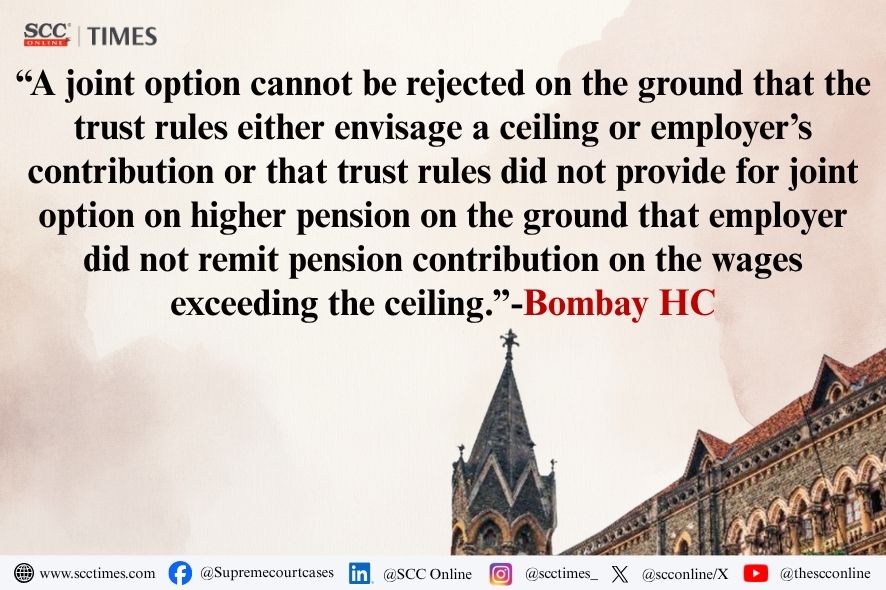
Bombay High Court: PF Trust Rules Cannot Override Higher Pension Rights Under EPS 1995
In India, the Bombay High Court recently ruled that employees of exempted provident fund establishments are entitled to the same higher pension benefits under the Employees' Pension Scheme (EPS) 1995 as employees of unexempted establishments, asserting that provident fund trust rules cannot override statutory rights. This decision reinforces the supremacy of statutory social security provisions over internal organizational regulations, ensuring equitable treatment for all employees under the scheme.
This judgment is highly significant for a large segment of the Indian workforce, particularly those employed in exempted establishments, as it clarifies and reinforces their right to higher pension benefits under the EPS 1995. It ensures that employees in such establishments are not disadvantaged compared to their counterparts in unexempted entities due to internal trust rules that might impose wage ceilings or restrict contributions on actual wages. For employers, it means a potential re-evaluation of their pension contribution policies and a need to align their trust rules with the statutory provisions of the EPS 1995, potentially leading to increased liabilities and requiring immediate compliance measures.
The Employees' Pension Scheme, 1995 (EPS 1995), is framed under the Employees' Provident Funds and Miscellaneous Provisions Act, 1952. Paragraphs 11(3) and 11(4) of the EPS 1995 are central to the right to higher pension, allowing employees to contribute to the pension fund on their actual wages exceeding the statutory wage ceiling, thereby securing a higher pension. Exempted establishments are those that have been granted exemption from the operation of the EPF Scheme, 1952, subject to certain conditions, including maintaining a provident fund trust that offers benefits no less favourable than those under the statutory scheme. The High Court's ruling underscores the principle that statutory rights, particularly those related to social security, cannot be curtailed by internal rules of private trusts, upholding the legislative intent.
The key party involved in this legal development is the Bombay High Court, which delivered this crucial judgment. The specific parties to the case, including the names of the employees or the exempted establishments involved, are not detailed in the provided excerpt. However, the ruling has broad implications for all exempted provident fund establishments and their employees across India, setting a significant precedent.
Employers operating exempted provident fund establishments in India must immediately review their provident fund trust rules and contribution practices to ensure full compliance with the EPS 1995, particularly concerning contributions on actual wages and the provision of higher pension benefits. Legal practitioners advising such employers should conduct a thorough audit of existing schemes and advise on necessary amendments to trust deeds and operational procedures to avoid future litigation and ensure adherence to statutory mandates. Employees, on the other hand, should be aware of their right to higher pension and may consider seeking legal counsel if their applications for higher pension have been denied based on restrictive trust rules, leveraging this ruling to assert their statutory entitlements.
How does this affect you?
Get an AI analysis of this article grounded in your jurisdictions, practice areas, and any policy documents you've uploaded to Wansom.
Finish Reading the Full Story and the Expert Analysis.
Wansom is AI and can make mistakes.