
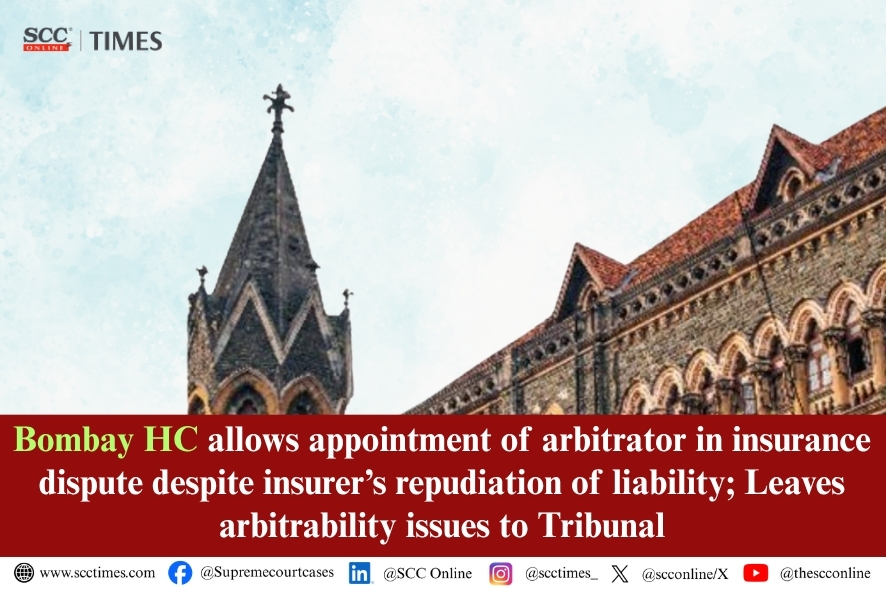
Bombay HC: Arbitrator Appointment Allowed Despite Insurance Repudiation
Summary
- The Bombay High Court reiterated that its role under Section 11 of the Arbitration Act is limited to confirming the existence of an arbitration agreement.
- The court allowed the appointment of an arbitrator in an insurance dispute despite the insurer's repudiation of liability.
- Substantive issues like repudiation, limitation, and arbitrability are to be decided by the arbitral tribunal, not the court at the appointment stage.
- This ruling provides clarity on the narrow scope of judicial intervention in arbitrator appointment proceedings in India.
Bombay HC Affirms Limited Judicial Role
By allowing the Bombay HC arbitrator insurance repudiation to proceed, the High Court effectively directed that complex questions surrounding the validity of the insurer's denial, along with issues of limitation and the overall arbitrability of the dispute, are matters to be thoroughly examined and decided by the appointed arbitral tribunal itself.
The Bombay High Court recently issued a significant ruling clarifying the scope of judicial intervention in arbitration proceedings, particularly concerning insurance disputes. The court sanctioned the appointment of an arbitrator in an insurance matter, even though the insurer had already repudiated liability for the claim. This decision underscores the judiciary's narrow function at the initial stage of arbitrator appointment under Indian law.
This particular judgment reinforces a fundamental principle: a court's primary responsibility at the Section 11 stage of the Arbitration and Conciliation Act, 1996, is solely to confirm the existence of a valid arbitration agreement between the parties. The court explicitly stated that the substantive merits of the dispute, including the insurer's denial of the claim, fall outside its purview at this juncture.
By allowing the Bombay HC arbitrator insurance repudiation to proceed, the High Court effectively directed that complex questions surrounding the validity of the insurer's denial, along with issues of limitation and the overall arbitrability of the dispute, are matters to be thoroughly examined and decided by the appointed arbitral tribunal itself. This approach promotes efficiency and minimizes pre-arbitration judicial interference.
Legal Framework for Arbitrator Appointment
The foundation of this ruling rests on Section 11 of the Arbitration and Conciliation Act, 1996, which outlines the procedure for appointing arbitrators when parties are unable to reach a consensus. While courts are empowered to make such appointments, the legislative design deliberately restricts the scope of judicial inquiry at this preliminary stage. The intent is to facilitate the swift commencement of arbitration without entangling it in protracted preliminary litigation over the dispute's merits.
The 'existence of arbitration agreement test' is the cornerstone of the court's jurisdiction under Section 11 Arbitration Act India. This test mandates that the court's review is confined to verifying that a legally binding agreement to arbitrate exists between the disputing parties. It does not extend to an examination of the specifics of the claim, such as whether it is time-barred, if a contractual breach occurred, or the justification behind an insurer's repudiation of liability.
These substantive issues, encompassing questions of repudiation, limitation, and the broader arbitrability insurance dispute Bombay HC, are explicitly reserved for the arbitral tribunal. This division of responsibility ensures that the tribunal, once constituted, possesses the necessary jurisdiction and expertise to adjudicate all facets of the dispute, including its own jurisdiction, in line with the principle of *kompetenz-kompetenz*. This prevents courts from prejudging the merits of a case before it reaches the designated arbitral forum.
Implications for Insurance Disputes
This recent pronouncement from the Bombay High Court carries significant weight for the landscape of arbitration in India, particularly for disputes involving insurance claims. It provides crucial clarity on the limited scope of judicial intervention at the Section 11 stage, reaffirming that courts should not overstep their bounds by adjudicating substantive issues prematurely, which are properly within the tribunal's domain.
For parties involved in insurance disputes, the ruling clarifies that an insurer's unilateral repudiation of liability does not serve as an impediment to the appointment of an arbitrator. This means that even if an insurance company denies a claim outright, the policyholder retains the right to pursue the appointment of an arbitrator to resolve the matter, ensuring that the dispute is heard through the agreed-upon mechanism. This significantly strengthens the enforceability of arbitration clauses embedded within insurance contracts.
The decision reinforces the principle that an arbitrator appointment despite repudiation is permissible, thereby promoting the efficiency and autonomy of the arbitration process. By leaving complex questions of insurer liability arbitration India, along with issues of limitation and the ultimate arbitrability of the dispute, to the tribunal, the High Court ensures that the arbitral mechanism remains the primary forum for resolving such contractual disagreements, consistent with the pro-arbitration stance of Indian law. This approach minimizes delays and encourages parties to adhere to their contractual commitments for dispute resolution.
Practical Implications
This Bombay High Court ruling provides clarity on the limited scope of judicial intervention at the Section 11 stage of arbitration proceedings in India. Lawyers advising clients on insurance disputes should note that an insurer's repudiation of liability does not prevent the appointment of an arbitrator, as such substantive issues are reserved for the arbitral tribunal itself.
Source
How does this affect you?
Get an AI analysis of this article grounded in your jurisdictions, practice areas, and any policy documents you've uploaded to Wansom.
Wansom is AI and can make mistakes.