
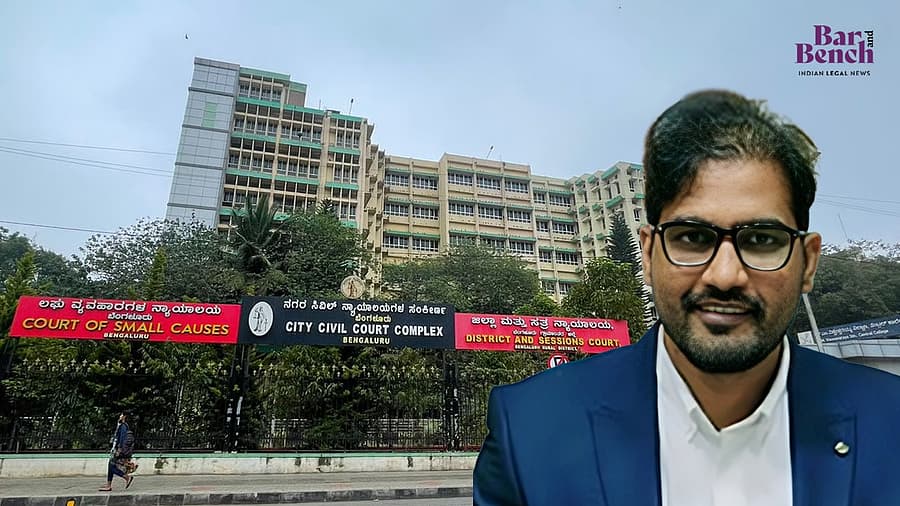
Bengaluru Court: Denies Gyanendra Gangwar Bail In KPSC Scam
Summary
- A Bengaluru court denied bail to suspended IAS officer Gyanendra Kumar Gangwar in the KPSC veterinary officer recruitment scam.
- Judge Nirmala Devi S cited prima facie evidence of a money trail and the risk of evidence destruction or influencing the ongoing investigation.
- Gangwar is accused of conspiring with Basavaraj Kannale to leak question papers and collect bribes for 400 veterinary officer posts.
- The scam involves allegations of question paper leaks, OMR sheet tampering, and relatives of officials securing high marks.
- The ruling underscores a strict judicial approach to bail for high-ranking officials accused of corruption, especially with a money trail and risk of evidence tampering.
Bengaluru Court Denies Bail to IAS Officer
The court's ruling highlighted the presence of significant preliminary evidence against Gangwar.
A Bengaluru court recently rejected the bail application filed by suspended Indian Administrative Service (IAS) officer Gyanendra Kumar Gangwar. The decision, handed down by Additional City Civil and Sessions Judge Nirmala Devi S, pertains to the ongoing Karnataka Public Service Commission (KPSC) veterinary officer recruitment scam case, officially titled `Gyanendra Kumar Gangwar v. State of Karnataka`.
The court's ruling highlighted the presence of significant preliminary evidence against Gangwar. Judge Devi S specifically noted that the prosecution had presented prima facie material demonstrating a financial connection, or 'money trail,' between Gangwar and another individual implicated in the scam. This evidence was deemed sufficient to warrant the continued detention of the high-ranking official.
In her observations, Judge Devi S underscored the critical stage of the investigation, which remains incomplete. She expressed concerns that granting bail at this juncture could lead to the destruction of crucial evidence or influence the ongoing investigative process. The court found that the submitted documents established initial grounds for suspicion, indicating that the petitioner had been in contact with Accused No. 6, Basavaraj Kannale, and that a money trail linking Accused No. 5, Accused No. 6, and various candidates had been identified by the respondent.
Allegations in the KPSC Recruitment Scam
The broader KPSC recruitment scam centers on alleged widespread irregularities in the examination process for 400 veterinary officer positions. The complaint details several serious accusations, including that relatives of KPSC officials attained unusually high scores, suggesting an unfair advantage. Furthermore, it is alleged that certain candidates were granted access to the examination question paper prior to the test, compromising the integrity of the selection process.
Another key allegation involves the tampering of OMR (Optical Mark Recognition) sheets, which are used for automated scoring of multiple-choice exams. The scheme reportedly involved middlemen who approached prospective candidates, promising to secure their appointments for substantial sums, ranging from ₹70-80 lakh. These appointments were allegedly guaranteed through the manipulation of the candidates' OMR marks, ensuring their success regardless of their actual performance.
Within this intricate web of corruption, Gyanendra Kumar Gangwar is accused of playing a pivotal role. It is alleged that he conspired with Basavaraj Kannale, a syndicate member of Tumkur University, to orchestrate the leaking of the question paper and to collect bribes from candidates seeking to secure the veterinary officer posts.
Legal Context and Judicial Rationale
The court's decision to deny bail to Gyanendra Kumar Gangwar establishes a precedent for the strict judicial approach to bail applications for high-ranking public officials accused of corruption in India. The ruling emphasizes the judiciary's commitment to preventing any potential obstruction of justice, particularly when a clear money trail and the risk of evidence tampering are identified. Gangwar faces charges under Section 3 of the relevant legal framework, indicating serious allegations of misconduct.
Judge Devi S's detailed reasoning highlights several critical factors influencing bail decisions in corruption cases. The court's focus on the pending nature of the investigation and the potential for the accused to influence witnesses or destroy evidence underscores the judiciary's cautious stance. This approach is particularly relevant in cases involving public servants, where the accused's position of power could be leveraged to impede justice. Lawyers representing clients in similar corruption or recruitment scam cases should be acutely aware of the court's emphasis on prima facie evidence and the potential for influencing investigations when preparing their bail arguments, as demonstrated by this ruling.
Why This Ruling Matters
The denial of bail to a suspended IAS officer in a high-profile recruitment scam sends a strong message regarding accountability in public service. It reinforces the principle that even high-ranking officials are not immune to the legal process, especially when faced with substantial preliminary evidence of corruption. This ruling contributes to the ongoing efforts to combat systemic irregularities in public recruitment examinations, which are crucial for ensuring fair opportunities and maintaining public trust in government institutions.
This judicial outcome serves as a significant indicator of the courts' resolve to thoroughly investigate and prosecute cases of official misconduct. By prioritizing the integrity of the investigation over the personal liberty of an accused official, particularly when there is a demonstrated money trail and risk of evidence tampering, the Bengaluru court has affirmed a robust stance against corruption. Such decisions are vital for upholding the rule of law and deterring future instances of malfeasance within the public administration.
Practical Implications
This ruling establishes a precedent for the strict judicial approach to bail applications for high-ranking public officials accused of corruption in India, particularly when a money trail and risk of evidence tampering are identified. Lawyers representing clients in similar corruption or recruitment scam cases should be aware of the court's emphasis on prima facie evidence and the potential for influencing investigations when preparing bail arguments.
Source
How does this affect you?
Get an AI analysis of this article grounded in your jurisdictions, practice areas, and any policy documents you've uploaded to Wansom.
Finish Reading the Full Story and the Expert Analysis.
Get the latest legal & regulatory intelligence in India
Wansom is AI and can make mistakes.