
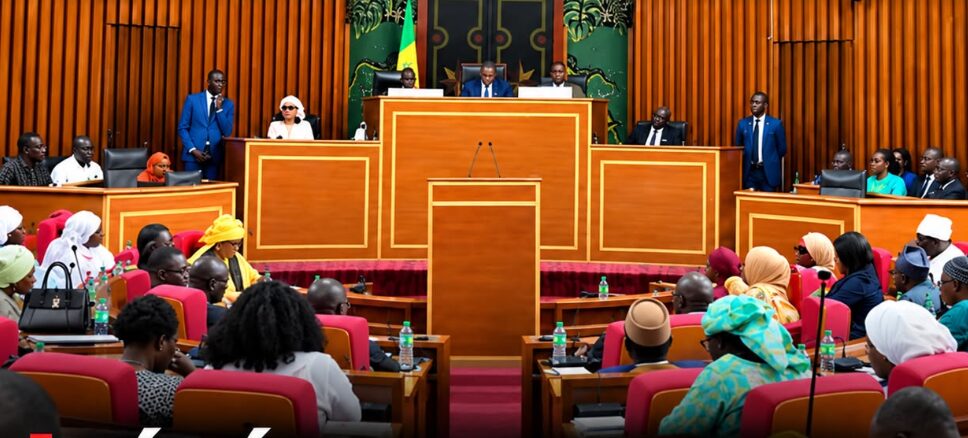
Babacar Ba: Sénégal Motion Censure Limit Under Article 86 Challenged
Summary
- Babacar Ba, President of the Forum du Justiciable, has challenged a common interpretation of Article 86 of the Senegalese Constitution.
- He disputes the view that deputies are limited to filing only one motion of censure per parliamentary session.
- Ba distinguishes between motions of censure initiated by parliament and those that are consequential.
- His perspective could significantly impact parliamentary oversight and government accountability in Senegal.
What Happened
If his view prevails, allowing for multiple motions of censure per parliamentary session, it would significantly enhance the legislative branch's capacity to scrutinize and challenge the executive.
The ongoing discussion surrounding the precise meaning of Article 86 within the Senegalese Constitution has recently seen a significant intervention. Babacar Ba, who serves as the president of the Forum du Justiciable, has put forward a new perspective on this constitutional provision. His contribution directly addresses a prevailing interpretation concerning the frequency with which parliamentary motions of censure can be introduced.
Specifically, Ba has openly challenged the widely held belief that members of parliament are restricted to submitting only a single motion of censure during any given parliamentary session. This stance introduces a fresh angle to the constitutional discourse, suggesting a more expansive understanding of legislative oversight mechanisms. His intervention aims to clarify the parameters governing such critical parliamentary actions, potentially reshaping how accountability is exercised within the Senegalese legislative framework.
Legal Context
Article 86 of the Senegalese Constitution governs the procedure for motions of censure, a fundamental tool for parliamentary oversight of the executive branch. The traditional interpretation, which Babacar Ba now contests, suggests a limitation on this power, allowing for only one such motion per parliamentary session. This restrictive view has implications for the dynamic between the legislative and executive arms of government, potentially limiting the parliament's ability to hold the government accountable on multiple occasions within a single session.
Babacar Ba's argument hinges on a crucial distinction he draws between different types of motions of censure. He differentiates between a motion of censure that originates directly from the initiative of the parliamentarians themselves and another category of motion that arises as a consequence of other parliamentary or governmental actions. This differentiation is central to his assertion that the "one per session" rule should not apply universally, thereby opening the door for multiple censure motions under varying circumstances. His analysis seeks to provide a more nuanced understanding of the `droit parlementaire Sénégal` as enshrined in the Constitution.
Why It Matters
The interpretation put forth by Babacar Ba regarding `Article 86 Constitution sénégalaise` carries substantial weight for the future of `procédure parlementaire Sénégal` and government accountability. If his view prevails, allowing for multiple motions of censure per parliamentary session, it would significantly enhance the legislative branch's capacity to scrutinize and challenge the executive. This expanded ability to initiate `motion censure Sénégal` could lead to a more robust system of checks and balances, providing deputies with greater flexibility to respond to various governmental actions or inactions throughout a session.
This re-evaluation of `interprétation motion censure` could empower parliamentary groups and political parties by offering more avenues for expressing no confidence in the government. For lawyers advising these entities, understanding this potential shift in `droit parlementaire Sénégal` is crucial for developing effective legislative strategies. The outcome of this debate could redefine the practical application of parliamentary oversight, making the government more continuously answerable to the National Assembly and potentially influencing the stability and responsiveness of the executive.
Practical Implications
Lawyers advising political parties or parliamentary groups in Senegal should be aware of this interpretation of Article 86, which posits that multiple motions of censure can be filed per parliamentary session, as it significantly impacts legislative strategy and government accountability mechanisms.
Source
How does this affect you?
Get an AI analysis of this article grounded in your jurisdictions, practice areas, and any policy documents you've uploaded to Wansom.
Wansom is AI and can make mistakes.