
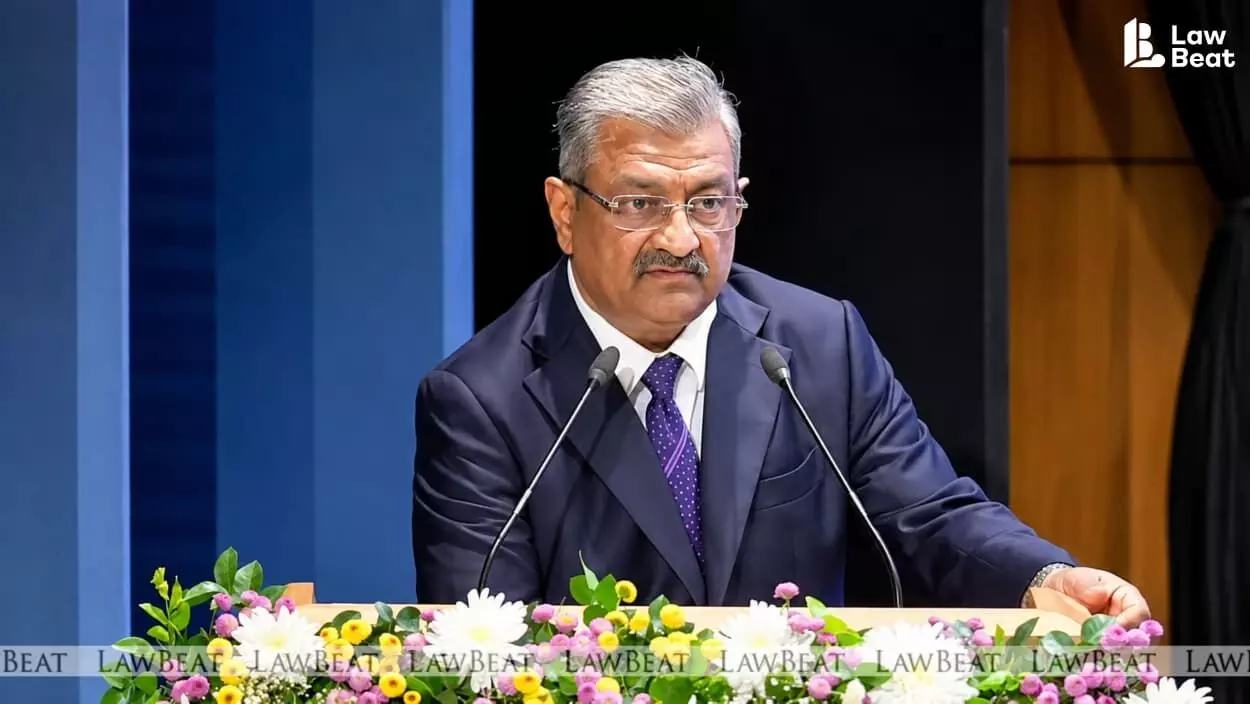
ASG Chetan Sharma: Article 19 Must Include Fundamental Duties
Summary
- ASG Chetan Sharma stated that Article 19 of the Indian Constitution must be interpreted dynamically, not in isolation.
- He emphasized reading Article 19 alongside Directive Principles and fundamental duties as Indian democracy evolves.
- Sharma, a Delhi High Court law officer, made these remarks at the launch of Akash Vajpayi's book, "Freedom on Trial."
- He highlighted how colonial courtrooms became platforms for Indian patriots to challenge the British Raj's legitimacy.
- Sharma contrasted the colonial era's facade of justice with the present-day system of open judicial review.
Dynamic Interpretation of Fundamental Rights
He emphasized that Article 19 should not be viewed in a "frozen" or absolute manner, but rather interpreted dynamically, considering its inherent reasonability, the Directive Principles, and the fundamental duties, especially as Indian democracy continues its evolution.
Additional Solicitor General Chetan Sharma recently articulated a significant perspective on the interpretation of Article 19 of the Indian Constitution, asserting that it must be read dynamically rather than in isolation. Speaking at the launch event for Akash Vajpayi's book, "Freedom on Trial: Twelve Cases That Shaped India’s Struggle for Freedom," Sharma, who serves as a law officer of the Delhi High Court, emphasized that the provision should not be considered in a static or absolute sense.
He emphasized that Article 19 should not be viewed in a "frozen" or absolute manner, but rather interpreted dynamically, considering its inherent reasonability, the Directive Principles, and the fundamental duties, especially as Indian democracy continues its evolution. Sharma highlighted the necessity of integrating these broader constitutional tenets to ensure a comprehensive understanding of the fundamental right to freedom.
Integrating Constitutional Principles
Sharma further elaborated on his vision for a more holistic approach to Article 19 interpretation in India, suggesting to the author that a subsequent book could delve into the "reasonability" aspect of Article 19. He urged a careful consideration of fundamental duties alongside fundamental rights, underscoring their interconnectedness in the ongoing development of Indian democracy.
He firmly stated that a "myopic and selective reading of Article 19" is inadequate for the nation's evolving legal landscape. Instead, he advocated for an interpretation that actively incorporates the Directive Principles and places a strong emphasis on the fundamental duties enshrined in the Indian Constitution, suggesting this integrated view would be a worthy subject for further academic exploration.
Law as a Tool in India's Freedom Struggle
During the event, Sharma also provided insights into the book's narrative, describing it as more than a mere collection of statutes and procedures. He characterized "Freedom on Trial" as a chronicle of individuals who bravely entered colonial courtrooms, often with the foreknowledge that their verdicts were predetermined, yet resolute in their desire for history to record their side of the struggle. Sharma pointed out that the British Raj, in its quest for legitimacy, prosecuted opponents in court, inadvertently creating a vulnerability that Indian patriots and lawyers skillfully exploited.
These prosecutions transformed courtrooms into public forums, turning charges into platforms for manifestos. The book meticulously covers twelve pivotal trials, including the INA trial of 1945-46, Mahatma Gandhi’s trial in 1922, the Alipore Conspiracy Case, and the trials of prominent figures such as Bal Gangadhar Tilak, Bhagat Singh, Savarkar, Madan Lal Dhingra, Udham Singh, and Mangal Pandey. Sharma noted the book's distinctive chronological structure, commencing with the Red Fort in 1945 and concluding with a single sepoy's court-martial at Barrackpore in 1857, thereby illustrating a continuous thread of resistance spanning nearly nine decades.
Lessons from Colonial Justice
Sharma recounted the 1897 sedition trial of Bal Gangadhar Tilak, where Justice Strachey controversially defined dissatisfaction as simply the absence of affection, effectively criminalizing a mere lack of love for the government. Following his 18-month sentence, Tilak famously remarked that Providence might intend his cause to prosper more through his suffering—words now inscribed on a plaque in the Bombay High Court, in the very room of his conviction, which Sharma cited as a clear instance of history reversing a verdict.
He also touched upon Bhagat Singh's trial, noting the prolonged periods during which the accused lacked legal representation, a situation the Congress later expressed regret over. Bhagat Singh, Sukhdev, and Rajguru were ultimately executed in Lahore on March 23, 1931. Sharma distilled three key takeaways from these colonial-era trials: the deployment of law as an instrument of power, the accused's steadfast refusal to conform to their assigned roles, and the unwavering conscience of the bar. He contrasted the colonial system, where legal forms were observed but substantive justice was often absent and decision-making was a mere facade, with the present era, where the decision-making process is subject to open judicial review.
Practical Implications
Lawyers should note the Additional Solicitor General's emphasis on interpreting Article 19 dynamically, alongside Directive Principles and fundamental duties. This perspective, from a high-ranking legal officer, could influence future judicial interpretations of fundamental rights, requiring practitioners to integrate these broader constitutional principles into their arguments, particularly in cases involving free speech or other Article 19 rights.
Source
How does this affect you?
Get an AI analysis of this article grounded in your jurisdictions, practice areas, and any policy documents you've uploaded to Wansom.
Finish Reading the Full Story and the Expert Analysis.
Get the latest legal & regulatory intelligence in India
Wansom is AI and can make mistakes.