
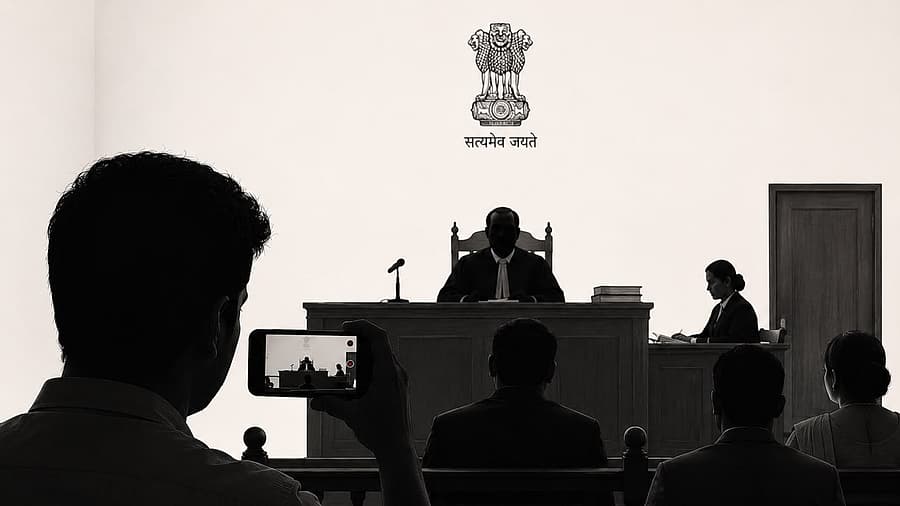
Allahabad High Court: Litigant Arrested, Jailed for Recording Hearing
Summary
- A man was arrested by the Allahabad High Court for recording court proceedings on his mobile phone.
- Justice Vikram D Chauhan discovered Raj Kulshrestha, who had an advocates' chamber pass, recording the hearing on November 19.
- The court found at least three videos of proceedings on Kulshrestha's seized phone.
- The Allahabad High Court has also issued a general prohibition against litigants carrying mobile phones into courtrooms.
- After apologizing, Kulshrestha was released, having appeared before the High Court on November 20, 2026, where the proceedings against him were dropped.
The Incident Unfolds
The swiftness of the arrest and the initial requirement for bail, even though the charges were eventually dropped, sends a powerful message regarding the strict enforcement of rules against unauthorized recording within judicial premises.
On November 19, a significant incident occurred within the Allahabad High Court when Raj Kulshrestha, a resident of Varanasi, was discovered actively recording ongoing judicial proceedings using his mobile phone. Justice Vikram D Chauhan, who was presiding over the courtroom at the time, personally observed Kulshrestha's actions. Following this observation, court staff promptly intervened, seizing the mobile device. A subsequent examination of the phone revealed the presence of at least three distinct video recordings of court sessions, confirming the unauthorized activity.
Kulshrestha's presence in the courtroom was further complicated by the fact that he possessed an entry pass specifically for the advocates’ chamber, not for direct access to the judicial proceedings themselves. When questioned, he was unable to provide any satisfactory justification for recording the court's activities. In response to these findings, the court issued an immediate order for his arrest and detention. He was subsequently directed to be produced before the Chief Judicial Magistrate (CJM) in Prayagraj on the following day, November 20, at 10:00 AM, with the explicit provision that he would be granted the liberty to seek bail.
Court's Firm Stance on Mobile Devices
This particular incident served to underscore a broader and more stringent directive recently issued by the Allahabad High Court, which unequivocally prohibits litigants from bringing mobile phones into its courtrooms. The court's resolute position against the unauthorized recording of judicial proceedings across India was clearly articulated in the context of the case titled Kuldeep Batra v State of UP and Another, which provided the legal framework for the specific orders concerning Mr. Kulshrestha. This comprehensive prohibition is designed to uphold the sanctity and decorum inherent to judicial processes, thereby preventing potential disruptions, maintaining confidentiality, and guarding against the unauthorized dissemination of sensitive information that may arise during hearings.
The judicial order further detailed the conditions for Mr. Raj Kulshrestha's potential release. A notable condition attached to this potential release was the requirement for Mr. Kulshrestha to appear before the High Court on November 20, 2026, at 10:00 AM. He did appear on this date, tendered an unconditional apology, and the court subsequently dropped the proceedings against him and ordered his release from custody.
Immediate Consequences and Broader Implications
On the designated Friday, Mr. Kulshrestha was brought before the court, appearing in police custody as previously ordered. During this appearance, he formally offered an apology for his conduct, acknowledging the impropriety of his actions in recording the court proceedings. In light of his apology, the Allahabad High Court made the decision to cease the ongoing proceedings against him and subsequently ordered his release from custody, bringing an end to the immediate punitive measures.
The swiftness of the arrest and the initial requirement for bail, even though the charges were eventually dropped, sends a powerful message regarding the strict enforcement of rules against unauthorized recording within judicial premises. The overarching directive banning litigants' mobile phones from courtrooms, coupled with the decisive action taken by Justice Vikram D Chauhan against Kulshrestha, clearly establishes a zero-tolerance policy for such violations. This case, therefore, sets a significant precedent for how the Allahabad High Court intends to address similar breaches of courtroom decorum and unauthorized recording in the future, underscoring the critical importance of strict compliance with established rules for all individuals present in judicial settings.
Practical Implications
Lawyers practicing in the Allahabad High Court must advise clients and ensure compliance with the new prohibition on carrying mobile phones into courtrooms to avoid contempt charges or similar penalties, as demonstrated by the immediate arrest in this case. This ruling sets a precedent for strict enforcement against unauthorized recording of proceedings.
Source
How does this affect you?
Get an AI analysis of this article grounded in your jurisdictions, practice areas, and any policy documents you've uploaded to Wansom.
Finish Reading the Full Story and the Expert Analysis.
Get the latest legal & regulatory intelligence in India
Wansom is AI and can make mistakes.