
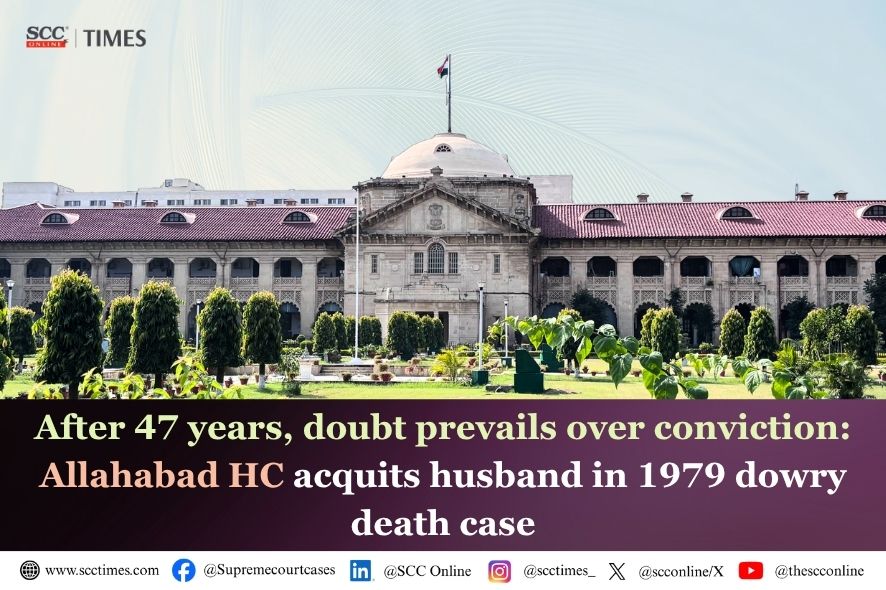
Allahabad High Court Sets Aside 1979 Dowry Death Conviction
Summary
- Allahabad High Court sets aside 1979 dowry death conviction after 47 years.
- Court rules that presence of accused at crime scene not proved beyond reasonable doubt.
- Decision highlights need for robust evidence in proving guilt in dowry death cases.
- Ruling may have implications for similar dowry death cases pending in Indian courts.
Dowry Death Conviction Overturned
The court's verdict is seen as a rare instance where a conviction has been overturned after such a long period.
In a significant development, the Allahabad High Court has set aside a 47-year-old conviction in a dowry death case. The court's decision has sparked debate over the reliability of evidence in such cases. The acquittal of the husband, who was convicted in 1979, has raised questions about the consistency of the chain of evidence.
The court's verdict is seen as a rare instance where a conviction has been overturned after such a long period. This decision may have far-reaching implications for similar dowry death cases pending in Indian courts.
Legal Context
Dowry deaths are a serious concern in India, with many cases going unreported due to social stigma and fear of reprisal. The Indian Penal Code (IPC) made dowry-related crimes punishable under Section 304B, which presumes the husband or his relatives' involvement in the death if it occurs within seven years of marriage. As of July 1, 2024, the Bharatiya Nyaya Sanhita (BNS) has replaced the IPC, and Section 80 of the BNS now addresses dowry deaths for new cases, with similar provisions. However, proving guilt beyond reasonable doubt can be challenging, especially when the accused's presence at the crime scene is disputed.
The Allahabad High Court's decision highlights the importance of robust evidence in such cases. Lawyers and experts are closely watching this development, as it may set a precedent for future dowry death cases.
Why It Matters
This ruling has significant implications for lawyers handling similar dowry death cases. The acquittal of the husband underscores the need for meticulous evidence collection and presentation in court. In cases where the accused's presence at the crime scene is disputed, this decision serves as a reminder that guilt must be proven beyond reasonable doubt.
The Allahabad High Court's verdict may also contribute to a re-evaluation of dowry death case law in India. As lawyers and judges grapple with the complexities of these cases, this development offers valuable insights into the importance of evidence-based justice.
Practical Implications
Lawyers should watch for this development as it highlights the importance of robust evidence in proving guilt, particularly in cases where the accused's presence at the crime scene is disputed. This ruling may have implications for similar dowry death cases pending in Indian courts.
Source
Source: Original reporting via SCC Times
How does this affect you?
Get an AI analysis of this article grounded in your jurisdictions, practice areas, and any policy documents you've uploaded to Wansom.
Wansom is AI and can make mistakes.