
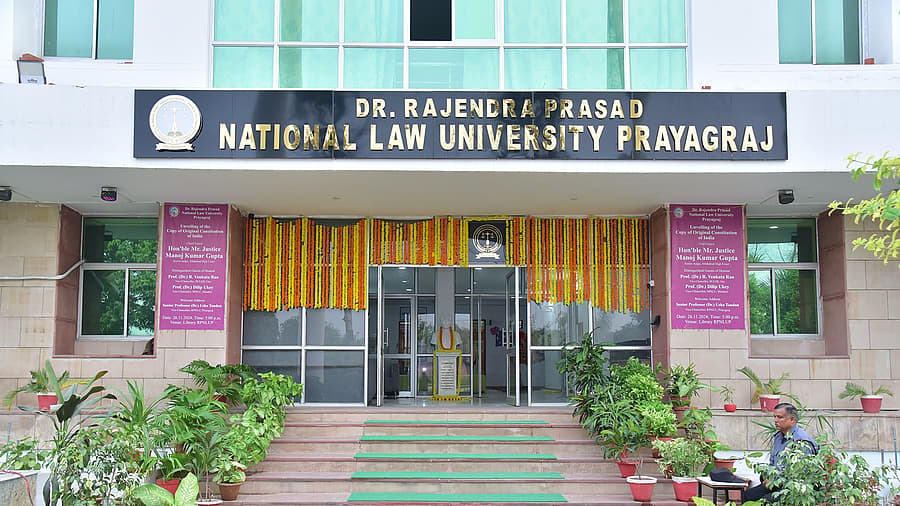
Allahabad High Court: Orders Judicial Inquiry Into NLU Prayagraj Caste Probe
Summary
- The Allahabad High Court ordered a judicial probe into caste-based harassment allegations at Dr. Rajendra Prasad National Law University, Prayagraj.
- Justice Vinod Diwakar appointed Judge Archana Singh and Chief Judicial Magistrate Arun Kumar Yadava to conduct the inquiry.
- Allegations were made by a BA LLB (Hons.) student against Dr Deepak Sharma, an Assistant Professor of Law, who was relieved of his administrative responsibilities as Head of the Department of Law and Warden of the Boys' Hostel following the court's order.
- The court deemed the allegations serious and mandated the inquiry to determine if SC/ST students faced discrimination and if university complaints were handled properly.
- The order, issued on September 16, required the inquiry to be completed before September 24 and included directives to protect student identities.
Court Orders Caste Probe at NLU Prayagraj
This ruling signals heightened judicial scrutiny on caste-based discrimination within educational institutions, compelling compliance officers and legal counsel to review and strengthen internal anti-discrimination policies and complaint resolution mechanisms to mitigate legal exposure and ensure compliance with judicial expectations.
The Allahabad High Court has mandated a judicial inquiry into serious allegations of caste-based harassment and discrimination at the Dr. Rajendra Prasad National Law University, Prayagraj. This significant directive, issued by Justice Vinod Diwakar, stems from a petition titled Shubhendu Anand And Another v State of UP And 5 Others. The court's order, passed on September 16, initiates a formal investigation into claims made against a prominent faculty member at the institution.
To ensure an impartial and thorough examination, Justice Diwakar appointed two judicial officers to lead the probe. Judge of Small Causes Court Archana Singh and Chief Judicial Magistrate Arun Kumar Yadava have been tasked with overseeing the inquiry. Their appointment underscores the judiciary's commitment to addressing such sensitive matters with due diligence and independence, particularly within academic environments.
Details of Allegations and Inquiry Scope
The allegations at the heart of this judicial intervention were brought forward by a BA LLB (Hons.) student enrolled at the Dr. Rajendra Prasad National Law University, Prayagraj. These claims specifically target Dr Deepak Sharma, an Assistant Professor of Law at the university, who was relieved of his administrative responsibilities as the Head of the Department of Law and the Warden of the Boys' Hostel following the court's order. The nature of the accusations points to systemic issues of caste-based harassment within the institution.
The court has meticulously defined the scope of the inquiry, instructing the appointed officers to ascertain two key aspects. Firstly, they must determine whether students belonging to Scheduled Castes (SC) and Scheduled Tribes (ST) have indeed been subjected to humiliation or discrimination based on their caste by Dr. Sharma, identified as respondent no. 6, or by any other individual employed by or working for gain at the university. Secondly, the probe will investigate whether the university adequately addressed and processed any complaints related to these matters in accordance with its established regulations and policies.
Judicial Directives and Protection Measures
In its order, the Allahabad High Court explicitly characterized the allegations as "serious in nature," emphasizing the imperative for an impartial examination. The court also stipulated that the accused academic, Dr Deepak Sharma, must be afforded a full opportunity to present his defense during the proceedings. This ensures adherence to principles of natural justice while pursuing the truth of the allegations.
A crucial directive from Justice Vinod Diwakar concerns the protection of student identities. The court mandated that all necessary measures be implemented to safeguard the anonymity of any student who provides testimony or evidence before the inquiry officers. This provision aims to encourage candid participation from witnesses without fear of reprisal, thereby facilitating a more comprehensive and accurate investigation. The court further imposed a tight deadline, requiring the inquiry to be completed before September 24, indicating the urgency with which these matters are being treated.
Broader Implications for Educational Institutions
The Allahabad High Court's decisive action in ordering a judicial inquiry into caste-based discrimination at NLU Prayagraj carries significant weight beyond the immediate case. This ruling signals heightened judicial scrutiny on caste-based discrimination within educational institutions, compelling compliance officers and legal counsel to review and strengthen internal anti-discrimination policies and complaint resolution mechanisms to mitigate legal exposure and ensure compliance with judicial expectations. The directive for an external, judicial probe, rather than relying solely on internal university mechanisms, highlights a growing expectation for transparency and accountability in addressing such sensitive issues.
This judicial inquiry into caste discrimination in India's educational sector serves as a powerful reminder to all universities about their responsibility to foster inclusive and equitable environments. The court's emphasis on protecting student identities and ensuring a thorough, impartial investigation sets a precedent for how allegations of caste-based harassment should be handled. Institutions are now under increased pressure to proactively prevent discrimination and to respond effectively and justly when such complaints arise, thereby upholding the constitutional values of equality and dignity.
Practical Implications
This ruling signals heightened judicial scrutiny on caste-based discrimination within educational institutions, compelling compliance officers and legal counsel to review and strengthen internal anti-discrimination policies and complaint resolution mechanisms to mitigate legal exposure and ensure compliance with judicial expectations.
Source
How does this affect you?
Get an AI analysis of this article grounded in your jurisdictions, practice areas, and any policy documents you've uploaded to Wansom.
Finish Reading the Full Story and the Expert Analysis.
Get the latest legal & regulatory intelligence in India
Wansom is AI and can make mistakes.