
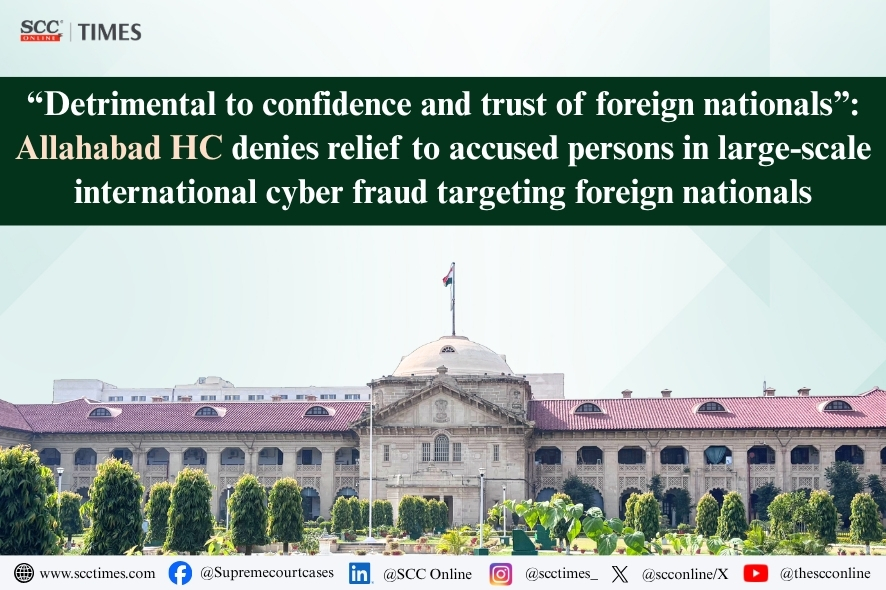
Allahabad High Court Cyber Fraud Foreign Nationals: Relief Denied
Summary
- The Allahabad High Court denied relief to individuals accused in a large-scale international cyber fraud case.
- The fraud involved 119 arrested individuals operating an illegal call centre to monetarily scam foreign nationals.
- The court stated that the cyber fraud was detrimental to India's political, economic, and social fabric.
- It also noted the fraud severely eroded the confidence and trust of foreign nationals in the country.
- This ruling signals a firm judicial stance against international cyber fraud targeting foreign victims in India.
What Happened
The court specifically remarked that the scheme was not only damaging to the political, economic, and social fabric of India but also severely eroded the confidence and trust of foreign nationals in the country.
The Allahabad High Court recently issued a significant ruling concerning a large-scale international cyber fraud operation, denying relief to individuals accused in the case. This judicial action stems from an investigation that led to the arrest of 119 people involved in running an illegal call centre. The primary objective of this illicit operation was to monetarily scam foreign nationals, highlighting the transnational nature and severe impact of the criminal enterprise. The court's decision underscores the gravity with which such offenses are being treated within the Indian legal system, particularly when they involve victims from other countries.
The individuals sought relief from the court, but their pleas were ultimately rejected. This rejection is directly tied to the court's assessment of the profound negative consequences of the cyber fraud. The operation, characterized by its sophisticated setup and targeting of international victims, represents a significant challenge to law enforcement and judicial authorities in India. The court's firm stance in denying relief serves as a clear indication of its commitment to addressing and deterring such complex cybercrimes.
Judicial Condemnation of International Cyber Fraud
In its pronouncement, the Allahabad High Court articulated a strong condemnation of the cyber fraud, emphasizing its far-reaching detrimental effects. The court specifically remarked that the scheme was not only damaging to the political, economic, and social fabric of India but also severely eroded the confidence and trust of foreign nationals in the country. This judicial observation highlights the multifaceted harm caused by such criminal activities, extending beyond direct financial loss to encompass broader reputational and systemic damage.
The court's focus on the impact on foreign nationals' trust is particularly noteworthy. Such international cyber fraud schemes, often originating from illegal call centres in India, can create a perception of insecurity and unreliability, potentially affecting diplomatic relations, tourism, and foreign investment. By explicitly linking the fraud to these broader societal and international concerns, the Allahabad High Court underscored the imperative of a robust judicial response. The denial of relief to the accused persons directly reflects this judicial determination to protect both national interests and the integrity of international relations.
Wider Implications for Cybercrime Enforcement in India
This ruling from the Allahabad High Court sends a clear signal regarding the judicial approach to international cyber fraud in India. The decision to deny relief to the accused, coupled with the court's strong remarks, indicates an increased scrutiny and a less lenient stance towards individuals involved in large-scale operations that target foreign nationals. This could have significant implications for future cases of illegal call centre arrests in India, suggesting that courts may be disinclined to grant pre-trial relief or show leniency in similar circumstances.
The court's emphasis on the damage to "confidence and trust of foreign nationals" suggests a judicial recognition of the unique harm caused by fraud targeting foreign nationals India. This perspective is likely to influence how such cases are prosecuted and adjudicated, potentially leading to more stringent penalties for those convicted of international cyber fraud India. The Allahabad HC cybercrime ruling reinforces the idea that crimes impacting India's international standing will be met with a firm judicial hand, aiming to deter such activities and protect the nation's reputation on the global stage.
Practical Implications
This ruling signals the Allahabad High Court's firm judicial stance against large-scale international cyber fraud, particularly when foreign nationals are targeted. Lawyers should advise clients on increased scrutiny and potential for harsher penalties in such cases, impacting defense strategies and compliance efforts for businesses operating internationally.
Source
Source: Original reporting via SCC Times
How does this affect you?
Get an AI analysis of this article grounded in your jurisdictions, practice areas, and any policy documents you've uploaded to Wansom.
Finish Reading the Full Story and the Expert Analysis.
Get the latest legal & regulatory intelligence in India
Wansom is AI and can make mistakes.