
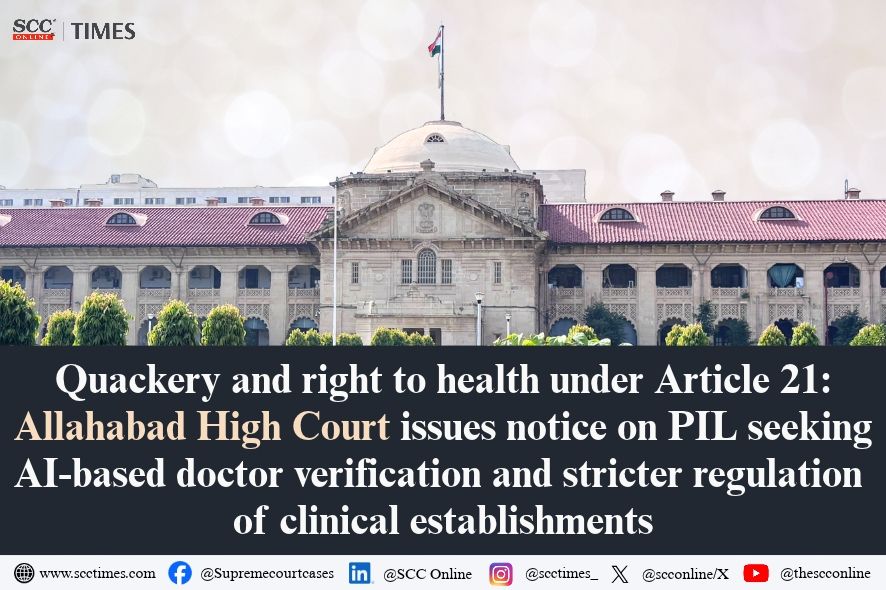
Allahabad High Court: AI Doctor Verification PIL Targets Quackery
Summary
- The Allahabad High Court has issued notice on a Public Interest Litigation addressing medical quackery.
- The PIL seeks an effective roadmap to eliminate quackery and prevent unqualified medical practice.
- It proposes AI-based doctor verification and stricter regulation of clinical establishments.
- The petition links these issues to the fundamental right to health under Article 21 of the Indian Constitution.
- The PIL aims to ensure that only duly qualified practitioners operate clinical establishments.
What Happened
Lawyers advising healthcare providers or involved in public health litigation should closely monitor these proceedings, as the court's decision could introduce new compliance obligations and reshape the landscape of medical practice and oversight across the nation.
The Allahabad High Court has recently taken cognizance of a significant Public Interest Litigation (PIL) that addresses critical issues surrounding medical practice in India. This legal challenge specifically targets the pervasive problem of quackery and the operation of clinical establishments by individuals lacking proper qualifications. The court has issued a notice in response to the PIL, signaling the initiation of judicial review into these pressing public health matters.
The core objective of the PIL is to compel authorities to develop a comprehensive strategy aimed at eradicating unqualified medical practitioners from the healthcare system. It advocates for stringent measures to prevent individuals without appropriate medical credentials from engaging in cross-disciplinary practice, thereby safeguarding patient well-being. A key proposal within this Allahabad High Court AI doctor verification PIL is the implementation of advanced, AI-based doctor verification systems to ensure that only genuinely qualified professionals are permitted to practice medicine.
Legal & Public Health Concerns
This PIL underscores the profound implications of unregulated medical practice on the fundamental right to health, as enshrined under Article 21 of the Indian Constitution. The petition argues that the prevalence of quackery directly infringes upon citizens' right to receive safe and effective medical care, necessitating urgent intervention. The issue of unqualified medical practitioners Allahabad operating without oversight poses a severe threat to public safety and erodes trust in the healthcare system.
The petitioners contend that the current regulatory landscape is insufficient to curb the activities of those who exploit the vulnerabilities of patients. By allowing individuals to practice medicine without the requisite training or licenses, the state inadvertently compromises the health and lives of its populace. This legal action seeks to rectify these systemic failures, emphasizing that the right to health under Article 21 is not merely aspirational but a justiciable right demanding robust protection and enforcement.
Proposed Solutions & Broader Impact
Central to the PIL's demands is the call for a robust framework for clinical establishment regulation India. Beyond just verifying individual practitioners, the petition seeks stricter oversight of the facilities where medical services are provided, ensuring they meet prescribed standards and are managed by qualified personnel. The proposed AI-based doctor verification India system represents a modern approach to tackling an age-old problem, leveraging technology to create a more transparent and accountable medical ecosystem.
The outcome of this Allahabad High Court AI doctor verification PIL could establish significant precedents for public health litigation under Article 21, potentially leading to new regulatory frameworks for clinical establishments and more rigorous verification processes for medical practitioners. Lawyers advising healthcare providers or involved in public health litigation should closely monitor these proceedings, as the court's decision could introduce new compliance obligations and reshape the landscape of medical practice and oversight across the nation. This initiative aims to ensure that only duly qualified practitioners operate clinical establishments, thereby upholding the integrity of medical services.
Practical Implications
Lawyers advising healthcare providers or involved in public health litigation should monitor the Allahabad High Court's proceedings on this PIL, as its outcome could lead to new regulatory frameworks for clinical establishments and medical practitioner verification, impacting compliance obligations and potentially setting precedents for public health litigation under Article 21.
Source
Source: Original reporting via SCC Times
How does this affect you?
Get an AI analysis of this article grounded in your jurisdictions, practice areas, and any policy documents you've uploaded to Wansom.
Wansom is AI and can make mistakes.