
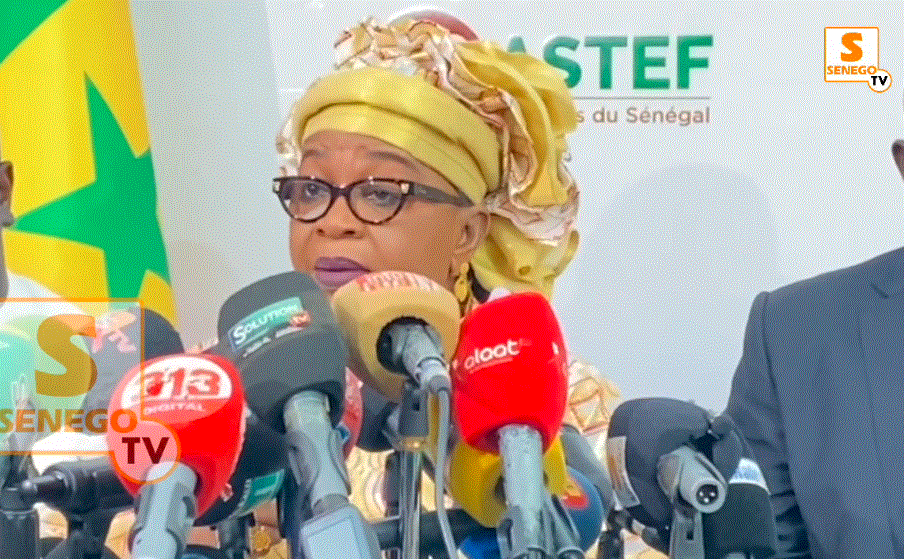
Aïda Mbodj: Transparence Fonds Politiques Sénégal Critical, Warns Obstruction
Summary
- Aïda Mbodj praised Pastef's initiatives for strengthening transparency at a recent press conference.
- She specifically highlighted efforts in controlling political funds and asset declarations.
- The former Director General of DER/FJ warned that any obstruction to transparency mechanisms compromises governance.
- Mbodj's remarks contribute to the ongoing national discourse on political accountability in Senegal.
Calls for Enhanced Transparency in Senegal
The former DER/FJ head's comments serve as a powerful reminder that robust governance in Senegal requires not just the creation of rules, but also their diligent enforcement and protection against any attempts to undermine them.
Aïda Mbodj, a prominent figure in Senegalese politics and former Director General of the Délégation Générale à l'Entrepreneuriat Rapide des Femmes et des Jeunes (DER/FJ), recently underscored the critical importance of transparency in the nation's political landscape. Speaking at a press conference held by the Pastef party on a Wednesday, Mbodj commended the party's proactive stance and various initiatives aimed at bolstering accountability and openness within the political system.
Her remarks specifically highlighted Pastef's efforts concerning the rigorous control of political funds and the mandatory declaration of assets, both crucial components of good governance. Mbodj's endorsement of these measures reflects a broader sentiment among civil society and political observers regarding the need for greater clarity in how political entities operate and manage their resources. Her presence and statements at the Pastef event lend significant weight to the ongoing discourse surrounding political integrity in Senegal.
The Imperative of Open Governance
During her address, Aïda Mbodj articulated a strong warning: any impediment to the established or proposed mechanisms designed to foster transparency inevitably jeopardizes the overall quality of governance in Senegal. This assertion, coming from an individual with her background, resonates deeply within the context of public trust and the fight against corruption. The principle of `transparence fonds politiques Sénégal` is not merely an abstract ideal but a practical necessity for ensuring that political processes are fair, equitable, and free from undue influence.
Her emphasis on `obstruction transparence politique` suggests a recognition that while initiatives like `déclaration patrimoine Sénégal` and `contrôle fonds politiques Pastef` are vital, their effectiveness hinges on the political will to implement and uphold them without hindrance. The former DER/FJ head's comments serve as a powerful reminder that robust governance in Senegal requires not just the creation of rules, but also their diligent enforcement and protection against any attempts to undermine them.
Broader Implications for Accountability
The statements made by Aïda Mbodj contribute to an escalating national conversation about `gouvernance Sénégal Aïda Mbodj` and the broader push for accountability. Her past role at DER/FJ, an institution focused on economic empowerment, provides her with a unique perspective on the intersection of public administration, resource allocation, and ethical conduct. The call for `DER/FJ transparence` in all public-facing entities, by extension, is implicit in her general advocacy for openness.
This ongoing dialogue is crucial for strengthening democratic institutions and ensuring that public officials and political parties operate with the highest degree of integrity. The focus on `déclaration patrimoine Sénégal` and the meticulous `contrôle fonds politiques` are foundational elements in building a political system resilient to corruption and responsive to the needs of its citizens. Mbodj's intervention reinforces the idea that transparency is not a partisan issue but a fundamental pillar for the nation's progress and stability.
Practical Implications
This article reflects an ongoing political discourse in Senegal regarding the importance of transparency in political funding and asset declarations. While it does not introduce new legal obligations or specific compliance actions, lawyers advising political entities, NGOs, or public officials should be aware of the heightened public scrutiny and calls for accountability, which could foreshadow future legislative or regulatory reforms related to anti-corruption and good governance.
Source
Source: Original reporting via Senego TV
How does this affect you?
Get an AI analysis of this article grounded in your jurisdictions, practice areas, and any policy documents you've uploaded to Wansom.
Wansom is AI and can make mistakes.