
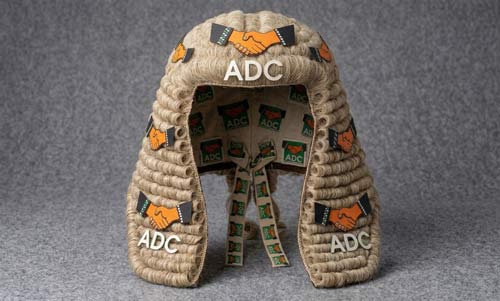
ADC: Seeks NJC Probe of Chief Judge Tsoho, Justice Lifu Transfer Case
Summary
- The African Democratic Congress (ADC) Presidential Campaign Council has requested a National Judicial Council (NJC) investigation.
- The probe concerns the transfer of an ADC leadership dispute case at the Federal High Court in Abuja.
- The case was reassigned from Justice Emeka Nwite to Justice Peter Lifu.
- The ADC also seeks an examination into the conduct of Chief Judge Tsoho.
- The council cited 'grave concerns about bias' regarding the sequence and timing of the case transfer.
Investigation Requested
The party's campaign council explicitly stated that the 'sequence and timing' of the case transfer have given rise to 'grave concerns about bias.'
The African Democratic Congress (ADC) Presidential Campaign Council has formally called upon the National Judicial Council (NJC) to initiate a comprehensive investigation into the circumstances surrounding a significant judicial reassignment. This request specifically targets the transfer of a leadership dispute case concerning the party, which was moved from Justice Emeka Nwite to Justice Peter Lifu within the Federal High Court in Abuja. The council's appeal underscores a demand for scrutiny over the procedural aspects of case management at a high level.
Beyond the specific case transfer, the ADC Presidential Campaign Council has also urged the NJC to examine the conduct of the Chief Judge, identified as Tsoho. This broader request suggests a concern extending beyond a single case, implying a desire to assess the overall handling of judicial matters by the court's leadership. The dual focus on the Justice Peter Lifu transfer case and the Chief Judge Tsoho conduct probe highlights the gravity with which the ADC views these developments, seeking accountability from multiple judicial figures.
Concerns Over Bias
The primary impetus behind the ADC's request for a National Judicial Council investigation stems from profound concerns regarding potential bias. The party's campaign council explicitly stated that the 'sequence and timing' of the case transfer have given rise to 'grave concerns about bias.' This assertion suggests that the manner and moment of the judicial reassignment, rather than merely the fact of it, are at the heart of the ADC's apprehension.
Such an allegation of judicial bias concerns Nigeria's legal system, as it questions the impartiality of the court in handling sensitive political matters like an African Democratic Congress leadership dispute. The council's emphasis on the specific timing and order of events implies a belief that these factors might have been manipulated or influenced in a way that could prejudice the outcome of the case. This forms the core of why the ADC seeks NJC probe Tsoho Lifu.
Legal and Procedural Context
The National Judicial Council, as the body responsible for overseeing judicial appointments, discipline, and conduct in Nigeria, is the appropriate authority to address such allegations. An NJC probe into the Justice Peter Lifu transfer case and the Chief Judge Tsoho conduct probe would typically involve a thorough review of court records, administrative procedures, and potentially interviews with the involved parties and judicial officers. The outcome of such an investigation could have significant implications for the judges involved and for the broader perception of judicial integrity within the Federal High Court.
The request by the African Democratic Congress Presidential Campaign Council underscores the critical importance of transparent and unbiased judicial processes, particularly in cases involving political leadership disputes. The call for a National Judicial Council investigation highlights the mechanisms available for addressing grievances related to judicial conduct and case management, reinforcing the principle that judicial actions must withstand public and professional scrutiny to maintain confidence in the legal system.
Practical Implications
Lawyers should monitor the outcome of this NJC probe as it could impact perceptions of judicial integrity and case assignment procedures within the Federal High Court. This development highlights the ongoing scrutiny of judicial conduct in Nigeria, which may influence future litigation strategies concerning judicial recusal or challenges to case transfers.
Source
How does this affect you?
Get an AI analysis of this article grounded in your jurisdictions, practice areas, and any policy documents you've uploaded to Wansom.
Finish Reading the Full Story and the Expert Analysis.
Get the latest legal & regulatory intelligence in Nigeria
Wansom is AI and can make mistakes.