
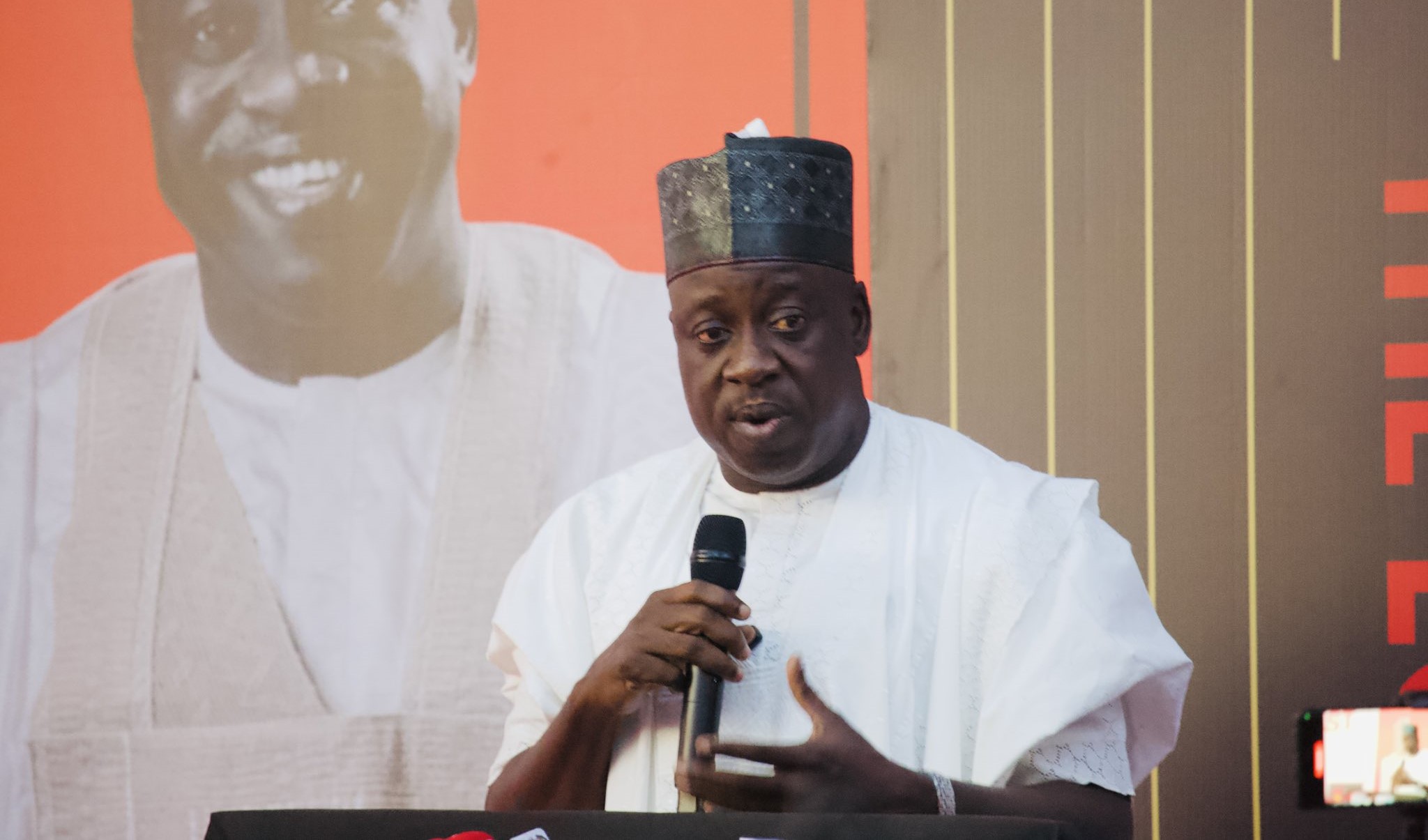
ADC Questions Akume Constitutional Role Tinubu Absence
Summary
- The African Democratic Congress (ADC) questioned the constitutional basis for Secretary to the Government of the Federation (SGF), George Akume, representing the President.
- This query arose when both President Tinubu and Vice President Shettima were absent from the country.
- Mr. Abdullahi of the ADC specifically articulated the party's concerns regarding Akume's role at official functions.
- The situation highlights potential ambiguities in Nigeria's constitutional provisions for executive authority delegation during presidential absence.
ADC Questions Akume's Constitutional Role Amidst Presidential Absence
It highlights potential constitutional ambiguities regarding the delegation of presidential authority in Nigeria, particularly concerning the SGF's role when both the President and Vice President are absent.
The African Democratic Congress (ADC), a prominent political party in Nigeria, has formally raised concerns regarding the constitutional propriety of the Secretary to the Government of the Federation (SGF), George Akume, representing the President at official engagements. This query was specifically articulated by Mr. Abdullahi, a representative of the party. The basis for the ADC's challenge stems from a period during which both President Tinubu and Vice President Shettima were reportedly out of the country, leaving a vacuum in the direct executive leadership. The party's intervention spotlights the critical issue of executive representation when the nation's two highest officeholders are simultaneously absent from their duties.
The core of the ADC's inquiry, as voiced by Mr. Abdullahi, centers on the precise constitutional framework that would permit the SGF to assume such a representative capacity in the absence of both the President and his Vice. This situation has prompted a public discussion about the established protocols for the delegation of presidential authority in Nigeria, particularly when the usual line of succession is unavailable. The party's stance suggests a perceived deviation from or ambiguity within the constitutional provisions governing executive functions under such circumstances, directly questioning George Akume's SGF powers in this context.
Scrutiny on Presidential Absence and Delegation of Authority
The challenge posed by the African Democratic Congress Nigeria regarding George Akume's SGF powers in the President's absence brings to the forefront fundamental questions about the Nigerian presidential absence constitutional provisions. While the Secretary to the Government of the Federation holds a crucial administrative role within the executive branch, their constitutional mandate typically does not extend to assuming the representative functions of the President or Vice President, especially in a manner that might imply a temporary delegation of sovereign authority. The ADC's query thus compels a closer examination of the specific constitutional articles that govern the temporary incapacitation or absence of the President and Vice President, and how executive responsibilities are to be managed during such periods.
This development underscores the importance of clear constitutional guidelines for the delegation of presidential authority Nigeria. The absence of both President Tinubu and Vice President Shettima abroad, and the subsequent representation by the SGF, George Akume, has inadvertently created a scenario that tests the robustness and clarity of the nation's executive succession and delegation protocols. The ADC's intervention, through Mr. Abdullahi, serves as a significant political and legal prompt for stakeholders to review and potentially clarify the boundaries of executive power and representation, ensuring strict adherence to constitutional principles even in unforeseen circumstances.
Implications for Governance and Constitutional Interpretation
The questioning of George Akume's constitutional role in Tinubu's absence by the African Democratic Congress carries substantial implications for Nigeria's governance framework. It highlights potential constitutional ambiguities regarding the delegation of presidential authority in Nigeria, particularly concerning the SGF's role when both the President and Vice President are absent. Such challenges are vital for maintaining the integrity of the constitutional order, as they push for greater transparency and adherence to established legal frameworks governing executive power. The precise delineation of roles and responsibilities during periods of presidential absence is paramount to prevent any perception of overreach or unconstitutional exercise of authority.
Lawyers specializing in constitutional law or public administration should closely monitor this challenge for its broader implications on executive power and constitutional interpretation. The outcome of this public discourse, and any subsequent official responses, could set important precedents for how future instances of presidential and vice-presidential absence are managed. It reinforces the principle that even high-ranking officials like the Secretary to the Government of the Federation operate within constitutionally defined limits, and that these limits are subject to scrutiny by political parties and the public to uphold democratic accountability.
Practical Implications
This development highlights potential constitutional ambiguities regarding the delegation of presidential authority in Nigeria, particularly concerning the SGF's role when both the President and VP are absent. Lawyers specializing in constitutional law or public administration should monitor this challenge for its implications on executive power and constitutional interpretation.
Source
How does this affect you?
Get an AI analysis of this article grounded in your jurisdictions, practice areas, and any policy documents you've uploaded to Wansom.
Finish Reading the Full Story and the Expert Analysis.
Get the latest legal & regulatory intelligence in Nigeria
Wansom is AI and can make mistakes.