
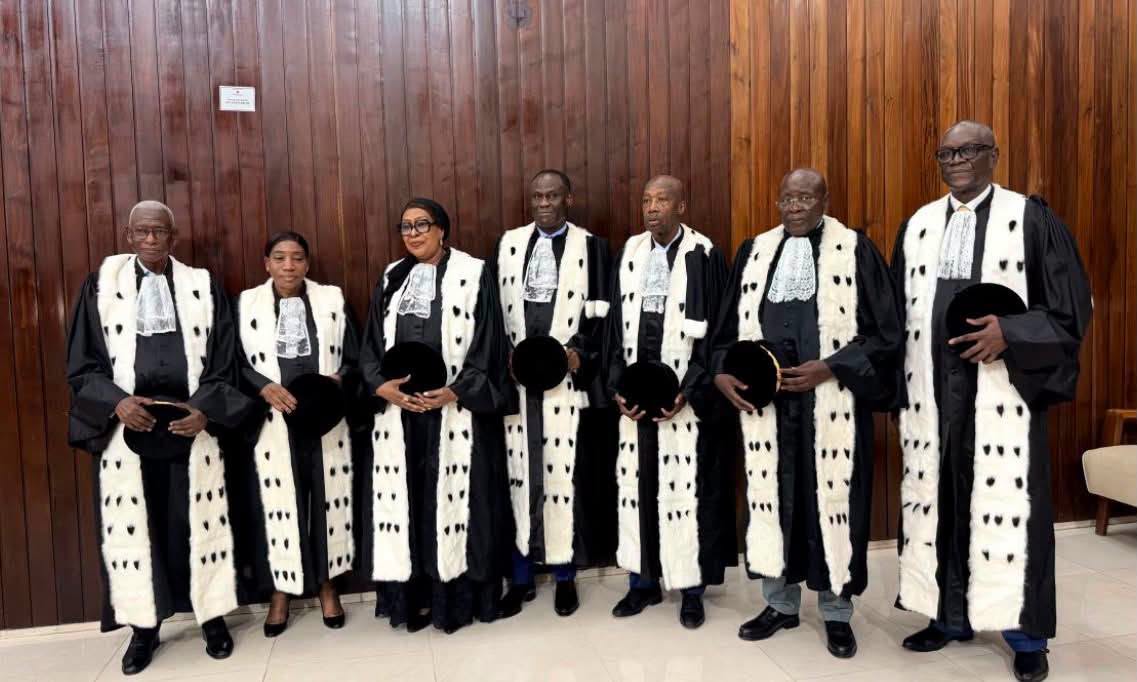
Adama Ndao: Conseil Constitutionnel Falsified Article 83 on Proposition de Loi
Summary
- Jurist Adama Ndao accuses the Senegalese Constitutional Council of falsifying Article 83 of the Constitution.
- Ndao claims the Council improperly asserted competence in Decision No. 6/2026 by treating an unadopted 'proposition de loi' as a voted law, contrary to Article 92.
- He alleges the Council added 'de loi' to Article 83, thereby reducing Parliament's legislative initiative power under Article 80.
- Ndao asserts recent Council decisions (6/2026, 7/2026) violate the Constitution and international anti-corruption conventions.
- He demands sanctions and criminal and civil liability for Council members, characterizing their actions as 'faute lourde'.
Challenge to Constitutional Council's Authority
For Adama Ndao, this modification constitutes a falsification of Article 83 of the Constitution.
From Washington, jurist Adama Ndao has voiced a significant challenge to the Senegalese Constitutional Council's interpretation of its powers, particularly concerning an unvoted legislative proposal. Ndao delineates a clear distinction between legislative texts: a 'projet de loi' originates from the President of the Republic or the Prime Minister, while a 'proposition de loi' is introduced by one or more deputies. He clarifies that a text attains the status of a law upon its adoption, even prior to its official publication.
Ndao contends that the Constitutional Council exceeded its constitutional mandate in its Decision No. 6/2026. He points to Article 92 of the Constitution, which grants the Council authority to rule on the constitutionality of adopted laws, but explicitly omits mention of legislative projects or unadopted proposals. According to Ndao, the Council improperly asserted jurisdiction by treating an unadopted 'proposition de loi' as if it were an already voted law, thereby misapplying its powers under the Constitution.
Alleged Falsification of Article 83
A central pillar of Adama Ndao's critique is the accusation that the Constitutional Council deliberately altered the wording of Article 83 of the Constitution. He alleges that the Council added the phrase 'de loi' after the term 'proposition' within this article. Ndao argues that the original intent of Article 83 is to regulate the broader legislative procedure, encompassing proposed amendments and amendments themselves, rather than specifically referring to a 'proposition de loi' as a distinct legislative instrument.
This alleged modification, Ndao asserts, constitutes a falsification of Article 83. He warns that such an interpretation would have profound consequences, specifically diminishing the Parliament's inherent prerogative to initiate legislation, a power he directly links to Article 80 of the Constitution. This dispute highlights a critical debate over the precise scope of legislative initiative and the interpretative authority of the Constitutional Council.
Calls for Accountability and Broader Violations
Adama Ndao extends his criticism beyond the specific interpretation of Article 83, asserting that recent decisions by both the Constitutional Council and the Executive branch are in violation of the Senegalese Constitution. He also claims these actions contravene international conventions against corruption to which Senegal is a signatory. Ndao specifically cites Decision No. 6/2026, issued in July 2026, and Decision No. 7/2026, dated August 25, 2026, as examples of these alleged constitutional and international law breaches.
Characterizing the actions of the Council members as 'faute lourde' (gross negligence), Ndao has called for severe repercussions. He demands that sanctions be imposed on the members of the Constitutional Council and advocates for their criminal and civil liability to be investigated and established. This demand underscores the gravity of his allegations and the potential for significant legal and political fallout.
Recent Constitutional Review Context
The current controversy surrounding the Constitutional Council's interpretation of legislative processes unfolds against a backdrop of its recent active role in constitutional review. In July 2026, just prior to the decisions cited by Adama Ndao, the Council had invalidated Law No. 18/2026, which aimed to revise the Constitution. This earlier decision demonstrates the Council's willingness to strike down legislative acts.
The invalidation of Law No. 18/2026 was based on specific constitutional grounds, including Article 82, paragraph 2, which addresses the voting of expenditures without corresponding revenues. Additionally, the Council cited the refusal of a blocked vote as a reason for its censure. This precedent illustrates the Council's established practice of scrutinizing legislative procedures and constitutional compliance, making Ndao's current challenge to its interpretative methods particularly noteworthy.
Practical Implications
This article highlights a significant challenge to the Senegalese Constitutional Council's interpretation of its powers and the Constitution itself, specifically regarding 'propositions de loi' and Article 83. Lawyers and compliance officers should monitor this dispute as it could impact the validity of past and future legislative processes, the scope of parliamentary powers, and the stability of constitutional jurisprudence in Senegal, potentially opening avenues for legal challenges against state actions or Council decisions.
Source
How does this affect you?
Get an AI analysis of this article grounded in your jurisdictions, practice areas, and any policy documents you've uploaded to Wansom.
Finish Reading the Full Expert Analysis.
Wansom is AI and can make mistakes.