
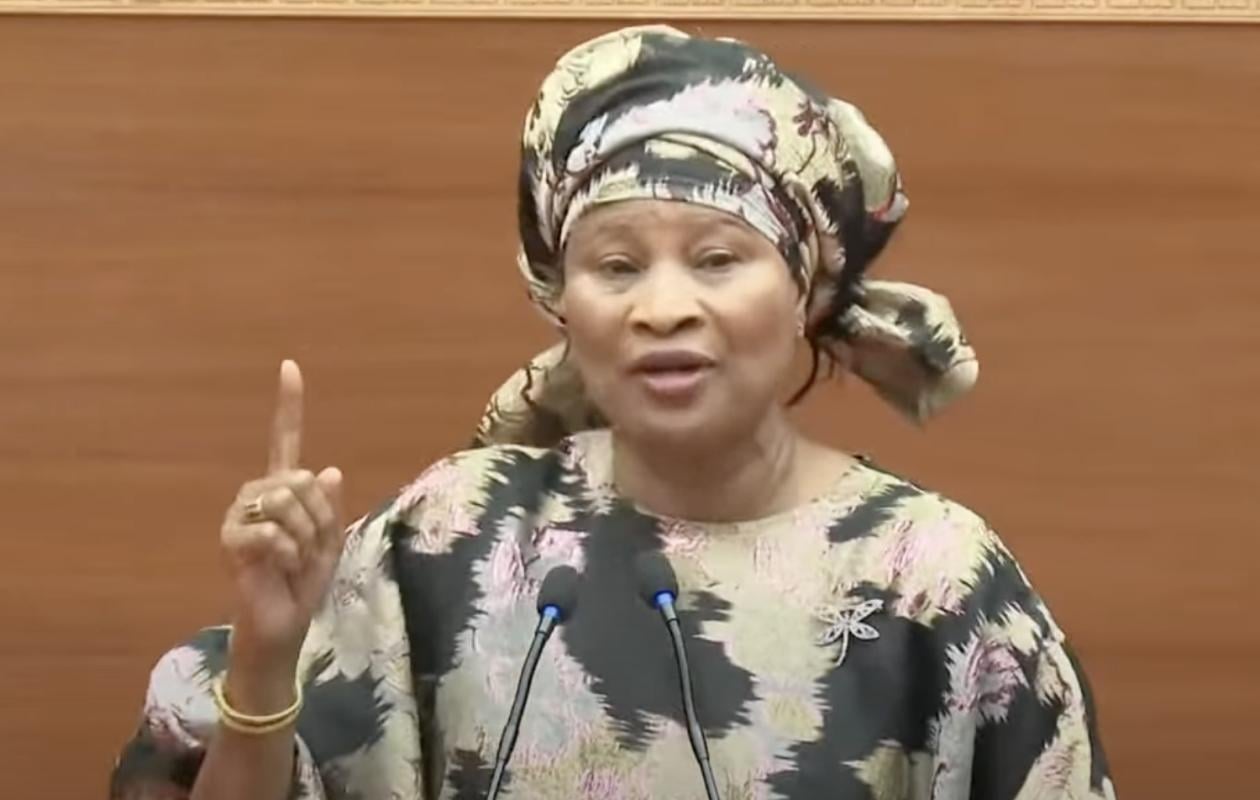
Aïssata Tall Sall: Sénégal Déficit Jumps to 7.6%, Exceeds UEMOA Criterion
Summary
- Aïssata Tall Sall criticized Senegal's public deficit, now projected at 7.6% in the 2026 amended finance law.
- This new deficit figure is significantly higher than the initial 3.4% projection and the UEMOA's 3% convergence criterion.
- Ms. Tall Sall, president of Takku Wallu Sénégal, stated on November 5th that this development compromises the credibility of public finance recovery.
- Takku Wallu Sénégal had previously abstained from voting on the draft amended finance law in committee on October 24th.
Senegal's Fiscal Outlook Worsens
The revised figure of 7.6% was proposed within the framework of the `loi de finances rectificative 2026 Sénégal`, which has since been rejected, marking a substantial deviation from earlier expectations.
Aïssata Tall Sall, a prominent political figure, recently voiced strong concerns regarding a significant increase in the projected public deficit for Senegal. The revised figure of 7.6% was proposed within the framework of the `loi de finances rectificative 2026 Sénégal`, marking a substantial deviation from earlier expectations. This updated projection, reported by Rewmi, contrasts sharply with the initial budget deficit forecast of 3.4%.
This new `déficit public sénégalais` far exceeds the 3% convergence criterion established by the West African Economic and Monetary Union (UEMOA), a benchmark designed to ensure fiscal stability among member states. Ms. Tall Sall, who serves as the president of the parliamentary group `Takku Wallu Sénégal`, articulated her apprehension on November 5th during a press conference held at the headquarters of the Alliance pour la République (APR). Her remarks underscore a growing unease within political circles regarding the nation's financial trajectory.
Credibility of Public Finance Recovery Questioned
The substantial jump in the projected deficit, from an initial 3.4% to 7.6%, has prompted serious questions about the credibility of Senegal's public finance recovery efforts. Ms. Tall Sall emphasized that such a significant increase undermines the established path towards fiscal health, potentially impacting investor confidence and the nation's economic standing within the UEMOA region. The `UEMOA critère convergence 3%` is a critical benchmark for regional economic integration and stability, and exceeding it by such a margin signals a challenging period for the country's `finances publiques Sénégal`.
The `loi de finances rectificative 2026 Sénégal` was the legislative instrument proposed to reflect these updated fiscal realities. However, it was rejected by the National Assembly on November 3, 2026, highlighting the government's acknowledgment of the revised economic landscape amidst parliamentary disagreement. The parliamentary group `Takku Wallu Sénégal` had previously demonstrated its reservations by abstaining from a committee vote on the draft amended finance law on October 24th, indicating an early awareness of the impending fiscal challenges.
Implications for Economic Stability
The pronounced `déficit public sénégalais` at 7.6% not only breaches the `UEMOA critère convergence 3%` but also raises broader concerns about Senegal's economic stability and its ability to manage its `finances publiques Sénégal` effectively. Such a high deficit can lead to increased borrowing, higher debt servicing costs, and potentially inflationary pressures, all of which can have a tangible impact on the daily lives of citizens and the operational environment for businesses.
Ms. Tall Sall's public denouncement, delivered from the Alliance pour la République headquarters, serves as a significant political statement, drawing attention to the fiscal challenges that lie ahead. The actions and statements of `Takku Wallu Sénégal` reflect a parliamentary body grappling with the implications of these revised financial forecasts, suggesting that the path to fiscal consolidation will require careful navigation and potentially difficult policy choices in the coming years.
Practical Implications
Lawyers and compliance officers should monitor Senegal's fiscal policy and economic stability, as the increased budget deficit exceeding UEMOA criteria may lead to future government austerity measures, regulatory changes, or impact the investment climate and public procurement.
Source
Source: Original reporting via Rewmi
How does this affect you?
Get an AI analysis of this article grounded in your jurisdictions, practice areas, and any policy documents you've uploaded to Wansom.
Wansom is AI and can make mistakes.