
The legal profession is at an inflection point. Artificial intelligence, once a futuristic concept discussed in theoretical terms, has become an operational reality promising to revolutionize efficiency, accuracy, and client service. For law firm leaders, the initial allure is often simple: a software subscription promising to slash document review time and automate legal research. However, this narrow focus on the visible price tag of a license is where many firms make their first critical mistake.
The true journey to becoming an AI-enabled practice is not a simple software purchase; it is a strategic transformation that carries a series of hidden investments beyond the monthly fee. A successful integration demands a holistic understanding of these costs, from the foundational infrastructure that must be built to the human capital that must be empowered. This comprehensive guide moves beyond the surface to reveal the full spectrum of investment required for AI integration and demonstrates why, when properly understood and managed, it remains the most strategic investment a modern law firm can make.
Part 1: The Hidden Foundation - Infrastructure Readiness
Before a single AI prompt is run, a firm must build the technological bedrock upon which intelligent tools can reliably operate. This stage, often overlooked in initial budgeting, is non-negotiable for security, performance, and compliance.
1. Data Preparation: Fueling the AI Engine
AI models are not magical; they are sophisticated pattern-recognition systems that require high-quality, structured data to function effectively. A firm's greatest asset—its decades of case files, precedent databases, contract libraries, and client communications—is often its most disorganized.
The Cost: This phase requires dedicated personnel time, potentially from paralegals, knowledge managers, or dedicated data specialists. The investment is measured in hundreds of hours of labor to:
Digitize remaining paper files.
Clean and standardize data across different formats and legacy systems.
Organize and tag documents with consistent metadata (e.g., matter type, jurisdiction, outcome, key clauses).
Create a centralized, searchable knowledge repository. Without this step, an AI tool is like a brilliant lawyer with access only to a scattered, incomplete, and chaotic library.
2. Security and Compliance: The Non-Negotiable Shield
Legal work is defined by confidentiality. Introducing any new technology, especially one that processes sensitive client data, necessitates an ironclad security review and upgrade.
The Cost: This includes both technology upgrades and expert consultation.
Robust VPN & Zero-Trust Architecture: Secure, encrypted access for all remote and in-office users is paramount. This may require upgrading existing VPN solutions or implementing more modern zero-trust network access.
End-to-End Encryption: Ensuring that data is encrypted not just "at rest" in storage, but also "in transit" to and from the AI platform.
Compliance Audits: Engaging IT security consultants to assess the AI vendor's compliance with frameworks like SOC 2, ISO 27001, and jurisdiction-specific data protection laws (GDPR, CCPA, etc.). The firm must also update its own internal data processing agreements and client engagement letters.
3. Cloud Compatibility and Integration: The Seamless Workflow
AI tools must live within the lawyer's existing workflow, not force them into a separate, disruptive silo. This requires seamless integration.
The Cost: This involves technical configuration and potential middleware.
Cloud Migration: If critical data is stored on aging on-premise servers, a secure migration to a compatible cloud environment (like Azure or AWS) may be a prerequisite. This is a significant project with its own cost structure.
API Integration: Ensuring the AI platform has robust APIs to connect with core systems: Document Management Systems (iManage, NetDocuments), Practice Management software (Clio, LeanLaw), Microsoft 365, and email. The cost here is the time of IT staff or a systems integrator to configure these connections for single sign-on and data flow.
Workflow Redesign: The hidden "soft cost" of rethinking how work gets done. A process built for manual review must be redesigned to incorporate AI-assisted drafting and checking.
Part 2: The Human Factor - Training and Change Management
The most sophisticated AI system will fail if the people meant to use it are unprepared, resistant, or unclear on its value. This human element is the most critical—and most frequently underestimated—line item.
1. Comprehensive, Role-Specific Training
A one-size-fits-all demo is insufficient. Different roles use AI in fundamentally different ways.
The Cost: Development and delivery of multi-tiered training programs.
For Partners & Senior Counsel: Strategic sessions focused on AI's impact on practice economics, competitive differentiation, and client reporting. Training on reviewing and validating AI output, not generating it.
For Associates: Hands-on, practical workshops on prompt engineering for research, drafting, and due diligence. Training on the ethical obligation to supervise AI work product.
For Paralegals and Legal Assistants: Training on using AI for document organization, initial fact pattern summarization, and automating high-volume administrative tasks.
Ongoing Support: Budget for a dedicated "AI Champion" or a relationship manager from the vendor to provide continued support and advanced training as use cases evolve.
2. Proactive Change Management
Lawyers are trained risk-managers. A new technology represents an unknown risk to their workflow, quality, and even professional identity. Managing this cultural shift is a deliberate process.
The Cost: Leadership time and potentially external change management expertise.
Internal Communication: Clear, consistent messaging from firm leadership about the "why" behind AI adoption, addressing fears about job displacement head-on by focusing on augmentation and value elevation.
Pilot Programs and Early Wins: Identifying a willing practice group for a controlled pilot. Publicizing their success stories (e.g., "The corporate team used AI to cut M&A due diligence time by 40%") builds organic buy-in.
Incentive Alignment: Adjusting performance metrics and compensation structures to reward efficiency gains and innovative use of technology, rather than purely billable hour volume.
Part 3: The Software Itself - Licensing and Customization
Finally, we arrive at the most visible cost: the software. Yet even here, options and associated expenses vary dramatically.
1. The Deployment Model: Cloud vs. On-Premise
This fundamental choice dictates your cost structure, security responsibility, and flexibility.
Software-as-a-Service (SaaS - Cloud):
Cost: Typically a predictable, monthly or annual subscription fee per user. For a focused legal AI platform, this can average $50 to $150 per user per month, depending on features and support levels.
Pros: Lower upfront cost, automatic updates and maintenance, scalability, and the vendor manages security and infrastructure.
Cons: Ongoing operational expense, reliance on vendor stability and roadmap, data resides on the vendor's (hopefully secure) cloud.
On-Premise Deployment:
Cost: A significant capital expenditure. Initial costs can start from $50,000 to $200,000+.
Hardware: Purchasing and maintaining powerful servers with specialized GPUs required for AI processing.
Software License: A large, one-time perpetual license fee or a hefty annual enterprise license.
IT Infrastructure & Personnel: Costs for data center space, cooling, power, and the salaries of specialized IT staff to maintain and secure the system.
Pros: Maximum data control and sovereignty, potential for deep customization, no recurring subscription fees.
Cons: Extremely high upfront cost, responsibility for all maintenance and security, slower updates, requires in-house technical expertise.
2. Model Fine-Tuning and Customization
Off-the-shelf AI is powerful, but a model fine-tuned on your firm's specific documents, writing style, and practice area nuances is transformative.
The Cost: A specialized project with costs typically starting from $15,000 to $50,000+.
This process involves data scientists working with your firm's prepared data to train a version of the core AI model that understands your specific terminology, clause preferences, and even argumentative styles.
The benefit is dramatically higher accuracy and relevance, making the tool feel like an extension of your firm's collective knowledge rather than a generic assistant.
The ROI: Quantifying the Return on a Holistic Investment
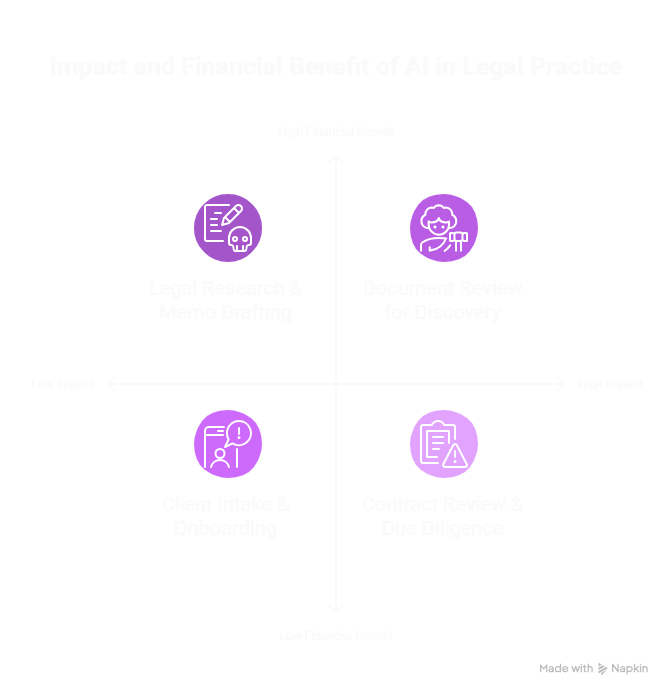
With a clear picture of the total investment, the critical question becomes: Is it worth it? The data and early adopter experiences provide a resounding yes. The return manifests in both hard metrics and strategic advantages that secure a firm's future.
The Tangible Efficiency Dividend
The Strategic Competitive Advantage
Beyond the spreadsheet, AI integration delivers intangible returns that define market leadership:
Elevated Service Quality: AI handles the routine, allowing lawyers to focus on high-judgment strategy, creative argumentation, and deep client counseling. This shifts the firm's value proposition from "hours worked" to "problems solved."
Attraction and Retention of Talent: Top legal talent, especially the new generation, seeks firms that provide modern tools. AI alleviates the burden of mundane tasks, reducing burnout and making the practice of law more engaging.
Winning the New Business Mandate: Sophisticated corporate clients now explicitly ask in RFPs: "What technology do you use to ensure efficiency and control our costs?" A demonstrable AI capability is no longer a nice-to-have; it is a prerequisite for competing for top-tier work.
Future-Proofing the Practice: The law firms that master AI today are building the data assets and technological fluency that will be essential for the next wave of legal innovation. They are not just buying a tool; they are building a new operational core.
Conclusion: An Investment in Your Firm's Future, Not Just a Software Purchase
Viewing AI integration through the narrow lens of a software license is a path to disappointment and underutilization. The true cost encompasses the foundational work of data preparation, the imperative of security hardening, the essential investment in human training and cultural evolution, and the strategic choice of deployment model.
This holistic investment, however, is precisely what makes the return so compelling. It is not an IT expense; it is a capital investment in the firm's operational engine. It transforms efficiency from an aspirational goal into a measurable, daily reality. It redefines roles, elevates service, and builds a defensible competitive moat.
The question for firm leaders is no longer if AI will reshape the legal landscape, but when and how their firm will adapt. Those who understand and proactively invest in the full spectrum of integration costs—the hidden foundation, the human factor, and the strategic software choice—will be the ones to capture the immense efficiency, quality, and competitive advantages that AI promises. They will not just be buying software; they will be architecting the future of their practice.
Looking for a private, secure, and seamlessly integrated legal AI workspace designed to maximize your return on this critical investment? Explore how Wansom.ai provides the platform, security, and support to guide your firm through each stage of this transformation.