In 2026, the question is no longer whether a law firm should use Artificial Intelligence, but how they are using it to protect their margins. For partners and legal innovation leads, the "shiny object" phase of AI has ended. You’ve seen the demos, you know that LLMs can summarize a deposition, and you’re likely already paying for a few seat licenses.
Yet, many firms are still struggling with the "Pilot Trap"—a cycle of endless testing that produces impressive anecdotes but fails to move the needle on firm-wide billable efficiency or client satisfaction. The gap between a firm that uses AI as a glorified search engine and one that uses it as a strategic engine is widening.
Top-tier firms that have successfully scaled AI don’t just buy software; they re-engineer their practice. Here are the four winning strategies they use to turn AI from a cost center into a competitive moat.
1. Moving from "Siloed Tools" to "Integrated Ecosystems"
The most significant mistake firms made in the early 2020s was treating AI as a destination—a separate tab where lawyers had to copy and paste text to get an answer. Top firms in 2026 have moved toward invisible AI.
The Strategy: Workflow Embedding
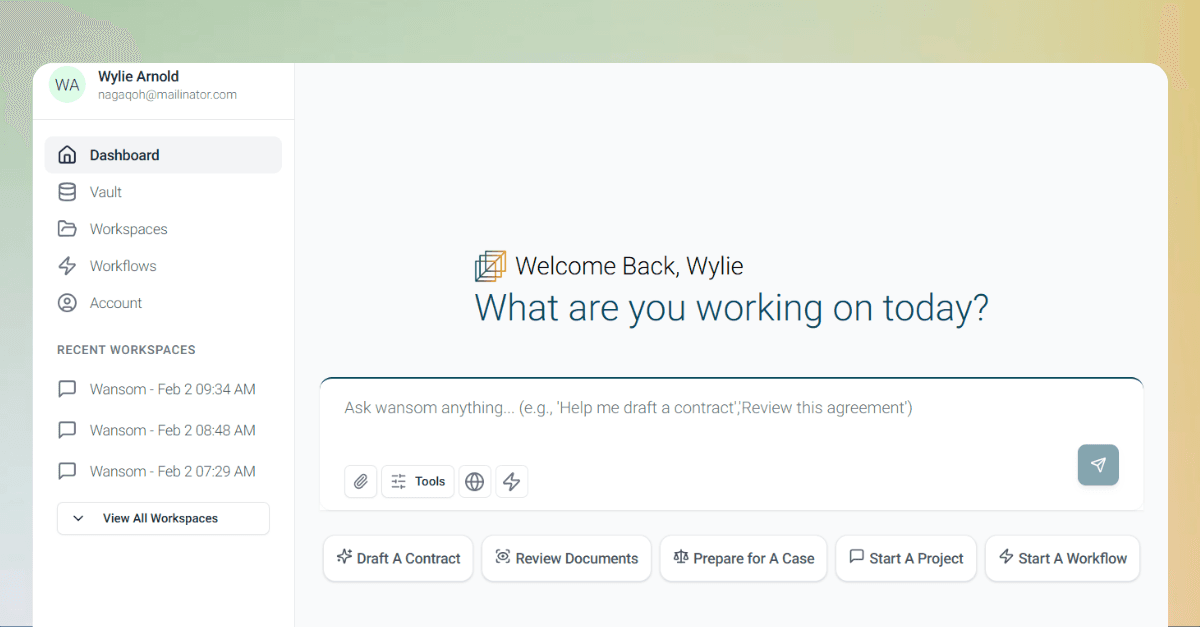
Instead of asking lawyers to learn a new interface, winning firms integrate AI capabilities directly into their existing Tech Stack: Document Management Systems (DMS), Microsoft Word, and specialized workspaces like Wansom AI.
When AI is embedded, the "friction of adoption" vanishes. A lawyer doesn't "go to use AI"; they simply open a matter folder and find a pre-generated risk summary already waiting for them.
Concrete Example: A leading Global 100 firm recently integrated AI-driven redlining into their M&A workflow. Instead of a junior associate manually comparing 50 vendor contracts against the firm’s "Gold Standard" clauses, the AI workspace automatically flags deviations and suggests the firm-approved counter-language within the document editor.
Why this works:
Reduces Context Switching: Every time a lawyer switches apps, they lose focus. Integration keeps them in the "flow" of legal analysis.
Data Integrity: Integrated systems pull directly from the firm’s secure "Document Vault," ensuring the AI isn't hallucinating based on public internet data, but is grounded in the firm's actual precedents.
2. The "Outcome-First" Workflow Redesign
Successful firms have realized that automating a broken process only makes it break faster. They don’t ask, "How can AI speed up our document review?" Instead, they ask, "What is the ultimate outcome the client needs, and what is the shortest path to it?"
The Strategy: Clean-Sheet Design
Top firms use A/B testing on their workflows. They take two similar matters: Team A follows the traditional manual process, and Team B uses a redesigned workflow built around AI agents.
Redesigning the Junior Associate Role
In winning strategies, the "first pass" is no longer a human task.
Traditional: Associate spends 10 hours reviewing 100 documents to find 5 key risks.
AI-Native: AI reviews 1,000 documents in 10 minutes, flags the 50 most suspicious ones, and categorizes the risks. The Associate then spends 2 hours performing high-level analysis on those 50.
The firm still bills for the high-value analysis, but the client receives a 10x more comprehensive review in 20% of the time.
3. Shifting from "General AI" to "Jurisdictional Specificity"
The skepticism lawyers feel toward AI often stems from "hallucinations"—the tendency of general models to make up case law. Top law firms mitigate this by deploying Semantic Legal Research and RAG (Retrieval-Augmented Generation) architectures.
The Strategy: Verification over Generation
Winning firms do not use AI to "write" a brief from scratch. They use it to "query" a verified database of statutes and case law.
The "Wansom Approach" to Accuracy
Tools like Wansom AI specialize in this by connecting to trusted legal authorities across specific jurisdictions (e.g., Euro-Lex, Kenya Law, SAFLII). By limiting the AI’s "worldview" to verified legal data, firms eliminate the risk of "ghost citations" that have plagued less-prepared practitioners.
The Strategy in Action: A litigation team preparing for a cross-border dispute uses an AI assistant to search through thousands of pages of Zambian and South African precedents. Instead of getting a "creative" summary, the system provides direct quotes with verified links to the original LII (Legal Information Institute) source. The lawyer’s job shifts from finding the needle to weaving the thread.
4. Formalized AI Governance and "Billable Education."
The final strategy isn't about the software—it’s about the people. The firms winning the AI race have addressed the "billable hour trap." If a lawyer is incentivized only by hours worked, they are naturally disincentivized to use tools that save time.
The Strategy: The AI Training Credit
Leading firms have implemented "Innovation Credits." They allow associates to bill a certain number of hours per year toward "AI Fluency" and workflow optimization.
Essential Governance Pillars:
Zero-Training Guarantees: Top firms only use enterprise-grade AI (like Wansom) that explicitly states user data will not be used to train public models.
The "Human-in-the-Loop" Mandate: Policy dictates that no AI-generated output can leave the firm without a senior lawyer’s "digital signature" of verification.
AI Committees: They mix senior partners (who understand risk) with tech-savvy associates (who understand the tool's limits) to vet every new deployment.
The Practical Path Forward
Top law firms have realized that AI is not a replacement for legal expertise; it is a force multiplier for it. By moving away from "vibe-based" adoption and toward these structured strategies, they are reducing burnout for their associates and delivering "Big Law" results at a scale previously impossible.
The transition from a traditional firm to an AI-augmented one doesn't happen overnight. It starts with a single, high-impact workflow.
Are you ready to see how your firm’s specific workflows can be transformed?
Wansom AI was built specifically to help legal teams move past the "Pilot Trap" and into production. We provide the secure "Document Vault," the verified jurisdictional search, and the drafting tools you need to scale your capacity without increasing your overhead.
Explore the Wansom AI Workspace – Start your free trial today.