Solo personal injury lawyers are the backbone of justice for countless individuals, often juggling a demanding caseload with limited resources. The sheer volume of documentation, from initial client intake forms and demand letters to complex complaints and settlement agreements, can be overwhelming. Each document requires meticulous attention to detail, accuracy, and adherence to specific legal standards – a time-consuming endeavor that often pulls lawyers away from core legal strategy and client interaction. In this high-stakes environment, efficiency is not just a preference; it's a necessity for survival and success.
The traditional model of legal drafting, heavily reliant on manual processes and generic templates, is increasingly unsustainable for solo practitioners facing a deluge of personal injury claims. This is where the power of artificial intelligence, specifically AI drafting assistants, emerges as a transformative force. These sophisticated tools are not merely spell-checkers or glorified word processors; they are intelligent co-pilots designed to streamline the entire document creation lifecycle, empowering solo lawyers to reclaim their time, enhance their output, and ultimately, better serve their clients.
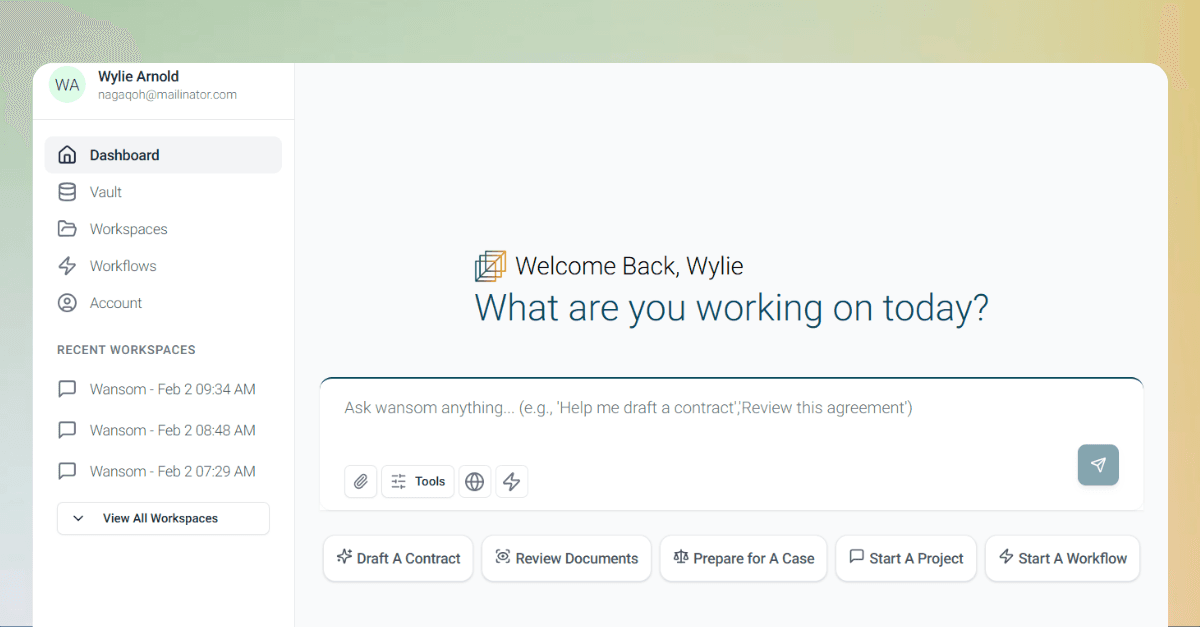
At Wansom, we understand the unique challenges faced by solo attorneys. Our secure, AI-powered collaborative workspace is built to automate document drafting, review, and legal research, enabling legal teams—including solo practitioners—to operate with unparalleled efficiency and precision. This article delves into the profound impact Legal AI drafting assistants are having on high-volume personal injury practices, demonstrating how they are not just tools, but strategic partners in navigating the complexities of modern law.
Can a Solo Attorney Truly Compete in High-Volume Personal Injury Without AI?
The landscape of personal injury law is intensely competitive. Large firms often boast dedicated paralegal teams, junior associates, and extensive administrative support, allowing them to process high volumes of cases with relative ease. For the solo attorney, replicating this level of support through traditional hiring is often financially prohibitive. This disparity creates a significant challenge: how can a single lawyer effectively manage hundreds of active cases, each with its own deadlines, discovery demands, and drafting requirements, while also ensuring high-quality legal representation?
Without AI, the answer is often a struggle against the clock, burnout, and the very real risk of errors that can jeopardize a case. Manual drafting means starting from scratch or heavily modifying generic templates for every new client and every new document. This repetitive work consumes valuable hours that could be spent on client consultations, negotiation strategy, court appearances, or business development. The sheer cognitive load of managing numerous similar but distinct cases without intelligent automation leads to decreased productivity, increased stress, and a potential ceiling on the number of cases a solo practitioner can realistically handle. The question isn't just about competing; it's about sustaining a practice that is both profitable and professionally rewarding.
Related Blog: The Future of Legal Practice: Embracing AI for Enhanced Efficiency
Automating the Drudgery: How AI Streamlines Initial Case Documents
The initial phase of any personal injury case is document-intensive. From the moment a client walks through the door, a cascade of paperwork begins: client intake forms, retainer agreements, medical record requests, and initial demand letters. Traditionally, each of these documents would require manual input, often with significant copy-pasting and careful proofreading to ensure accuracy for each individual client. This process is ripe for AI-driven automation.
AI drafting assistants can ingest client data rapidly and use it to automatically populate a multitude of initial documents. Imagine a system where, after a single data entry, the client’s name, contact information, incident details, and preliminary injuries are seamlessly inserted into a retainer agreement, HIPAA authorization form, and initial letter of representation. This not only saves hours of clerical work but also drastically reduces the potential for transcription errors.
Furthermore, these tools can be trained on a solo lawyer's preferred templates and clauses, ensuring consistency and brand voice across all outgoing communications. For demand letters, AI can help structure the narrative, integrate medical chronologies, and even suggest relevant legal precedents or damages calculations based on similar past cases. This level of automation frees the solo attorney to focus on the unique aspects of each client's story and the strategic elements of their claim, rather than the mechanics of document assembly.
Related Blog: Accelerating Legal Workflows: The Power of Document Automation in Law Firms
Enhancing Precision and Compliance: AI as Your Quality Control Partner
Accuracy and compliance are non-negotiable in legal drafting. A single misplaced decimal, an omitted clause, or an outdated legal reference can have severe consequences for a client's case. For solo practitioners managing a high volume of cases, the risk of such errors increases proportionally with the workload. Manually reviewing every document for compliance with local rules, specific statutes, and evolving case law is an arduous and fallible process.
AI drafting assistants act as an intelligent layer of quality control, working tirelessly to ensure precision and compliance. They can perform instantaneous checks for:
Grammar and Spelling: Beyond basic proofreading, advanced AI can identify nuanced grammatical errors and stylistic inconsistencies.
Factual Accuracy: By cross-referencing against the case file's data, AI can flag discrepancies in dates, names, or factual assertions within documents.
Legal Compliance: The most powerful AI tools are trained on vast legal databases, allowing them to identify missing clauses, ensure adherence to jurisdictional pleading standards, and even highlight potential conflicts with current legislation or recent court rulings. This is particularly crucial in personal injury, where specific damages caps, filing deadlines, and procedural rules can vary significantly.
Consistency Across Documents: In a high-volume practice, maintaining consistency across multiple documents related to the same case (e.g., ensuring the injury description in a demand letter matches the complaint) is vital. AI can identify and flag these inconsistencies, prompting the lawyer for review.
This advanced level of review significantly mitigates risk, reduces the likelihood of costly errors, and ensures that every document leaving the solo practitioner's office is of the highest professional standard. It's like having a dedicated legal editor and compliance officer for every single document, without the overhead.
Related Blog: Mitigating Risk: How AI-Powered Tools Enhance Legal Compliance
Strategic Advantage: Leveraging AI for Superior Demand Letters and Pleadings
Beyond automating the mundane, AI drafting assistants offer a significant strategic advantage in crafting persuasive demand letters and robust legal pleadings. These documents are often the first major impression a solo attorney makes on opposing counsel or the court, setting the tone for negotiations or litigation.
For demand letters, AI can assist in:
Optimizing Language for Persuasion: By analyzing successful demand letters and settlement outcomes, AI can suggest stronger phrasing, highlight key facts, and structure arguments in a way that maximizes the client's position.
Quantifying Damages: Integrating data from medical bills, lost wage statements, and even general damages benchmarks, AI can help construct a comprehensive and defensible damages calculation.
Identifying Gaps: AI can prompt the attorney to include specific types of evidence or arguments that might be missing, drawing from its knowledge base of common personal injury claims.
When it comes to drafting complaints, motions, and other pleadings, AI can accelerate the process by:
Generating Initial Drafts: Based on the facts of the case and the type of personal injury claim, AI can produce a solid first draft of a complaint, complete with standard allegations, jurisdictional statements, and prayer for relief.
Incorporating Legal Citations: Leveraging its research capabilities, AI can suggest and even insert relevant case law and statutory references, saving hours of manual legal research.
Ensuring Formal Requirements: AI can verify that the pleading adheres to specific court formatting rules, captioning requirements, and signature block conventions, which can be surprisingly time-consuming to manage manually.
This level of intelligent assistance allows solo lawyers to focus on the overarching legal strategy and the unique nuances of each client's case, rather than getting bogged down in the mechanics of drafting. The result is not just faster document creation, but the production of higher-quality, more strategically sound legal arguments.
Related Blog: AI in Legal Research: Unlocking Efficiency and Strategic Insights
Scaling the Solo Practice: Managing Workload Without Expanding Staff
One of the most significant benefits for solo personal injury lawyers is the ability to scale their practice without proportionally increasing their overhead. Traditionally, taking on more cases meant hiring more paralegals, legal assistants, or even junior attorneys. Each new hire brings additional costs, training requirements, and management responsibilities.
AI drafting assistants fundamentally alter this equation. By automating a substantial portion of the drafting workload, a solo attorney can effectively manage a caseload that would typically require multiple support staff members. This means:
Increased Case Capacity: A solo lawyer can comfortably handle a larger volume of personal injury cases, directly translating to increased revenue potential.
Reduced Operational Costs: The cost of an AI subscription is significantly lower than the salary, benefits, and overhead associated with hiring additional personnel.
Greater Flexibility and Agility: Solo practitioners gain the flexibility to take on new cases without the logistical hurdles of hiring, allowing them to respond more quickly to market opportunities.
Focus on High-Value Tasks: With AI handling the routine drafting, the solo attorney can dedicate more time to client interaction, complex legal analysis, negotiation, and court appearances – the tasks that truly require their expertise and generate the most value.
This operational leverage empowers solo practitioners to compete more effectively with larger firms, offering clients the personalized attention of a solo practice combined with the efficiency and capacity typically associated with larger legal teams. Wansom's platform is designed precisely for this purpose, providing solo lawyers with the advanced tools they need to grow their practice intelligently and sustainably.
Related Blog: Maximizing ROI: Measuring the Impact of Legal Automation Tools
The Future is Collaborative: How Wansom Elevates the Solo Personal Injury Practice
While this article focuses on the individual benefits for solo lawyers, it's important to remember that Wansom's platform is also built for secure, AI-powered collaboration. Even solo practitioners often work with co-counsel, expert witnesses, or external consultants. Our platform facilitates seamless, secure sharing and co-editing of documents, ensuring that all parties are working from the most current version and that sensitive client information remains protected.
For the solo personal injury lawyer, AI drafting assistants are not a luxury; they are a necessity in today's competitive and demanding legal landscape. These tools transform the daily workflow, from the initial client intake to the final settlement agreement, by automating repetitive tasks, enhancing accuracy, ensuring compliance, and providing strategic drafting assistance.
Embracing AI isn't about replacing the solo attorney; it's about empowering them to be more efficient, more precise, and more strategic. It allows them to reclaim their time, reduce their administrative burden, and ultimately, dedicate their invaluable legal expertise to where it matters most: advocating vigorously for their clients and achieving the best possible outcomes in high-volume personal injury cases. With Wansom, solo practitioners are not just keeping pace; they are leading the way into the future of legal practice.
Ready to Revolutionize Your Personal Injury Practice?
Discover how Wansom's secure, AI-powered collaborative workspace can transform your solo personal injury practice. Experience firsthand how intelligent automation can streamline your document drafting, enhance legal research, and free you to focus on what you do best: winning cases for your clients.
Contact Wansom today for a personalized demonstration.
Related Blog: 11 Best Free Legal AI Tools for Modern Workflows in 2026 (No Signup Required)