
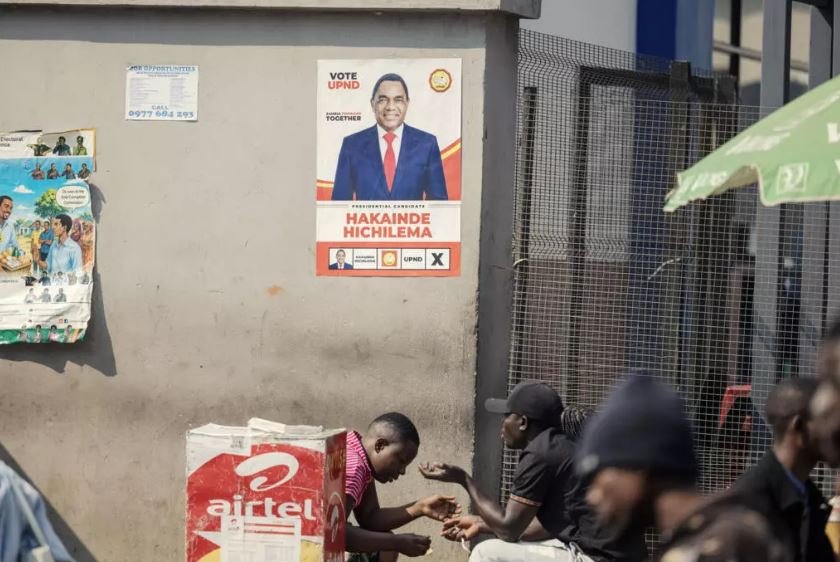
Zambia Election 2026: Hichilema's Recovery Story Meets a Fragmented Opposition — and a Real Runoff Risk
Summary
When: Election day is Thursday, August 13, 2026
Who's running: A record 26 presidential candidates registered, 14 approved to contest — led by incumbent Hakainde Hichilema (UPND) and Brian Mundubile of the Tonse Alliance
The stakes: Hichilema needs more than 50% of the vote to avoid a runoff; independent analysis puts runoff odds at 15–25%
The economic story: Zambia restructured more than $12 billion in sovereign debt after a 2020 default, had its default status lifted in 2025, and growth is forecast above 4% in 2026
The tension: Falling inflation and a stronger kwacha haven't stopped rising costs for food, fuel, and basic goods at the household level
The global angle: Zambia is a top global copper producer, putting it at the center of U.S.-China competition for critical minerals
From debt default to a recovery pitch
Zambia's economic story under Hichilema starts with crisis. The country defaulted on its external debt in 2020, following years of heavy borrowing under the previous Patriotic Front government — one of the higher-profile sovereign defaults to draw attention to unsustainable debt burdens facing developing nations during the pandemic era.
Hichilema, a former financial services executive and one of Zambia's largest cattle ranchers, won the presidency in 2021 after five previous losses dating back to 2006. His government subsequently negotiated a debt restructuring program, completed in 2024, covering more than $12 billion owed to foreign governments — including China — and private creditors. Zambia's formal sovereign default status was lifted in 2025, restoring access to international capital markets, and economic growth is forecast to exceed 4 percent in 2026.
Inflation has fallen sharply since 2021, and the kwacha performed strongly against major currencies through 2025. None of that, however, has closed the gap between national-level indicators and what households are paying at the till — the cost of essential goods keeps climbing faster than wages for many workers.
A record-fragmented opposition field
Zambia's Electoral Commission registered a record 26 presidential candidates for 2026, with 14 ultimately approved to run. Analysts point to that fragmentation as one of the race's defining features, not just a footnote — it reflects both a genuinely open electoral space and serious internal splintering among opposition parties.
Brian Mundubile, a 55-year-old law graduate, has emerged as Hichilema's most credible challenger, leading the Tonse Alliance. He wasn't considered a major political figure until January 2026, when he took over the alliance's leadership following internal wrangling.
Ballot access itself has become a measurable advantage for the ruling party: the UPND fielded candidates in all 226 National Assembly constituencies — up from 156 after a constitutional amendment expanded and added reserved seats for women, youth, and people with disabilities — while its closest rival fielded candidates in far fewer seats and is contesting only one of 116 mayoral and council chair races nationwide.
Could this go to a runoff?
Zambian law requires a presidential candidate to win more than 50 percent of the vote outright, or the race goes to a second round. Independent political-risk analysis published ahead of the vote puts the probability of a runoff at 15 to 25 percent, while identifying a first-round UPND victory as the single most likely outcome — with ballot access, rather than incumbent popularity alone, cited as the clearest structural driver of that projection.
Warning signs beneath a democratic success story
Zambia is often cited as one of Africa's stronger multiparty democracies, ranking among the continent's top 10 in the 2025 Economist Intelligence Unit Democracy Index — though it's still classified as a "hybrid regime" due to persistent governance constraints.
That reputation faces real tests in 2026. Criminal defamation laws were repealed in 2022, but Zambia's 2025 Cyber Crimes Act has since been used against political speech: opposition Socialist Party president Fred M'membe was arrested in March under the act over Facebook posts authorities described as intended to humiliate Hichilema. Analysts tracking the election say the credibility of the vote will depend less on whether democratic institutions formally exist and more on whether they behave neutrally under a charged political climate — pointing to alleged executive interference in the body that registers political parties as a specific concern feeding opposition fragmentation.
Why the world is watching Zambia's copper
Zambia is one of the world's top copper producers, and that fact has pulled the election into a broader geopolitical contest. Copper and other critical minerals sit at the center of competition between the United States and China for supply chains feeding batteries, electronics, and defense manufacturing, giving Zambia's political stability outsized relevance well beyond its borders, regardless of which candidate wins.
What happens next
Polls open Thursday, August 13. If no candidate clears 50 percent of the vote, Zambia proceeds to a runoff between the top two finishers. Given the scale of opposition fragmentation and the ruling party's structural ballot-access advantage, most independent analysis published ahead of the vote favors a first-round Hichilema win, but not with certainty high enough to rule out a second round
Citations
- 1.This article draws on reporting from The Washington Post (AP), RFI, Pan African Visions, the Institute for Security Studies (ISS Africa), Lusaka Times, and Al Jazeera. It will be updated as results are announced.
Finish Reading the Full Story and Expert Analysis.
Get the latest legal & regulatory intelligence in Zambia
Wansom is AI and can make mistakes.