
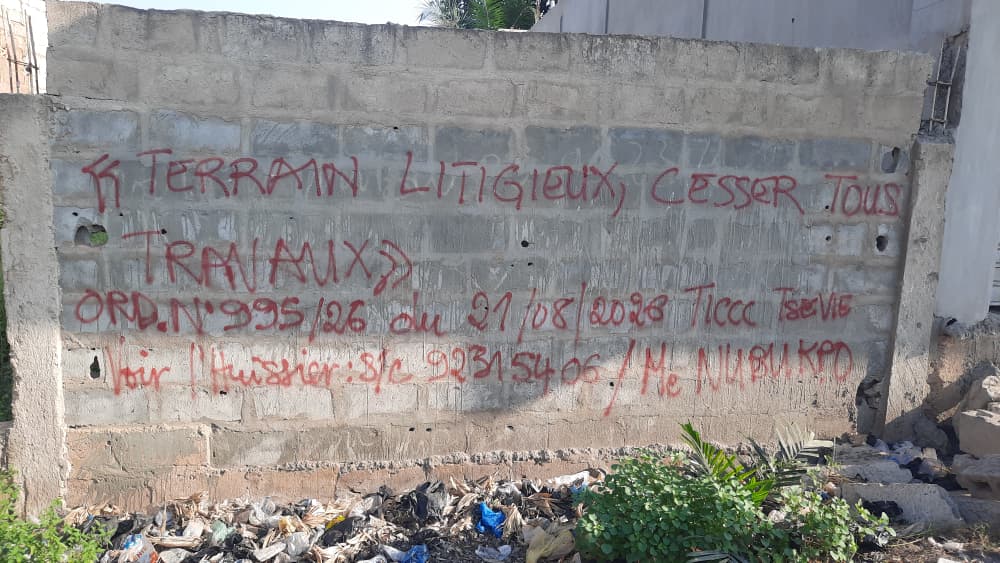
Togo: Yogon Land Dispute Intensifies for Assignon, Woanyako Collectivities
Summary
- Residents and land purchasers in Yogon Zongo are embroiled in a land dispute between the Assignon and Woanyako collectivities, challenging decades-old property rights.
- Individuals like Ibrahim Garba and Aladji Salami report their long-held land and investments are threatened by contested claims and unauthorized construction.
- Kodjo Assignon of the Assignon collectivity alleges collusion between Woanyako Apédo and Deputy Soklingbé Senou, whom he labels a "land predator."
- Soklingbé Senou denies the accusations, claiming victimhood and citing past court rulings from Tsévié and Lomé that affirmed the Woanyako collectivity's property rights.
- The dispute highlights widespread uncertainty for landholders in the area, with the matter currently awaiting judicial resolution.
Deep-Seated Land Dispute in Yogon
Despite his claims of victimhood, the deputy's name reportedly appears on a sales receipt as a seller, a detail that raises questions about his true role in the ongoing land conflict.
Residents and land purchasers in Yogon Zongo, located within the Abobo canton of the Zio 1 commune, are currently facing significant hardship due to an escalating land conflict. The dispute primarily involves the Assignon and Woanyako collectivities, creating an environment of uncertainty for individuals who have occupied or acquired parcels of land over several decades. Many report that their long-established rights are now being challenged, leading to contested claims, unauthorized construction, and alleged property sales conducted without their consent.
One affected individual, Ibrahim Garba, states that his family has resided on the contested land for more than 60 years, having been settled there by the Assignon family. He recounts refusing an offer from the Woanyako collectivity to switch allegiance in exchange for three and a half land lots. Similarly, Aladji Salami, who purchased his parcel approximately 26 years ago, describes investing significantly in building his home, only to witness his own construction materials being used to erect an unauthorized fence on the disputed property. Despite his efforts to seek intervention from the Tsévié tribunal, the gendarmerie, and local authorities, the construction activities reportedly continue unabated.
Allegations of Influence and Conflicting Claims
Kodjo Assignon, a representative for the Assignon collectivity, attributes the current difficulties to a series of successive land transactions involving parcels that had already been allocated to other acquirers. He expresses concern that both original landholders and families to whom his ancestors had bequeathed land are now in a state of complete uncertainty. Assignon further alleges that Woanyako Apédo, a party implicated in the ongoing legal proceedings, is acting in concert with Soklingbé Senou, a deputy and member of the UNIR party, whom Assignon describes as a "land predator."
Kodjo Assignon also claims he was detained for 24 hours in Tsévié the previous week, an event he considers unusual and attributes to an order from Soklingbé Senou. However, Deputy Soklingbé Senou refutes these accusations, asserting his own victimhood in the dispute. He maintains that multiple judicial decisions, including judgments from the Tsévié Tribunal in 2006 and 2018, as well as rulings from the Lomé Court of Appeal in 2013 and 2015, have consistently upheld the property rights of the Woanyako collectivity, from whom he claims to have purchased his own parcels. Despite his claims of victimhood, the deputy's name reportedly appears on a sales receipt as a seller, a detail that raises questions about his true role in the ongoing land conflict, according to a third party familiar with the case.
Uncertainty for Residents and Pending Justice
Beyond the specific allegations and counter-allegations, this land conflict underscores the profound distress experienced by numerous families and property owners who feel powerless in the face of recurrent land disputes. Many express frustration over alleged speculative practices and report a lack of effective redress despite their attempts to engage with official channels. The prevailing sentiment among those affected is one of disbelief, encapsulated by the statement, "We bought, we built, and now we are told it's no longer ours."
With the matter currently awaiting judicial resolution, the outcome remains uncertain. Those impacted by the dispute are urgently seeking a definitive ruling before the unauthorized construction activities on their properties are completed, hoping for clarity and justice in a complex and protracted situation.
Practical Implications
Lawyers advising on property acquisition or development in Togo, particularly in areas prone to historical land disputes like Yogon, must conduct extensive due diligence beyond official titles. This includes investigating local community claims, historical occupation, and potential political interference to mitigate significant risks of protracted litigation, investment loss, and reputational damage for clients. Compliance officers should note the allegations of political involvement, which could indicate corruption risks in land transactions.
Source
How does this affect you?
Get an AI analysis of this article grounded in your jurisdictions, practice areas, and any policy documents you've uploaded to Wansom.
Finish Reading the Full Story and the Expert Analysis.
Get the latest legal & regulatory intelligence in Togo
Wansom is AI and can make mistakes.