
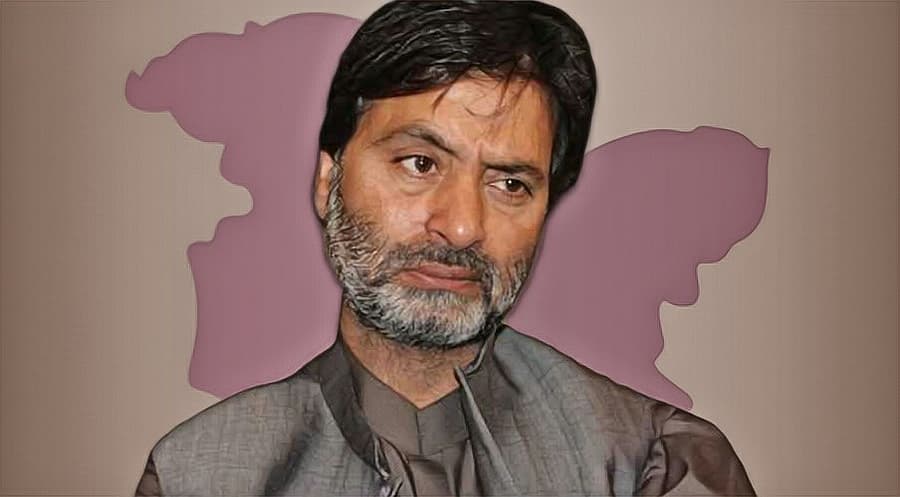
Yasin Malik: Kashmir Court Capital Punishment Request Despite Denying Guilt
Summary
- Yasin Malik, the jailed JKLF chief who is already serving a life sentence for terror funding, has filed an affidavit in a Jammu and Kashmir court denying involvement in the 1990 murder of Sarla Bhat.
- Despite asserting his innocence, Malik has requested capital punishment for himself and stated he will not contest the trial proceedings.
- He claims he was falsely implicated decades after the incident and that the prosecution's narrative is a "fictional story" lacking contemporaneous evidence.
- Malik maintains he only learned of Sarla Bhat's murder on February 21, 1991, while in judicial custody.
- Sarla Bhat, a 27-year-old Kashmiri Pandit nurse, was abducted on April 18, 1990, and later found shot dead after allegedly being tortured.
Unprecedented Plea in Kashmir Murder Case
This unique stance, where a defendant simultaneously asserts innocence and seeks the gravest penalty, presents a unique procedural challenge for the Indian judiciary.
Jailed Kashmiri separatist leader Yasin Malik, who is currently serving a life sentence for terror funding and remains the chairman of the Jammu Kashmir Liberation Front (JKLF) despite the organization being banned in India since March 2019, has taken an extraordinary position in a long-standing murder case. Appearing before a court in Jammu and Kashmir, Malik has formally denied any involvement in the 1990 killing of Sarla Bhat, a Kashmiri Pandit nurse. Despite his assertion of innocence, the defendant has made the highly unusual request for capital punishment for himself, while simultaneously declaring his intention not to contest the ongoing trial proceedings. This development marks a significant and unconventional turn in the legal proceedings.
Malik's affidavit, submitted to the court, states that he believes he has been “falsely implicated” in the crime, which occurred over three decades ago. This unique stance, where a defendant simultaneously asserts innocence and seeks the gravest penalty, presents a unique procedural challenge for the Indian judiciary. His refusal to engage with the prosecution's case, coupled with his plea for the death sentence, marks a significant and unconventional development in the Kashmir 1990 murder trial involving Yasin Malik. The JKLF chief's capital punishment plea, while denying culpability, has drawn considerable attention.
The Defendant's Stance and Allegations
In his affidavit, Yasin Malik elaborated on his reasons for not contesting the charges and for his capital punishment request. He characterized the prosecution's current account of events as a “fictional story” rather than a legitimate criminal investigation. Malik contended that this narrative was “carefully woven together after several decades” with the sole purpose of falsely implicating him in the case.
Furthermore, the JKLF chief asserted that the prosecution's version of events lacks support from any contemporaneous records or from the conduct of investigating agencies at the time of the incident. He maintained that he only became aware of Ms. Bhat’s murder on February 21, 1991, while he was already in judicial custody. Prior to that date, Malik stated he had no knowledge of Sarla Bhat or the circumstances surrounding her death. This forms a key part of his defense, even as he declines to actively participate in the trial.
Details of the 1990 Sarla Bhat Murder
The murder at the center of this high-profile case dates back to April 18, 1990. On that day, Sarla Bhat, a 27-year-old Kashmiri Pandit nurse, was abducted. She was returning from her duties at the Sher-i-Kashmir Institute of Medical Sciences (SKIMS) in Srinagar when the incident occurred.
According to reports, Ms. Bhat was subjected to torture and assault before being fatally shot with an automatic rifle. Her body was subsequently recovered. The brutal nature of the crime and its historical context underscore the gravity of the charges now being faced by Yasin Malik, even as he denies Sarla Bhat's murder and seeks capital punishment.
Broader Implications of the Request
The defendant's request for capital punishment in India, while simultaneously denying guilt and refusing to contest the proceedings, introduces an extraordinary element into the legal process. This procedural development compels the court to navigate a complex situation where a defendant's stated wishes clash with the conventional understanding of a fair trial and defense strategy. The court must now determine how to proceed when a defendant, like Yasin Malik, effectively disengages from his own defense while demanding the ultimate penalty.
Such a stance in a politically sensitive case, particularly one involving a prominent figure like the JKLF chief, could set unusual precedents for future criminal trials. Legal observers will closely watch how the court addresses Yasin Malik's Kashmir court capital punishment request, as it challenges established norms of criminal jurisprudence and defendant rights in India, potentially influencing how similar high-profile cases are handled.
Practical Implications
This case presents an unusual procedural development where a defendant, while denying guilt, requests capital punishment and refuses to contest proceedings. Lawyers practicing criminal law in India, particularly those involved in high-profile or politically sensitive cases, should observe how the court addresses this unprecedented stance, as it could influence future defense strategies or judicial interpretations regarding a defendant's right to a fair trial versus their stated wishes.
Source
How does this affect you?
Get an AI analysis of this article grounded in your jurisdictions, practice areas, and any policy documents you've uploaded to Wansom.
Finish Reading the Full Story and the Expert Analysis.
Wansom is AI and can make mistakes.