
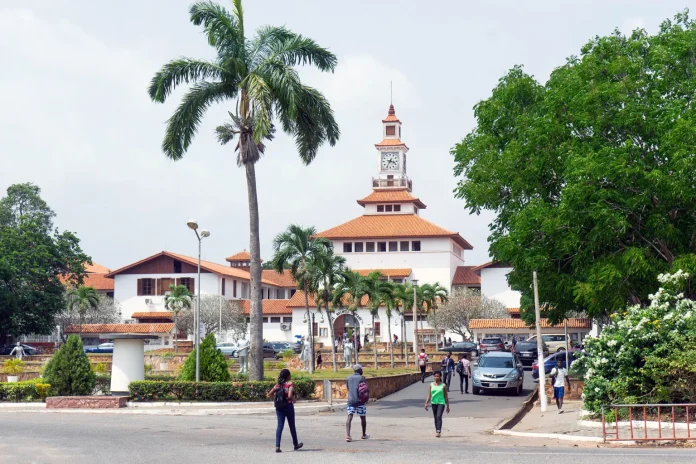
University of Ghana: 2026 Reopening Delayed Amid GAUA Strike
Summary
- The University of Ghana has postponed the reopening for its 2026/2027 academic year, originally set for October 12, 2026.
- This delay was announced on October 10, 2026, with a new reopening date to be communicated later.
- The postponement is contextualized by an ongoing strike by the Ghana Association of University Administrators (GAUA), affecting public universities.
- Students are still advised to complete their academic registration online to secure their places and eligibility for bed allocation.
- Kwame Nkrumah University of Science and Technology (KNUST) also indefinitely postponed its 2026/2027 academic year reopening due to the GAUA strike.
What Happened
The current situation, marked by the University of Ghana's 2026 reopening postponement and the broader Ghana Association of University Administrators strike, carries significant implications for various stakeholders.
The University of Ghana has announced a delay in the commencement of its 2026/2027 academic year, pushing back the previously scheduled reopening date of Monday, October 12, 2026. This decision was communicated through an official notice issued on October 10, 2026, by the university's management. While the notice itself did not explicitly state the rationale behind the postponement, it occurs amidst a persistent industrial action by the Ghana Association of University Administrators (GAUA), which has significantly hampered the operational and administrative functions of public universities across the nation.
Professor Gordon A. Awandare, the Pro Vice-Chancellor responsible for Academic and Student Affairs, signed the announcement. In its communication, the university conveyed its sincere regrets for any inconvenience caused to students by this unexpected delay. Management also expressed appreciation for the patience and understanding of the student body, assuring them that arrangements for a revised reopening date are actively being made and will be communicated in due course.
Despite the indefinite nature of the new reopening date, the University of Ghana has advised students to proceed with their academic registration process online. This directive follows previously disseminated instructions and is crucial for students to secure their enrollment for upcoming classes. Furthermore, completing this online registration is a prerequisite for eligibility in the forthcoming random bed allocation exercise, which is anticipated to take place shortly. This ensures that students can still prepare for their academic year even as the start date remains uncertain.
Broader Context of Industrial Action
The postponement at the University of Ghana is not an isolated incident but rather reflects a wider disruption impacting Ghana's higher education sector. The ongoing strike by the Ghana Association of University Administrators (GAUA) has created significant challenges for the effective operation and administration of numerous public universities. This widespread industrial action has led to considerable uncertainty regarding the academic calendar for the 2026/2027 year.
Notably, the Kwame Nkrumah University of Science and Technology (KNUST) had already announced an indefinite postponement of its 2026/2027 academic year reopening. KNUST explicitly cited the GAUA strike as the direct cause for its decision, highlighting the profound and far-reaching consequences of the labor dispute. This earlier announcement from KNUST underscores the systemic nature of the challenges faced by public universities in Ghana due to the ongoing GAUA strike, which has compelled institutions to adjust their academic schedules.
The collective impact of these postponements, including the University of Ghana's 2026 reopening delay, signifies a critical period for higher education in Ghana. The sustained industrial action by GAUA members, who are integral to the administrative backbone of these institutions, directly impedes the ability of universities to function normally and adhere to their planned academic timelines. This situation creates a ripple effect, affecting not only the immediate start of the academic year but also potentially the entire educational cycle.
Why It Matters
The current situation, marked by the University of Ghana's 2026 reopening postponement and the broader Ghana Association of University Administrators strike, carries significant implications for various stakeholders. For thousands of prospective and returning students, the uncertainty surrounding the academic calendar creates considerable anxiety and logistical challenges. While online registration is encouraged, the physical commencement of classes and access to campus facilities, including accommodation, remains contingent on the resolution of the labor dispute.
This ongoing industrial action by GAUA members underscores the critical role administrative staff play in the seamless functioning of higher education institutions. Their absence disrupts everything from admissions and record-keeping to student support services, making a normal academic environment untenable. The repeated postponements, such as those seen at the University of Ghana and KNUST, highlight a systemic vulnerability within Ghana's public university system to labor disputes, impacting academic continuity and institutional planning.
The protracted nature of the GAUA strike and its subsequent impact on the academic calendar of major institutions like the University of Ghana could have long-term repercussions for the country's higher education landscape. It raises questions about the stability of academic schedules, the welfare of both staff and students, and the overall reputation of Ghanaian public universities. Resolving these labor disputes is paramount to ensuring the uninterrupted delivery of quality education and maintaining the trust of students and their families.
Practical Implications
Lawyers advising educational institutions, labor unions, or students in Ghana should monitor the ongoing GAUA strike for potential legal implications concerning contractual obligations, student enrollment agreements, and labor relations, particularly regarding the legality of the strike and its impact on academic continuity and institutional liabilities.
Source
How does this affect you?
Get an AI analysis of this article grounded in your jurisdictions, practice areas, and any policy documents you've uploaded to Wansom.
Finish Reading the Full Story and the Expert Analysis.
Get the latest legal & regulatory intelligence in Ghana
Wansom is AI and can make mistakes.