
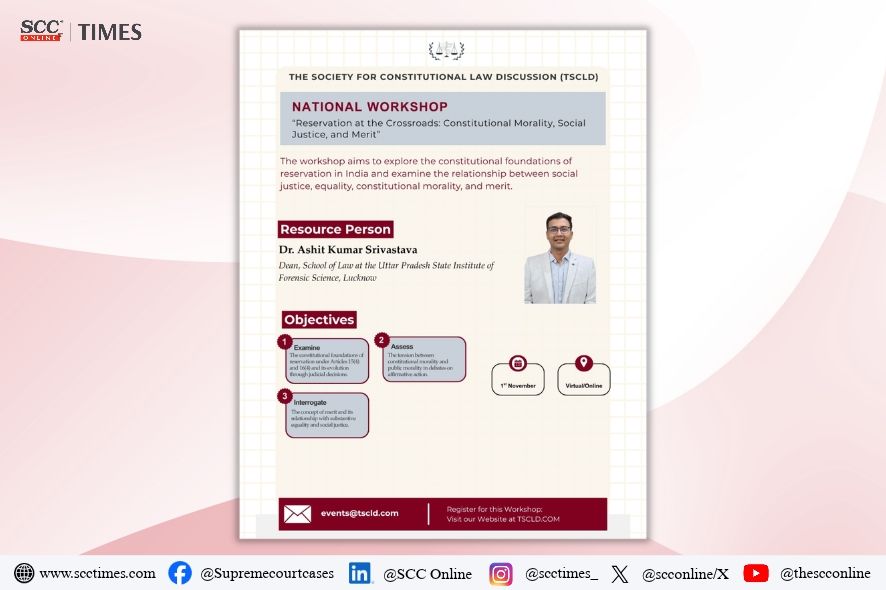
TSCLD Announces National Workshop: Reservation Crossroads Examined
Summary
- The Society for Constitutional Law Discussion is organizing a National Workshop.
- The workshop's central theme is "Reservation at the Crossroads: Constitutional Morality, Social Justice, and Merit."
- Participants will explore the constitutional underpinnings of India's reservation policies.
- Discussions will also delve into the interplay of social justice, equality, constitutional morality, and merit.
- This significant event is scheduled to take place on November 1, 2026.
Upcoming Legal Discourse on Reservation
The chosen theme itself, "Reservation at the Crossroads," signals a recognition of the current challenges and ongoing re-evaluations surrounding these policies.
The Society for Constitutional Law Discussion (TSCLD) has announced an upcoming National Workshop set to critically examine the intricate landscape of India's reservation policies. Scheduled for November 1, 2026, this significant event, titled "Reservation at the Crossroads: Constitutional Morality, Social Justice, and Merit," aims to foster deep academic and legal discourse on a subject of profound national importance. The workshop is designed to provide a platform for exploring the fundamental constitutional underpinnings that govern reservation in India, a topic that consistently generates extensive debate and legal scrutiny.
A primary objective of this TSCLD National Workshop Reservation Crossroads event is to meticulously analyze the complex interplay between social justice, the principle of equality, the evolving concept of constitutional morality, and the notion of merit within the framework of affirmative action. By bringing these critical elements into sharp focus, the organizers intend to facilitate a comprehensive understanding of how these principles interact and sometimes conflict in the application of reservation policies across the nation. This exploration is crucial for navigating the future trajectory of such policies.
The chosen theme itself, "Reservation at the Crossroads," signals a recognition of the current challenges and ongoing re-evaluations surrounding these policies. It underscores the necessity of a nuanced discussion that considers both the historical imperatives for reservation and its contemporary implications. This workshop will undoubtedly contribute significantly to the ongoing dialogue concerning Reservation Constitutional Morality India, offering insights into potential pathways forward.
Delving into Constitutional Foundations
A core component of the upcoming workshop will be an in-depth exploration of the constitutional foundations upon which India's reservation system is built. Participants will engage with the original intent and subsequent interpretations of the constitutional provisions that empower the state to implement affirmative action. This segment promises to dissect the legal architecture that supports reservation, examining how various judicial pronouncements have shaped its application over decades.
The discussions will also critically assess the balance struck between ensuring social justice and upholding the principle of merit, particularly in the context of educational and employment opportunities. The workshop aims to shed light on the inherent tensions and synergies between these ideals, providing a robust forum for examining the practical and theoretical challenges associated with Social Justice Merit Reservation. Understanding these foundational aspects is paramount for any comprehensive analysis of the system.
The Interplay of Core Principles
The workshop's agenda is specifically structured to examine the intricate relationships among social justice, equality, constitutional morality, and merit. These four pillars represent distinct yet interconnected concepts that are central to the philosophical and legal debates surrounding reservation. Attendees will analyze how the pursuit of social justice, often through preferential treatment, aligns with or diverges from the strict interpretation of equality.
Furthermore, the concept of constitutional morality, which guides the spirit and application of the constitution, will be a key area of focus. The workshop will investigate how this evolving doctrine influences the judicial and public perception of reservation policies, especially when juxtaposed against traditional notions of individual merit. This analytical approach seeks to clarify the ethical and legal boundaries within which reservation operates.
Significance for Indian Jurisprudence
The November 1 2026 legal workshop, organized by the Society for Constitutional Law Discussion, holds considerable significance for the future of Indian jurisprudence. Insights gleaned from the discussions are expected to inform legal scholarship, judicial reasoning, and policy formulation regarding affirmative action. For legal practitioners and compliance officers, monitoring the outcomes of this event, potentially covered by outlets like the SCC Online Blog workshop, will be crucial for understanding evolving legal interpretations.
Such a focused national workshop provides a vital platform for academics, legal experts, and policymakers to converge and deliberate on one of the most complex and sensitive areas of Indian law. The conclusions and perspectives shared could influence future legislative amendments, judicial reviews, and the overall societal understanding of reservation, making it an essential date on the legal calendar.
Practical Implications
Lawyers and compliance officers should monitor discussions from this workshop to understand potential shifts in judicial interpretation or legislative intent regarding reservation policies in India, which could influence future legal challenges, policy drafting, or client advisory on employment and education matters.
Source
How does this affect you?
Get an AI analysis of this article grounded in your jurisdictions, practice areas, and any policy documents you've uploaded to Wansom.
Finish Reading the Full Story and the Expert Analysis.
Wansom is AI and can make mistakes.