
Trump Admin Asks SCOTUS to Block Transgender Inmate Care Policy
Summary
- The Trump administration has asked the Supreme Court to block a lower court order preventing new restrictions on gender-affirming care for transgender inmates in federal prisons.
- This emergency application, the 41st by the administration, argues for judicial deference to prison officials' expertise on institutional security.
- A lower court had blocked the Federal Bureau of Prisons' 2026 policy, finding it was "reverse engineered" from a 2025 Trump executive order and lacked evidence of security concerns.
- The administration claims transgender inmates would not be harmed by withdrawing treatments, asserting that hormone interventions and social accommodations are "not medically necessary" for gender dysphoria.
- The case highlights a significant legal conflict over prisoner rights, healthcare policy, and the extent of judicial oversight of correctional authorities.
Supreme Court Intervention Sought
The Trump administration has formally requested the Supreme Court to intervene in a significant legal dispute concerning healthcare for transgender individuals within federal correctional facilities. In its 41st emergency application to the high court, filed on a Monday, the administration seeks to overturn a lower court's injunction that currently prevents the Federal Bureau of Prisons (BOP) from implementing new restrictions on gender-affirming care for transgender inmates. This move aims to allow the BOP to proceed with its proposed policy changes.
Central to the administration's argument is the assertion that judicial bodies should grant substantial deference to the operational experience and professional expertise of prison officials. The government contends that it should not be required to present specific evidence demonstrating that gender-affirming healthcare has previously led to security concerns within the prison system. This position underscores a broader argument for administrative autonomy in correctional management.
The administration further claims that the lower court's order, by nullifying the BOP's statutory authority to adopt policies deemed necessary for institutional security, inflicts "irreparable harm" upon both the government and the public. This assertion frames the ongoing legal challenge as a matter of significant public interest and governmental function, urging the Supreme Court to lift the existing block on the BOP's policy.
The Contested Policy and Its Origins
The policy at the heart of this legal challenge is a 2026 directive from the Federal Bureau of Prisons, which seeks to impose new limitations on gender-affirming healthcare for transgender inmates. These restrictions encompass various forms of care, including hormone treatment, social accommodations, and surgical interventions. This 2026 policy represents a notable departure from previous regulations that had permitted such treatments within federal prisons.
The origins of this restrictive policy are closely tied to actions taken by President Donald Trump upon his return to office in January 2025. At that time, he issued an executive order, described as "anti-transgender," which declared an intent to restore "biological truth to the federal government." Following this executive order, the Bureau of Prisons issued a memorandum that specifically prohibited inmates from requesting undergarments not aligning with their sex assigned at birth. Furthermore, this memorandum barred the use of federal funds for any medical procedure, treatment, or drug designed to alter an inmate's appearance to conform to a gender identity that does not align with their sex assigned at birth.
While the government has argued that the 2026 BOP policy was an independent judgment by the agency and not merely an extension of the 2025 executive order, a lower court rejected this claim. The court found that the 2026 policy was, in fact, "reverse engineered" to implement the directives of the executive order. Consequently, the lower court ordered the policy to be put on hold while the litigation proceeds, a decision the Trump administration now asks the Supreme Court to stay.
Arguments for Deference and Harm
The Trump administration's appeal to the Supreme Court heavily relies on the principle of judicial deference to correctional authorities. The Federal Bureau of Prisons argues that courts should have deferred to its "experience and expertise" in determining that concerns related to security and prison administration independently justified the 2026 policy. The administration explicitly stated that any suggestion by lower courts for BOP to provide additional factual support for these concerns was "misguided."
The administration invoked a specific legal standard, asserting that "considerations of ‘institutional security’ are ‘peculiarly within the province and professional expertise of corrections officials, and, in the absence of substantial evidence in the record to indicate that the officials have exaggerated their response to these considerations, courts should ordinarily defer to their expert judgment in such matters.’" This highlights the administration's belief that prison officials are uniquely qualified to make decisions impacting institutional safety, and their judgment should be respected by the judiciary.
Furthermore, the government contends that transgender inmates would not suffer harm from the withdrawal of gender-affirming treatments. It specifically claimed that hormone interventions and social accommodations are "not medically necessary" to treat gender dysphoria. The administration argues that any potential harm to the inmates is "substantially outweighed" by the harm that would be inflicted upon the government and the public if the BOP were compelled to maintain prior policies that it has deemed problematic.
Broader Implications
This Supreme Court emergency application concerning transgender inmate care signals a significant legal battle over the scope of gender-affirming care in federal prisons and the extent of judicial deference to correctional authorities. The case underscores the ongoing tension between prisoner rights and administrative discretion, particularly in the context of evolving medical standards for gender dysphoria.
The administration's approach in this case aligns with a pattern observed in other appeals where the Supreme Court has previously sided with the Trump administration based on "security concerns." For instance, the high court recently supported the administration's use of Social Security data for verifying voters’ citizenship status, citing election security, and approved continued construction of a White House ballroom, citing national security. Similar arguments were also made by Trump to justify the construction of a 250-foot "Independence Arch" in D.C. This history suggests a consistent strategy of invoking security as a justification for administrative actions, often with success at the highest court.
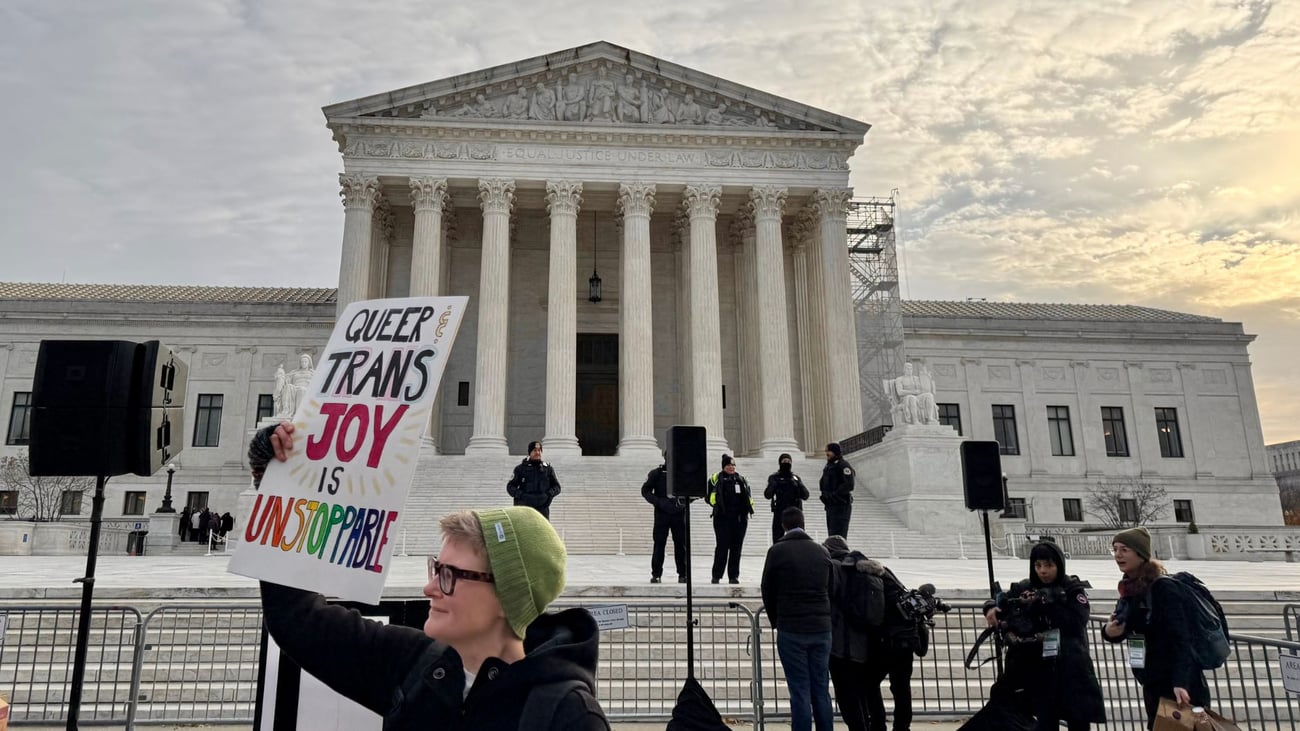
The outcome of this Supreme Court review will have profound implications for the future of gender-affirming care in federal prisons, potentially setting a precedent for how courts weigh the medical needs of transgender inmates against the asserted security and administrative concerns of prison officials. Protesters gathered at the Supreme Court on December 4, 2024, ahead of oral arguments in a major transgender rights case, highlighting the public attention and societal importance attached to these proceedings.
Practical Implications
This case signals a significant legal battle over the scope of gender-affirming care in federal prisons and judicial deference to correctional authorities. Lawyers representing inmates or advising prison systems should monitor the Supreme Court's decision for implications on prisoner rights, healthcare policy, and the legal standard for challenging administrative restrictions on medical treatment.
Source
How does this affect you?
Get an AI analysis of this article grounded in your jurisdictions, practice areas, and any policy documents you've uploaded to Wansom.
Finish Reading the Full Story and the Expert Analysis.
Get the latest legal & regulatory intelligence in United States
Wansom is AI and can make mistakes.