
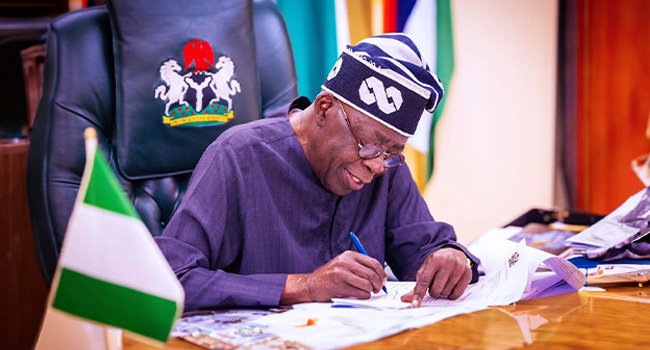
President Tinubu Seeks House Approval: $7.7 Billion External Borrowing for 2026 Budget
Summary
- President Bola Ahmed Tinubu has requested legislative approval for an external borrowing plan.
- The plan involves N10.79 trillion, equivalent to $7.7 billion.
- This borrowing component is part of the 2026 Appropriation Act.
- The request was sent to the House of Representatives for endorsement.
Presidential Request for 2026 Budget Funding
Lawyers advising on public finance, international debt, or infrastructure projects should closely monitor the legislative approval process for Nigeria's 2026 external borrowing plan.
President Bola Ahmed Tinubu has formally communicated with the House of Representatives, initiating the legislative process for the implementation of an external borrowing component already approved within the 2026 Appropriation Act. This critical request seeks parliamentary endorsement for the implementation of a N10.79 trillion external loan, which translates to approximately $7.7 billion. This significant financial component is specifically earmarked as a core part of the upcoming 2026 Appropriation Act, outlining the government's fiscal strategy for the year.
The communication from President Tinubu underscores the executive's intention to secure a considerable sum through external sources to support the nation's fiscal agenda for the 2026 financial year. This proposed $7.7 billion external borrowing is a key element of the overall funding strategy for the 2026 budget, indicating a strategic reliance on international debt to finance government operations and planned projects. The move highlights the administration's approach to resourcing its long-term development objectives.
Legislative Oversight and Fiscal Policy
The President's submission to the House of Representatives highlights the constitutional framework governing public finance in Nigeria, where major financial undertakings, especially external loans, require legislative approval. This process ensures that the executive's borrowing plans are subject to scrutiny and consent from the elected representatives, providing a crucial check on government spending and debt accumulation. The 2026 Appropriation Act, of which this borrowing is an integral part, represents the nation's annual financial blueprint, detailing projected revenues and expenditures and setting the stage for the country's economic activities.
Securing the House of Representatives' approval for the implementation and terms of the N10.79 trillion external borrowing, which is already provided for in the 2026 Appropriation Act, is a mandatory step before the funds can be accessed and deployed for national development. This legislative oversight is designed to foster transparency and accountability in the management of public funds, particularly when engaging in international debt. The decision by the House regarding this $7.7 billion external loan will therefore be a significant moment for Nigeria's fiscal policy and its adherence to established financial governance principles.
Economic Implications of the Borrowing Plan
The proposed $7.7 billion external borrowing for the 2026 budget carries substantial implications for Nigeria's economic trajectory and public debt profile. The sheer scale of the N10.79 trillion external loan indicates a strategic reliance on foreign capital to finance the government's ambitious plans outlined in the 2026 Appropriation Act. This funding is expected to support various sectors, potentially including critical infrastructure development, social programs, and other essential government initiatives aimed at fostering economic growth and stability.
The approval of President Tinubu's borrowing plan will directly influence the government's capacity for future spending and its ability to meet contractual obligations, impacting various sectors and investment opportunities. Lawyers advising on public finance, international debt, or infrastructure projects should closely monitor the legislative approval process for Nigeria's 2026 external borrowing plan. The outcome will dictate the government's capacity for future spending and potential contractual obligations, making the House of Reps' decision on this $7.7 billion loan a critical factor for the nation's financial health and its engagement with international creditors. This move is central to the Nigeria 2026 budget external loan strategy.
Practical Implications
Lawyers advising on public finance, international debt, or infrastructure projects should closely monitor the legislative approval process for Nigeria's 2026 external borrowing plan, as it will dictate the government's capacity for future spending and potential contractual obligations, impacting various sectors and investment opportunities.
Source
How does this affect you?
Get an AI analysis of this article grounded in your jurisdictions, practice areas, and any policy documents you've uploaded to Wansom.
Finish Reading the Full Story and the Expert Analysis.
Get the latest legal & regulatory intelligence in Nigeria
Wansom is AI and can make mistakes.