
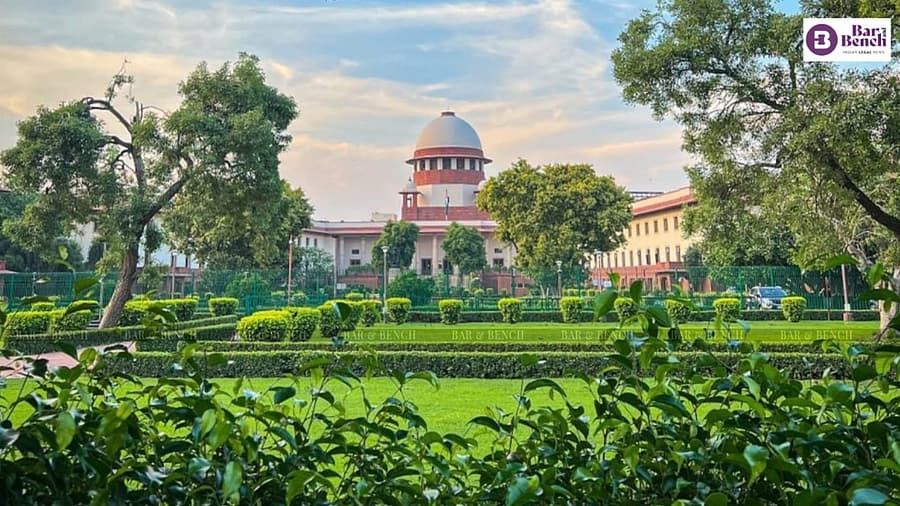
Supreme Court: Thiruparankundram Contempt Petitions Over Unlit Deepam
Summary
- The Supreme Court will hear all petitions regarding the non-lighting of a lamp atop Thiruparankundram hill on November 27.
- Justices Aravind Kumar and Vipul Pancholi had previously permitted the lighting of the Karthigai deepam at the Deepathoon on November 24 as a one-time measure.
- Despite the court's order, the lamp was lit at the customary Deepa Mandapam, but the Deepathoon, the disputed site, remained unlit.
- The temple administration cited established practices, stating the Deepathoon is a British-erected survey stone, not a traditional lighting spot.
- The Tamil Nadu government informed the Supreme Court about the situation on Wednesday.
Judicial Review of Non-Compliance
This development signals the Supreme Court's firm stance on compliance with its orders, even in sensitive matters involving religious practices and state administration.
The Supreme Court is set to address a series of petitions this Friday, November 27, concerning the failure to illuminate a lamp atop the Thiruparankundram hill. This development follows a previous directive issued on November 20 by a bench comprising Justices Aravind Kumar and Vipul Pancholi, which had granted permission for the lighting of the Karthigai deepam at a contested location adjacent to a Muslim dargah. The Court's decision to list "everything" for the upcoming hearing underscores the gravity with which it views the unfolding situation.
The initial order on November 20 specifically authorized a limited group from the temple administration to light the Karthigai deepam at the Deepathoon, situated on Thiruparankundram hill, on November 24. This permission was explicitly designated as a singular, one-time event. Furthermore, the Supreme Court mandated that the local Collector oversee the arrangements for this lighting and submit a comprehensive compliance report within three days following the festival.
Despite the clear judicial instruction, the lamp was ultimately lit on the evening of November 24 at the customary Deepa Mandapam, which is located near the Uchipillaiyar Temple. Crucially, the Deepathoon, the specific site identified in the Supreme Court's order and the focal point of the ongoing dispute, remained unlit. The temple administration subsequently stated that its trustees had collectively decided to adhere to the temple's established customs, which, according to them, dictate that the lamp should be lit at the Uchipillaiyar Temple and not at the Deepathoon, which they consider merely a British-era survey stone. The Tamil Nadu government had also communicated with the Supreme Court on Wednesday regarding these events.
The Contested Deepathoon and Historical Context
At the heart of the ongoing legal contention is the Deepathoon, a structure atop Thiruparankundram hill whose very nature is subject to significant disagreement. This particular site is geographically positioned in close proximity to a Muslim dargah, adding a layer of inter-community sensitivity to the dispute. The State government has consistently maintained that the Deepathoon is nothing more than a survey stone, originally erected by the British, and asserts that it holds no intrinsic connection to the temple or its religious practices.
Conversely, the temple administration, while also referring to the Deepathoon as a British-era survey stone, bases its actions on long-standing traditions. Their trustees' unanimous resolution to light the lamp exclusively at the Uchipillaiyar Temple reflects a commitment to what they perceive as the temple's established and authentic practices. This divergence in interpretation regarding the Deepathoon's significance and its role in religious rituals forms the fundamental basis of the Thiruparankundram lamp lighting row.
The Supreme Court's initial directive on November 20 to light the lamp at the Deepathoon, even as a one-time measure, was issued in full awareness of this underlying dispute. The Court's decision to proceed with the directive, despite the differing views on the Deepathoon's identity, underscores its attempt to find a temporary resolution while the broader issues remain unresolved.
Upholding Judicial Authority
The Supreme Court's decision to convene a hearing for all petitions related to the Thiruparankundram lamp lighting row, particularly in the wake of the Deepathoon remaining unlit, sends a clear message regarding the judiciary's expectation of compliance with its orders. The initial directive, which included specific instructions for the Collector to supervise the arrangements and submit a compliance report, highlighted the Court's intent to ensure its pronouncements were followed meticulously.
The subsequent non-compliance, where the lamp was lit at an alternative location rather than the judicially specified Deepathoon, places the temple administration in a precarious position. Their justification, rooted in established temple practices and the characterization of the Deepathoon as a survey stone, directly challenges the authority of the Supreme Court's one-time directive. This Karthigai deepam non-compliance case therefore transcends a mere procedural oversight, evolving into a significant test of judicial supremacy.
This development signals the Supreme Court's firm stance on compliance with its orders, even in sensitive matters involving religious practices and state administration. The upcoming hearing, presided over by Justices Aravind Kumar and Vipul Pancholi, will likely delve into the reasons for the non-adherence and the implications of such actions. It reinforces the principle that judicial directives, once issued, must be respected and executed, irrespective of differing interpretations or traditional customs, unless explicitly overturned or modified by the Court itself.
Practical Implications
This development signals the Supreme Court's firm stance on compliance with its orders, even in sensitive matters involving religious practices and state administration. Lawyers advising religious institutions or government bodies should note the potential for contempt proceedings if court directives are not followed precisely, emphasizing the need for clear communication and adherence to judicial pronouncements to avoid further legal action.
Source
How does this affect you?
Get an AI analysis of this article grounded in your jurisdictions, practice areas, and any policy documents you've uploaded to Wansom.
Finish Reading the Full Story and the Expert Analysis.
Get the latest legal & regulatory intelligence in India
Wansom is AI and can make mistakes.