
Third Circuit: LaMonica McIver Immunity Denial Upheld
Summary
- A Third Circuit panel denied U.S. Representative LaMonica McIver immunity from federal assault charges.
- The charges stem from a May 2025 incident at the Delaney Hall detention center during an oversight visit, where McIver allegedly made physical contact with federal officers.
- McIver faces three counts of assaulting, resisting, impeding, and interfering with federal officers, carrying a potential sentence of up to 17 years.
- The court's majority ruled that McIver's alleged physical actions were nonlegislative and thus not protected by the Speech or Debate Clause.
- A dissenting judge questioned the ruling's impact on congressional oversight and raised concerns about potential selective prosecution.
The Delaney Hall Confrontation
The court's majority ruled that McIver's alleged physical actions were nonlegislative and thus not protected by the Speech or Debate Clause.
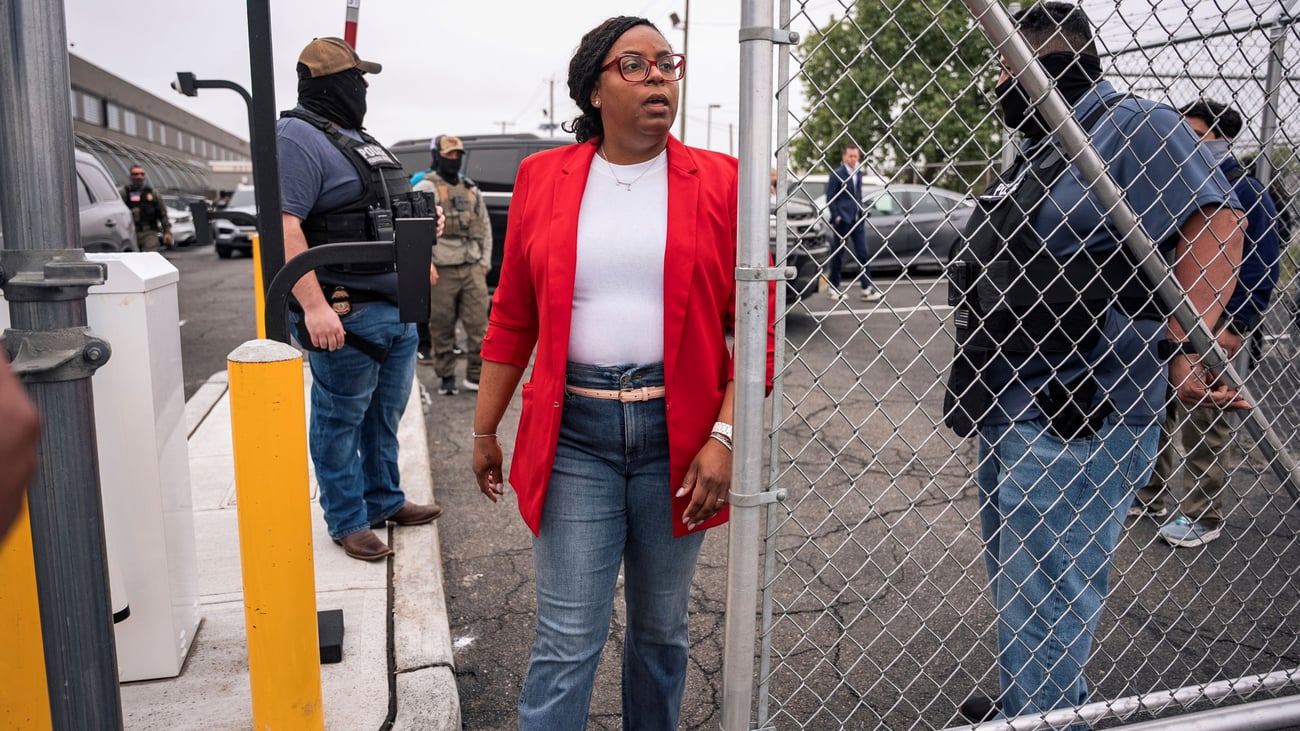
U.S. Representative LaMonica McIver, a Democrat representing New Jersey, is facing serious federal charges stemming from an incident in May 2025 outside the Delaney Hall detention center in Newark. The congresswoman stands accused of three counts of assaulting, resisting, impeding, and interfering with federal officers, charges that could lead to a maximum sentence of 17 years in prison. This confrontation occurred during an official oversight visit to the immigration facility.
During the May 2025 event, Representative McIver and two other Democratic legislators were inside the facility's gates when Newark Mayor Ras Baraka attempted to join them. Federal officials subsequently moved beyond the facility's perimeter into a crowd to arrest Mayor Baraka on trespassing charges. In response, McIver and her colleagues reportedly encircled the mayor, making repeated physical contact with the officers in an attempt to prevent the arrest.
Despite their efforts, Mayor Baraka was ultimately removed from the crowd and taken into custody, though the charges against him were later dropped. However, the alleged physical interactions by Representative McIver with the federal officers led to her own indictment on three federal charges. She has pleaded not guilty, asserting that the charges are a form of political intimidation, but a New Jersey federal judge previously denied her motions to dismiss the case.
Immunity Claim and Third Circuit's Decision
Following the denial of her motions to dismiss, Representative McIver sought protection under the Speech or Debate Clause of the U.S. Constitution, which grants lawmakers immunity for actions integral to their legislative duties. During oral arguments before a Third Circuit panel, McIver contended that this constitutional provision broadly shielded her conduct during the Delaney Hall visit from litigation. This argument centered on the idea that her actions, even if physical, were part of her official oversight responsibilities.
However, a majority of the Third Circuit panel, composed of U.S. Circuit Judges Cindy K. Chung (a Joe Biden appointee) and Stephanos Bibas (a Donald Trump appointee), rejected McIver's claim. In their ruling, they determined that the congresswoman's alleged actions were nonlegislative and therefore not protected by the clause. Judge Chung, writing for the majority, clarified that the Speech or Debate Clause limits are not a “blanket protection over all things in any way related to the legislative process.”
The majority opinion explicitly stated that Representative McIver's physical contact with an officer was not integral to the deliberative and communicative processes essential for members participating in committee and House proceedings, specifically her inspection of Delaney Hall. Judge Chung further emphasized that acts such as “pushing past and forcibly striking someone” are unambiguously nonlegislative and do not form an integral part of the legislative process, thus denying the requested congressional immunity for federal officers.
Dissenting Views and Broader Concerns
While the majority denied immunity, U.S. Senior Circuit Judge Thomas L. Ambro, a Bill Clinton appointee, issued a partial dissent, raising important questions about the scope of the ruling and potential implications for congressional oversight liability. Judge Ambro specifically challenged the validity of McIver's second charge, which pertained to contact she claimed was made in an effort to re-enter Delaney Hall to continue her oversight visit.
Judge Ambro argued that this particular contact could be considered ambiguously legislative, as it was plausibly necessary for Representative McIver to fulfill her official duties. He highlighted that when an executive branch official obstructs a member of Congress from accessing a Department of Homeland Security facility, it effectively denies them the investigative tools provided by federal law for oversight inspections. According to McIver's account, the contact was a calculated attempt to circumvent an official to gain access to the facility, which was crucial for her inspection.
Beyond the specific charge, Judge Ambro also suggested that the court should have allowed McIver to pursue additional evidence regarding whether she was being selectively prosecuted for intimidatory purposes. He underscored the rarity of retaliatory prosecutions against sitting members of Congress, warning that such instances could jeopardize the constitutional foundation of the government. Ambro criticized the majority for not recognizing these cases as extraordinary, implying that their choice could lead to significant harm. Representative McIver has publicly expressed her disapproval of the majority's decision.
Practical Implications
This ruling clarifies the narrow scope of Speech or Debate Clause immunity, indicating that physical actions during congressional oversight visits are unlikely to be protected if they fall outside direct legislative functions. Lawyers advising public officials should note this precedent when assessing potential criminal liability for actions taken in the field, even when related to official duties.
Source
How does this affect you?
Get an AI analysis of this article grounded in your jurisdictions, practice areas, and any policy documents you've uploaded to Wansom.
Wansom is AI and can make mistakes.