
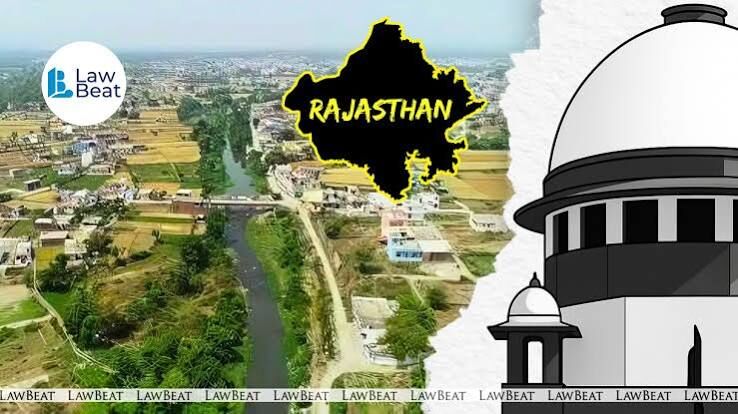
Supreme Court: Redefines River Corridor, Warns Rajasthan on Jojari-Luni Illegal Mining
Summary
- The Supreme Court mandated that river corridors must be measured by flood levels, not dry-season flow, for the Jojari-Luni system in Rajasthan.
- Justices Vikram Nath and Sandeep Mehta endorsed a committee's recommendation to preserve the entire recorded river corridors.
- Rajasthan state officials were warned by the Supreme Court regarding false references to its orders and the regularization of illegal mining.
- The Court directed Rajasthan to submit an acceptable proposal for the restoration of the Jojari-Luni river system.
What Happened
The directive explicitly states that the measurement of river corridors must be determined by the extent of floodwaters, not merely by the river's flow during dry periods.
The Supreme Court of India recently issued significant directives concerning the Jojari-Luni river system in Rajasthan, emphasizing a critical redefinition of river corridor measurements and delivering a stern warning to state officials. A bench comprising Justices Vikram Nath and Sandeep Mehta mandated that river corridors must be delineated based on flood levels, rather than the more restrictive dry-season flow. This ruling underscores the judiciary's commitment to comprehensive environmental protection and the preservation of natural water bodies.
The Court's order also included a clear endorsement of a committee's recommendation, which called for the preservation of the entire recorded corridors of the river system. Furthermore, the state of Rajasthan has been instructed to present an acceptable proposal aimed at restoring the river system to its natural state. This comprehensive approach seeks to address the long-standing issues of pollution and degradation affecting the Jojari-Luni rivers.
Legal Context and Directives
Central to the Supreme Court's recent pronouncement is the precise methodology for defining ecological zones around rivers. The directive explicitly states that the measurement of river corridors must be determined by the extent of floodwaters, not merely by the river's flow during dry periods. This distinction is crucial for ensuring that the full ecological breadth and flood-carrying capacity of river systems are protected, preventing encroachment and degradation that often occur when narrower definitions are applied.
The bench, consisting of Justices Vikram Nath and Sandeep Mehta, also formally backed the recommendations put forth by an expert committee. These recommendations specifically advocated for the preservation of all recorded corridors associated with the river system, highlighting the importance of maintaining these areas for ecological balance and flood management. Consequently, the state of Rajasthan is now under a direct order to formulate and submit a viable plan for the comprehensive restoration of the affected river system, indicating a firm judicial stance on environmental accountability.
Implications for Rajasthan Officials
In a particularly sharp rebuke, the Supreme Court issued a direct warning to officers within the Rajasthan administration. This admonition stemmed from concerns regarding the regularization of illegal mining activities and the alleged false referencing of previous court orders by state officials. The Court's stance indicates a serious view of any attempts to circumvent judicial directives or to legitimize unlawful operations, especially those contributing to environmental degradation like the Jojari-Luni river pollution.
The warning underscores the potential for severe consequences for officials found to be involved in such practices. The Court's scrutiny extends beyond mere policy implementation, delving into the integrity of how its orders are interpreted and applied by state authorities. This development signals a heightened level of judicial oversight over administrative actions, particularly concerning environmental compliance and the prevention of illegal mining in Rajasthan.
Why It Matters
This Supreme Court order holds significant implications for environmental governance and the rule of law across India, particularly in states grappling with illegal mining and pollution. By mandating a flood-level definition for river corridors, the Court has established a precedent that prioritizes ecological integrity and natural processes over more convenient, but environmentally damaging, interpretations. This decision provides a robust framework for protecting vital river ecosystems from further encroachment and degradation.
Moreover, the explicit warning to Rajasthan officials regarding false references and the regularization of illegal mining activities sends a powerful message about accountability. It reinforces the judiciary's role in ensuring that state administrations not only comply with environmental laws but also act with integrity in upholding judicial pronouncements. This ruling serves as a critical reminder that environmental protection is a non-negotiable imperative, and those responsible for its enforcement will be held to the highest standards.
Practical Implications
Lawyers advising mining or industrial clients in Rajasthan must ensure strict environmental compliance, particularly regarding river corridor definitions based on flood levels, and be aware of the Supreme Court's heightened scrutiny of illegal mining regularisation and potential for personal liability for officials involved in such activities.
Source
How does this affect you?
Get an AI analysis of this article grounded in your jurisdictions, practice areas, and any policy documents you've uploaded to Wansom.
Finish Reading the Full Story and the Expert Analysis.
Wansom is AI and can make mistakes.