
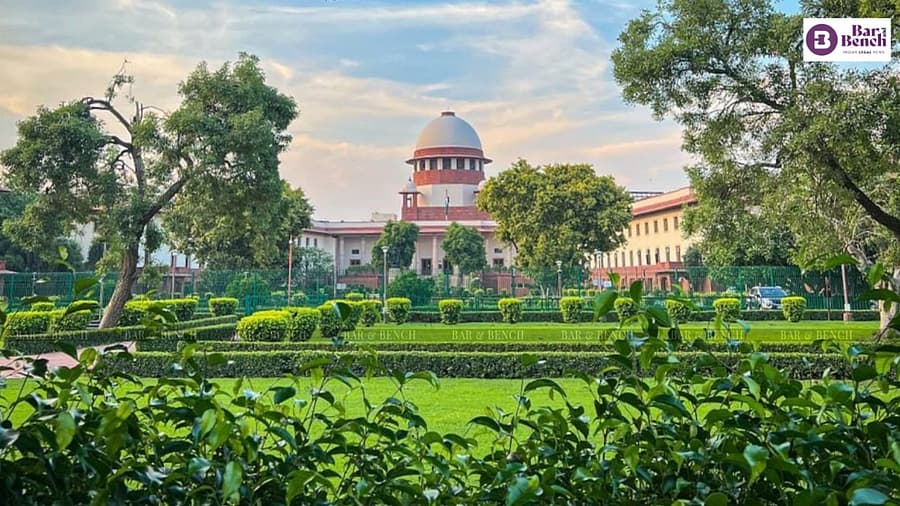
Supreme Court: Arulmigu Annamalainathar Temple Eviction Orders Affirmed
Summary
- The Supreme Court upheld eviction orders for 3.93 acres of Arulmigu Annamalainathar Temple land in Kadayanallur, Tamil Nadu.
- The land, where Muslim families, a mosque, and an Arabic school were located, was part of a dispute spanning over three decades.
- Justices Aravind Kumar and Vipul Pancholi declined to interfere with a Madras High Court ruling that found serious irregularities in a 1995 auction of the land.
- Key irregularities included inviting objections under Section 34 of the Tamil Nadu Hindu Religious and Charitable Endowments Act, 1959, only after the auction, and concerns about undervaluation.
- Despite the HR&CE Commissioner cancelling the auction in 1997, the Tamil Nadu government issued an order in 2002 directing the sale to proceed.
Supreme Court Upholds Eviction from Temple Land
The Supreme Court's decision to uphold the Madras High Court temple land ruling sends a clear message about the importance of strict compliance with statutory provisions governing religious properties.
India's Supreme Court recently affirmed eviction orders pertaining to a 3.93-acre parcel of land belonging to the Arulmigu Annamalainathar Temple in Kadayanallur, Tamil Nadu. This decision impacts several Muslim families who had established residential homes, a mosque, and an Arabic school on portions of the property after it had changed hands over time.
A bench comprising Justices Aravind Kumar and Vipul Pancholi declined to intervene with the prior ruling issued by the Madras High Court in this long-standing dispute. The apex court's judgment effectively upholds the lower court's findings regarding the irregularities surrounding the land's transfer, leading to the confirmation of the eviction directives. The case represents the culmination of a legal battle that has spanned more than three decades, highlighting complex issues surrounding religious endowment properties.
The land in question is unequivocally recognized as part of the Annamalainathar Temple's assets. The Supreme Court's stance reinforces the principle of protecting properties designated for religious and charitable purposes, particularly when procedural lapses are identified in their alienation.
Decades-Long Land Controversy Unfolds
The origins of this protracted Kadayanallur temple land dispute trace back to 1994 when the Hindu Religious and Charitable Endowments (HR&CE) Department initially sanctioned the sale of the 3.93-acre property through a public auction. An upset price of ₹3.10 lakh was set for the transaction. The auction subsequently took place on June 19, 1995, with five individuals reportedly participating.
R Subramanian, identified as the nephew of the then-hereditary trustee V Subramaniya Iyer, emerged as the highest bidder, offering ₹10.17 lakh for the land. However, the Madras High Court later uncovered significant irregularities in the auction process. A critical finding was that objections, as mandated by Section 34 of the Tamil Nadu Hindu Religious and Charitable Endowments Act, 1959, were solicited only after the auction had concluded. Furthermore, one of the objections specifically questioned whether the auction valuation was substantially below the prevailing market value.
Following these revelations, the HR&CE Commissioner took action in 1997, cancelling the auction proceedings. Despite this cancellation, the Tamil Nadu government subsequently issued a Government Order in 2002, directing that the sale be given effect. In the interim period between the initial auction and the government's directive, portions of the land had already been transferred and developed, setting the stage for the extensive legal challenge that followed.
Judicial Scrutiny of Temple Land Sales
This Supreme Court Arulmigu Annamalainathar Temple eviction ruling underscores the judiciary's stringent oversight of property transactions involving religious endowments in India. The case prominently features the application and interpretation of the Tamil Nadu Hindu Religious and Charitable Endowments Act, 1959, particularly Section 34, which outlines crucial procedural requirements for the alienation of such properties. The Madras High Court's initial determination of serious irregularities, specifically the post-auction invitation for objections, proved pivotal in the subsequent legal trajectory.
The Supreme Court's decision to uphold the Madras High Court temple land ruling sends a clear message about the importance of strict compliance with statutory provisions governing religious properties. It highlights that even government directives, such as the 2002 Government Order, can be superseded when fundamental procedural safeguards, designed to protect the assets of religious institutions, have been breached. The Justices Aravind Kumar and Vipul Pancholi bench emphasized the need for due process in such sales, ensuring that temple properties are not undervalued or improperly transferred.
This outcome serves as a significant precedent for the management and disposal of assets belonging to religious trusts and endowments across the country. It reinforces the principle that the welfare and protection of these properties are paramount, and any deviation from established legal procedures will face robust judicial scrutiny.
Implications for Property Transactions
The Supreme Court's affirmation of the eviction orders carries substantial implications for anyone involved in property transactions concerning religious endowments in India, especially within Tamil Nadu. The ruling unequivocally demonstrates the long-term risks associated with non-compliance with the Tamil Nadu Hindu Religious and Charitable Endowments Act, 1959, and related regulations. Parties acquiring or managing such properties must ensure meticulous adherence to all procedural requirements, as even decades after a transaction, judicial review can lead to its nullification.
This judgment serves as a critical reminder that the sanctity and legal protection afforded to temple lands are robust. The judiciary will not hesitate to invalidate sales or transfers where procedural irregularities, such as the improper timing of public objections or concerns over undervaluation, are identified. The case of the Arulmigu Annamalainathar Temple property illustrates that the initial approval of a sale, even by a government body, does not guarantee its legal permanence if statutory safeguards were circumvented.
Ultimately, the Supreme Court's decision reinforces the need for comprehensive due diligence and strict legal adherence in all dealings with religious endowment properties. It underscores that the protection of these assets is a fundamental aspect of public policy, with courts prepared to intervene to rectify historical procedural missteps, regardless of the time elapsed or the subsequent developments on the land.
Practical Implications
Lawyers advising on property transactions involving religious endowments in India, particularly Tamil Nadu, must ensure strict compliance with the HR&CE Act and related regulations. This ruling underscores the judiciary's scrutiny of procedural irregularities in such sales, highlighting the long-term risks of non-compliance for clients acquiring or managing such properties.
Source
Source: Original reporting via The Hindu
How does this affect you?
Get an AI analysis of this article grounded in your jurisdictions, practice areas, and any policy documents you've uploaded to Wansom.
Finish Reading the Full Story and the Expert Analysis.
Wansom is AI and can make mistakes.