
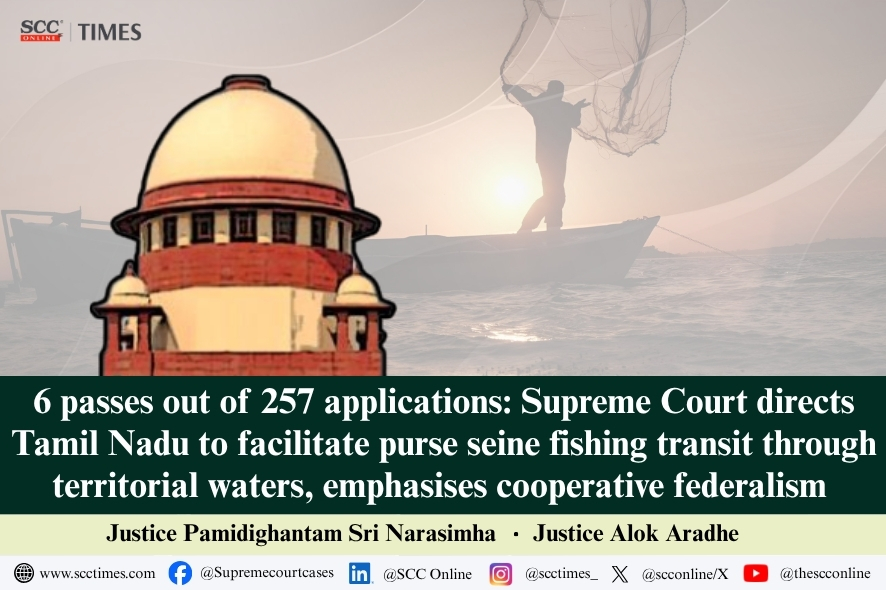
Supreme Court: Tamil Nadu Must Streamline Fishing Transit Passes
Summary
- The Supreme Court has directed Tamil Nadu to facilitate transit for purse seine fishing vessels through its territorial waters.
- The directive also mandates timely clearance of access passes for purse seine fishing in the Exclusive Economic Zone (EEZ).
- Only 6 out of 257 applications for fishing passes had been granted prior to the Court's intervention.
- The Supreme Court emphasized the principle of cooperative federalism in its instructions to the state.
- The ruling aims to improve operational compliance and inter-state resource access for fishing companies.
Supreme Court Mandates Fishing Transit Facilitation
Lawyers advising fishing companies in Tamil Nadu should be aware of the Supreme Court's directive on facilitating transit passes for purse seine fishing, which impacts operational compliance and inter-state resource access.
The Supreme Court of India has issued clear directives to the state of Tamil Nadu, compelling it to streamline the process for fishing vessels seeking transit through its territorial waters. These instructions specifically address the facilitation of movement for vessels engaged in purse seine fishing, a method that has been subject to regulatory scrutiny. The Court's intervention aims to ensure that fishing operations can proceed without undue hindrance, particularly when accessing designated fishing zones.
Beyond mere transit, the Supreme Court's order also mandates timely clearance for access passes, which are essential for purse seine fishing activities within the Exclusive Economic Zone (EEZ). This dual focus on both transit and timely access pass clearance underscores a judicial effort to balance state control over territorial waters with the operational needs of the fishing industry. The directive emerged in a context where, out of 257 applications for such passes, only a meager six had been granted, highlighting a significant bottleneck in the existing administrative process.
This ruling directly impacts the operational landscape for fishing companies, particularly those relying on purse seine fishing territorial waters India for passage to richer fishing grounds. The Supreme Court Tamil Nadu fishing transit passes directive is poised to alleviate bureaucratic delays that have historically hampered fishing vessel movements and access to the EEZ, thereby influencing the economic viability of these operations.
Emphasizing Cooperative Federalism in Fishing Rights
A cornerstone of the Supreme Court's recent directive to Tamil Nadu is its explicit emphasis on the principle of cooperative federalism. This legal doctrine, which promotes collaboration and mutual respect between central and state governments, is deemed crucial for the effective management of shared resources like marine fisheries. By invoking cooperative federalism fishing rights, the Court signals that state regulations, while legitimate, must not unduly impede national economic activities or the rights of citizens to access common resources under federal frameworks.
This judicial stance is particularly relevant in the context of EEZ fishing access passes Tamil Nadu, where state territorial waters often serve as transit routes to federally managed EEZ areas. The Supreme Court's directions Tamil Nadu fishing underscore the need for state authorities to act as facilitators rather than impediments, ensuring that their administrative processes align with broader national interests and inter-state harmony. The ruling suggests that a collaborative approach is necessary to resolve disputes and ensure equitable access to marine resources, preventing individual states from creating barriers that affect the fishing industry as a whole.
The Court's invocation of cooperative federalism aims to foster a more integrated approach to marine resource governance, where states work in concert to support sustainable fishing practices and economic activity. This principle is intended to guide Tamil Nadu in its future handling of fishing vessel transit and access pass applications, ensuring that state-level decisions contribute to a cohesive national policy on marine resource utilization.
Operational Impact and Legal Compliance
The Supreme Court's directive carries substantial implications for the operational compliance of fishing companies and the regulatory environment in Tamil Nadu. Lawyers advising fishing companies in Tamil Nadu should be aware of the Supreme Court's directive on facilitating transit passes for purse seine fishing, which impacts operational compliance and inter-state resource access. The mandate for timely access pass clearance for EEZ fishing access passes Tamil Nadu means that the state administration must now adopt a more efficient and responsive system for processing these critical permits, moving away from the previous low approval rate.
This ruling is expected to significantly improve the ease of doing business for fishing fleets, particularly those engaged in purse seine fishing territorial waters India. By ensuring smoother Tamil Nadu fishing vessel transit, the directive aims to reduce operational costs and increase fishing efficiency, as vessels will spend less time awaiting bureaucratic approvals and more time engaged in productive activities within the EEZ. The emphasis on facilitating transit through territorial waters is a direct response to the practical challenges faced by the industry, which often relies on these routes to reach distant fishing grounds.
Ultimately, the Supreme Court's intervention seeks to create a more predictable and supportive regulatory environment for the fishing sector. The directive serves as a clear signal to state authorities regarding their responsibilities in upholding principles of cooperative federalism and ensuring that administrative procedures do not inadvertently stifle legitimate economic activities. Compliance with these Supreme Court directions Tamil Nadu fishing will be crucial for both the state government and the fishing industry operating within its jurisdiction.
Practical Implications
Lawyers advising fishing companies in Tamil Nadu should be aware of the Supreme Court's directive on facilitating transit passes for purse seine fishing, which impacts operational compliance and inter-state resource access.
Source
Source: Original reporting via SCC Times
How does this affect you?
Get an AI analysis of this article grounded in your jurisdictions, practice areas, and any policy documents you've uploaded to Wansom.
Finish Reading the Full Story and the Expert Analysis.
Wansom is AI and can make mistakes.