
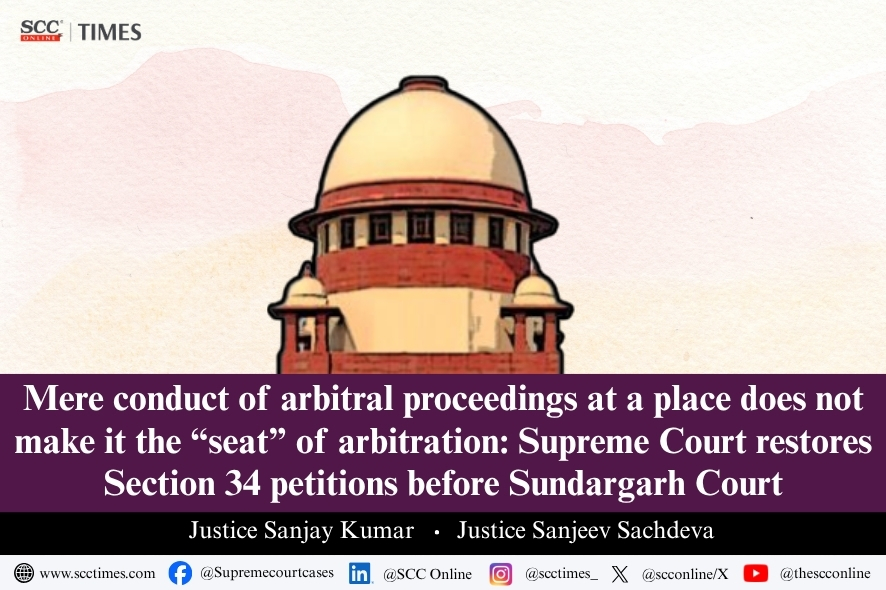
Supreme Court: Seat Of Arbitration Sundargarh Validates Section 34 Petitions
Summary
- The Supreme Court ruled that merely conducting arbitration proceedings in Cuttack did not establish it as the seat of arbitration.
- The Court upheld the maintainability of Section 34 petitions before the Sundargarh Court, confirming its jurisdiction.
- This decision clarifies the critical distinction between the 'seat' and 'venue' of arbitration under Indian law.
- The ruling emphasizes that the seat, not the venue, determines the supervisory court for challenging arbitral awards.
- The judgment underscores the importance of clearly defining the arbitration seat in agreements to prevent jurisdictional disputes.
Supreme Court Upholds Sundargarh Jurisdiction
The Supreme Court of India recently delivered a significant ruling clarifying the jurisdictional requirements for challenging arbitral awards, specifically affirming that the physical location where arbitration proceedings are conducted does not automatically establish the 'seat' of arbitration.
The Supreme Court of India recently delivered a significant ruling clarifying the jurisdictional requirements for challenging arbitral awards, specifically affirming that the physical location where arbitration proceedings are conducted does not automatically establish the 'seat' of arbitration. This decision directly impacted the maintainability of Section 34 petitions, with the apex court upholding their validity before the Sundargarh Court.
The core of the Supreme Court's determination revolved around a dispute where arbitral proceedings had taken place in Cuttack. Despite this, the Court concluded that Cuttack merely served as the venue for these proceedings, rather than the designated seat of arbitration. Consequently, the jurisdiction to hear challenges against the arbitral award, brought under Section 34 of the Arbitration and Conciliation Act, 1996, correctly lay with the Sundargarh Court, not a court associated with the Cuttack venue. This outcome reinforces a critical distinction in Indian arbitration law, emphasizing that the convenience of a meeting place does not dictate the supervisory court.
Distinguishing Seat from Venue in Arbitration
Under the Arbitration and Conciliation Act, 1996, the distinction between the 'seat' and 'venue' of arbitration is paramount, particularly when considering the jurisdiction to challenge an arbitral award. The 'seat' of arbitration determines the curial law governing the arbitration proceedings and, crucially, identifies the court with supervisory jurisdiction over the arbitration. This supervisory jurisdiction includes the power to entertain applications for interim measures, appoint arbitrators, and, most importantly, hear petitions to set aside an arbitral award under Section 34.
Conversely, the 'venue' refers to the geographical location where the arbitration hearings or meetings physically take place. It is often chosen for convenience, logistical reasons, or to facilitate witness testimony, but it does not, by itself, confer jurisdiction on the local courts. The Supreme Court's ruling underscores that while Cuttack served as the arbitration venue, it did not acquire the status of the arbitration seat, thereby preventing courts in Cuttack from exercising jurisdiction over the Section 34 petitions. This clarification is vital for understanding the proper forum for challenging arbitral awards in India.
Jurisdictional Implications for Section 34 Petitions
The Supreme Court's pronouncement on the arbitration seat in relation to the Sundargarh Court's jurisdiction provides critical guidance for the filing of Section 34 petitions across India. Section 34 of the Arbitration and Conciliation Act allows parties to challenge an arbitral award on specific grounds, such as incapacity of a party, invalidity of the arbitration agreement, or if the award is against public policy. The court competent to hear such a petition is exclusively determined by the designated seat of arbitration.
By affirming that the mere conduct of arbitral proceedings at a place like Cuttack does not make it the seat of arbitration, the Supreme Court has reinforced the principle that jurisdiction to challenge arbitral awards is not automatically transferred to the courts of the venue. This means that even if all hearings occur in one city, the supervisory jurisdiction remains with the courts of the chosen or determined seat. The decision ensures that the Sundargarh Court retained its jurisdiction to adjudicate the Section 34 petitions, aligning with the established legal framework for the Arbitration and Conciliation Act seat.
Why This Ruling Matters for Arbitration Practice
This Supreme Court ruling holds significant implications for arbitration practice, particularly concerning the drafting of arbitration agreements and the strategic filing of challenges to arbitral awards. It serves as a clear reminder to legal practitioners and parties involved in arbitration that explicit designation of the arbitration seat is paramount to avoid jurisdictional ambiguities and disputes. Without a clearly defined seat, parties risk protracted litigation over the appropriate forum for challenging awards, as seen in the case leading to the Sundargarh Court's upheld jurisdiction.
The judgment reinforces the need for meticulous attention to detail in arbitration clauses, ensuring that the chosen seat is unequivocally stated. This clarity helps prevent situations where a party might attempt to challenge an award in a court simply because it was the arbitration venue, rather than the legally recognized seat. Ultimately, the Supreme Court's stance promotes certainty and predictability in the enforcement and challenge of arbitral awards, streamlining the dispute resolution process and upholding the foundational principles of the Arbitration and Conciliation Act.
Practical Implications
This ruling clarifies the jurisdictional requirements for challenging arbitral awards under Section 34, emphasizing that the mere location of proceedings does not establish the seat. Lawyers must ensure arbitration agreements clearly define the seat to avoid jurisdictional disputes and correctly file challenges.
Source
Source: Original reporting via SCC Times
How does this affect you?
Get an AI analysis of this article grounded in your jurisdictions, practice areas, and any policy documents you've uploaded to Wansom.
Finish Reading the Full Story and the Expert Analysis.
Get the latest legal & regulatory intelligence in India
Wansom is AI and can make mistakes.