
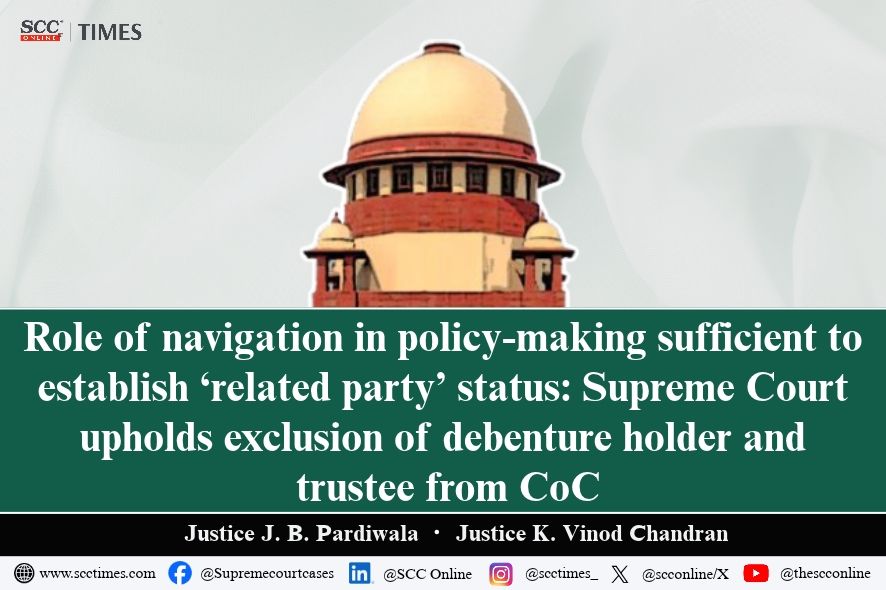
Supreme Court: Policy Navigation Makes Debenture Holder Related Party Under IBC
Summary
- The Supreme Court ruled that a role in policy-making navigation is sufficient to establish 'related party' status under the IBC.
- This decision upheld the exclusion of a debenture holder and a trustee from the Committee of Creditors.
- The ruling clarifies the interpretation of Section 5(24)(m)(i) of the Insolvency and Bankruptcy Code.
- The judgment emphasizes preventing conflicts of interest within the Committee of Creditors.
Supreme Court Clarifies 'Related Party' Test
This decision establishes that merely having a role in navigating policy and channeling business interests is sufficient to classify an entity as a related party, even without direct ownership or control.
The Supreme Court of India recently issued a significant ruling clarifying the criteria for determining 'related party' status under the Insolvency and Bankruptcy Code (IBC). This decision establishes that merely having a role in navigating policy and channeling business interests is sufficient to classify an entity as a related party, even without direct ownership or control.
This pivotal judgment specifically addressed the exclusion of a debenture holder and a trustee from the Committee of Creditors (CoC) in an insolvency proceeding. The Court upheld their removal, affirming that their involvement in guiding the corporate debtor's strategic direction met the threshold for related party classification under Section 5(24)(m)(i) of the IBC.
Legal Framework and Committee of Creditors Exclusion
The determination of 'related party' status carries substantial implications within the framework of the Insolvency and Bankruptcy Code. Entities designated as related parties are typically excluded from the Committee of Creditors, a crucial body responsible for making key decisions during the corporate insolvency resolution process. This exclusion is designed to prevent conflicts of interest and ensure that the CoC acts in the best interests of all genuine, unrelated financial creditors.
Section 5(24)(m)(i) of the IBC defines a 'related party' to include any person who is accustomed to act in accordance with the advice, directions or instructions of the corporate debtor, or vice versa. The Supreme Court's interpretation broadens the scope of this provision, emphasizing that a more subtle influence, such as policy-making navigation, can trigger this classification. This ruling provides a clearer benchmark for identifying such relationships, particularly concerning a debenture holder trustee related party status.
Impact on Insolvency Proceedings and Stakeholders
This judgment by the India Supreme Court on insolvency law has far-reaching consequences for various stakeholders involved in corporate insolvency resolution. It underscores the judiciary's commitment to maintaining the integrity and impartiality of the Committee of Creditors by preventing entities with potential conflicts of interest from influencing critical decisions. The ruling serves as a crucial precedent for future cases involving complex financial arrangements and inter-party relationships.
For legal practitioners, this decision necessitates a re-evaluation of client relationships and potential 'related party' designations. Lawyers must now advise clients on the implications for Committee of Creditors composition and potential challenges to their inclusion or exclusion in insolvency proceedings, especially where a policy-making navigation related party test might apply. The expanded definition means that even indirect influence through strategic guidance can lead to exclusion, impacting voting rights and the overall resolution process for a Supreme Court related party IBC debenture holder.
Practical Implications
This Supreme Court ruling clarifies the criteria for 'related party' status under the IBC, particularly for debenture holders and trustees, by establishing that a role in policy-making navigation is sufficient. Lawyers must advise clients on the implications for Committee of Creditors composition and potential challenges to their inclusion or exclusion in insolvency proceedings.
Source
Source: Original reporting via SCC Times
How does this affect you?
Get an AI analysis of this article grounded in your jurisdictions, practice areas, and any policy documents you've uploaded to Wansom.
Wansom is AI and can make mistakes.