
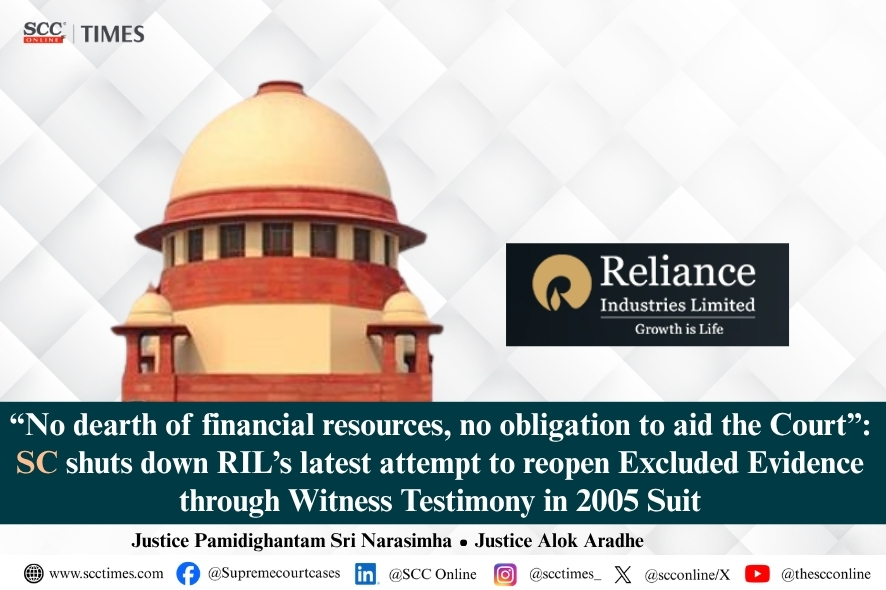
Supreme Court Rejects RIL's Bid to Introduce Excluded Documents Through Witness Testimony in IN 2005 Suit
Summary
- The Supreme Court rejected RIL's bid to introduce excluded documents through witness testimony in a 2005 suit, which remains ongoing.
- The court upheld the Bombay High Court's decision to redact certain documents and imposed a penalty of ₹10 lakh on RIL.
- The ruling reinforces the principle that excluded documents cannot be introduced through oral testimony, with significant implications for lawyers and their clients.
What Happened
The Supreme Court's reasoning highlights the need for lawyers and their clients to carefully consider the admissibility of evidence before introducing it in court.
The Supreme Court has dealt a significant blow to Reliance Industries (RIL) by rejecting its bid to introduce excluded documents through witness testimony in a 2005 suit, which remains ongoing. The court's ruling is a clear indication that the principle of excluding certain evidence from consideration cannot be circumvented using oral testimony. This decision has far-reaching implications for lawyers and their clients, as it reinforces the importance of adhering to established procedures for introducing new evidence.
In its judgment, the Supreme Court upheld the Bombay High Court's decision to redact certain documents and imposed a penalty of ₹10 lakh on RIL. The court's reasoning was that the contents of excluded documents cannot be introduced through oral testimony, and that doing so would undermine the integrity of the legal process.
Relevant Legal/Regulatory Context
The Supreme Court's ruling is a significant development in the ongoing debate over document admissibility in Indian courts. The court's decision to uphold the Bombay High Court's redaction and impose costs on RIL sends a strong message that lawyers must adhere to established procedures for introducing new evidence. This decision has implications not only for this particular case but also for future cases where similar issues may arise.
The Supreme Court's judgment is also noteworthy for its emphasis on the importance of maintaining the integrity of the legal process. The court's reasoning highlights the need for lawyers and their clients to carefully consider the admissibility of evidence before introducing it in court. This approach ensures that the legal process remains fair and unbiased, and that justice is served.
Why It Matters
The Supreme Court's ruling has significant implications for lawyers and their clients, as it reinforces the principle that excluded documents cannot be introduced through witness testimony. This decision may impact strategies for introducing new evidence in similar cases, and highlights the importance of adhering to established procedures for document admissibility. The court's emphasis on maintaining the integrity of the legal process also underscores the need for careful consideration of evidence before it is presented in court.
The practical implications of this ruling are far-reaching, and lawyers should take note of the Supreme Court's decision as they navigate similar cases in the future. By understanding the principles underlying this judgment, lawyers can better advise their clients on how to introduce new evidence while maintaining the integrity of the legal process.
Practical Implications
Lawyers should note that the Supreme Court's ruling reinforces the principle that excluded documents cannot be introduced through witness testimony, which may impact their clients' strategies for introducing new evidence in similar cases.
Source
Source: Original reporting via SCC Times
How does this affect you?
Get an AI analysis of this article grounded in your jurisdictions, practice areas, and any policy documents you've uploaded to Wansom.
Wansom is AI and can make mistakes.