
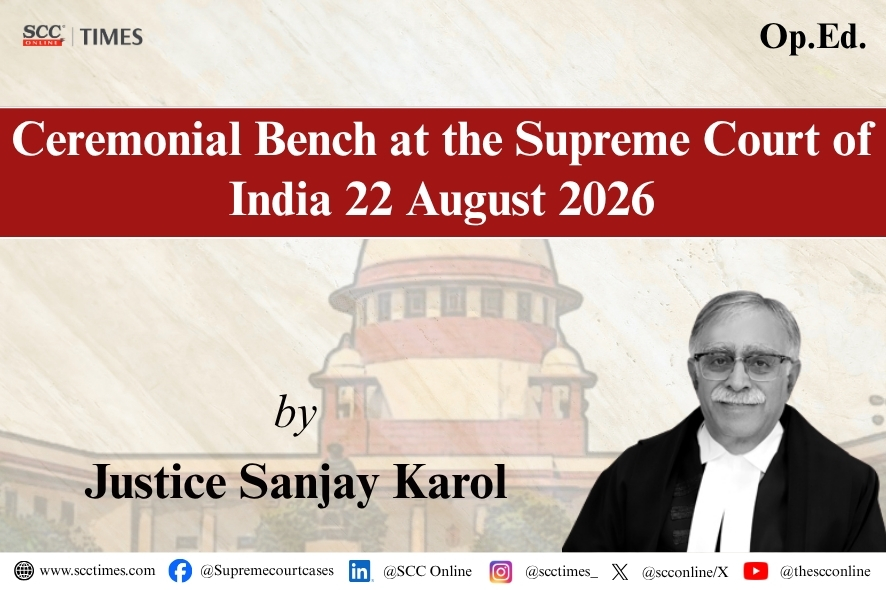
Justice Sanjay Karol: Farewell Supreme Court India, Reflects on Legacy
Summary
- Justice Sanjay Karol delivered his farewell address at the Supreme Court of India after a 40-year legal career, including 19 years as a judge.
- He emphasized that the judicial institution is greater than any individual, and a judge's legacy is defined by upholding justice and dignity.
- Justice Karol interpreted the "silences" in courtrooms as different forms of prayer, which judges must learn to hear.
- He noted that while the Bench appears authoritative from below, from above it signifies profound responsibility.
- He stressed that the court's true significance lies in providing a platform for ordinary citizens to be heard, while acknowledging significant barriers to access to justice.
A Distinguished Farewell
He underscored that his legacy should not be measured by outward displays of respect, but rather by whether he consistently upheld justice and treated all individuals with dignity during his tenure.
Justice Sanjay Karol recently delivered his farewell address at the Supreme Court of India, marking the culmination of a remarkable 40-year career in law, with nearly two decades spent on the bench. The ceremonial event, attended by Chief Justice of India Justice Surya Kant, Justice Mohana, the learned Attorney General, and representatives from the Supreme Court Bar Association (SCBA) and Supreme Court Advocates-on-Record Association (SCAORA), saw Justice Karol reflect deeply on his journey and the profound responsibilities of judicial office. Lawyers, both present in the courtroom and joining via video conferencing, along with his friends, witnessed the poignant occasion.
During his Justice Sanjay Karol farewell speech, he conveyed heartfelt gratitude to those who shaped his path: the legal community that educated him, colleagues who offered support, friends who celebrated his achievements, litigants who placed their trust in him, and his family for their unwavering presence. He acknowledged the traditional deference shown upon a judge's entry into a courtroom, noting that this custom would cease with his retirement. His family, he shared, had already indicated that this convention would not extend to their home, a gentle reminder, he suggested, that the judicial "chair" itself holds greater significance than the individual occupying it.
Justice Karol underscored that his legacy should not be measured by outward displays of respect, but rather by whether he consistently upheld justice and treated all individuals with dignity during his tenure. He admitted the difficulty of departing from an institution that had been central to his life for so long, yet he emphasized the enduring principle that institutions transcend any single person who passes through them. He viewed his role as a temporary custodian of the courtroom, a sacred trust inherited from predecessors and held for future generations, highlighting the collective and continuous nature of the Supreme Court India judicial values.
The Silent Language of Justice
Justice Karol delved into the profound "silences" he observed throughout his four decades in the legal profession, first as an advocate and then for nineteen years as a judge. He described these silences not as an absence of sound, but as distinct forms of prayer within the courtroom. He identified the quiet moment of a lawyer gathering courage before their initial argument as a prayer for strength, and the collective breath-holding just before a judgment is pronounced as a prayer for hope.
He further elaborated on the silence that follows an exceptionally ingenious argument, where the court pauses, struck by an unprecedented thought, interpreting it as a prayer of admiration. For Justice Karol, a judge's true calling extends beyond merely hearing legal arguments; it involves discerning these unspoken "prayers" that reside in the spaces between words. This unique insight into the human element of legal proceedings is something he expressed he would deeply miss from his position on the bench.
Recalling his first visit to Courtroom No. 1 of the Supreme Court in 1986, Justice Karol described the Bench as appearing grand, imposing, and almost six feet above the ground, seemingly unreachable to a young lawyer. His subsequent journey taught him the true symbolism of this elevated position. While from below it might signify authority, from the perspective of the Bench itself, its height primarily represents immense responsibility. This shift in perception underscores a core aspect of the Supreme Court India judicial values.
Upholding Constitutional Principles and Ensuring Access
The Supreme Court, Justice Karol noted, has been the forum for some of the most pivotal constitutional questions in the nation's history, addressed by distinguished members of the Bar. Decisions emanating from its hallowed halls extend far beyond its physical boundaries, profoundly influencing the lives of millions across the country. He articulated that the court's ultimate significance lies in its capacity to assure an ordinary citizen that, upon entering its doors, their voice will be heard. This principle is central to the concept of access to justice India judge.
However, Justice Karol also highlighted a critical challenge: the many individuals who never manage to reach the court's doors. He pointed out that justice can often be too remote, excessively expensive, overly intimidating, or simply too slow for a significant portion of the population. This observation underscores the ongoing imperative to address systemic barriers that impede equitable access to the legal system.
In his Justice Sanjay Karol retirement address, he reflected on the grand ideals of the legal profession, such as the Rule of Law and due process. His remarks implicitly call for continuous efforts to bridge the gap between these lofty principles and the practical realities faced by ordinary citizens seeking redress, emphasizing the critical role of lawyers Indian judiciary in ensuring these values are not just theoretical but practically accessible to all.
Practical Implications
This article provides valuable insight into the judicial philosophy and ethical considerations that guide the Indian Supreme Court, as articulated by a retiring Justice. Lawyers and compliance officers can use this to better understand the judiciary's perspective on constitutional values, access to justice, and the professional responsibilities of the bar, informing their advocacy and client advice within the Indian legal system.
Source
How does this affect you?
Get an AI analysis of this article grounded in your jurisdictions, practice areas, and any policy documents you've uploaded to Wansom.
Finish Reading the Full Story and the Expert Analysis.
Wansom is AI and can make mistakes.