
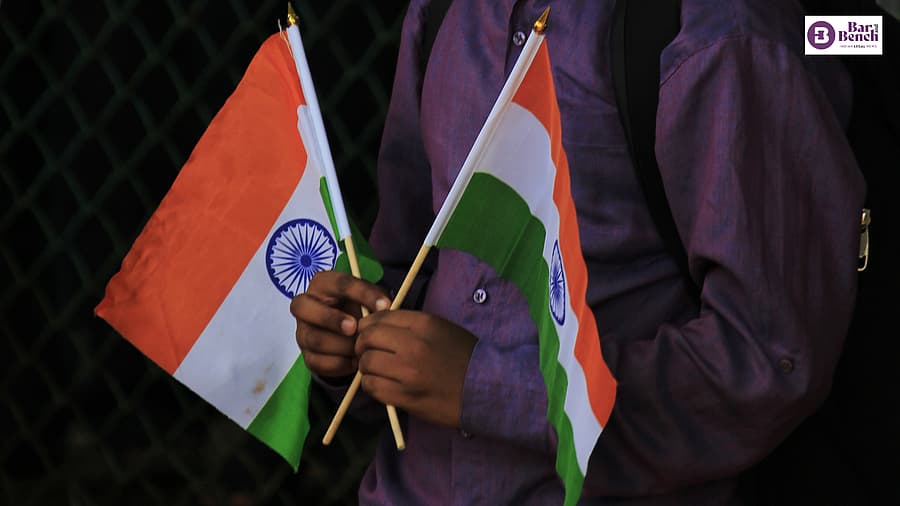
Supreme Court Dismisses Satya Jhanda National Flag Plea
Summary
- The Supreme Court dismissed a petition seeking to declare a self-designed "Satya Jhanda" as India's national flag.
- The litigant in person claimed his flag, linked to Sanatan Dharma, was a "weapon" in his fight for justice amidst a crisis.
- Justices Vikram Nath and Aparesh Kumar Singh questioned the petitioner on the constitutional and symbolic significance of the existing national flag.
- The Court emphasized that the Indian national flag is already established under law and cannot be replaced by a personal design.
- This ruling reinforces the legal and constitutional sanctity of the national flag, signaling judicial resistance to such challenges.
The Challenge to India's National Flag
This ruling reinforces the established legal and constitutional sanctity of India's national flag, indicating that courts will swiftly dismiss petitions seeking to alter its status or symbolic representation.
On a recent Monday, the Supreme Court of India addressed a unique petition brought by a litigant representing himself. The individual sought judicial endorsement for a flag of his own design, which he referred to as the "Satya Jhanda," or "flag of truth," demanding its official declaration as the national flag of India. This direct challenge to the established national symbol prompted immediate scrutiny from the apex court.
The Bench, comprising Justices Vikram Nath and Aparesh Kumar Singh, swiftly engaged with the petitioner. Their initial line of questioning focused on the fundamental constitutional and symbolic significance already vested in the existing national flag. This preliminary exchange set the tone for the proceedings, indicating the Court's firm stance on matters concerning national identity. The Supreme Court's decision to dismiss the Satya Jhanda national flag plea highlights the judiciary's role in safeguarding national symbols.
Petitioner's Arguments and Judicial Scrutiny
During the hearing, the petitioner articulated his motivations, asserting that he was confronting a significant crisis. He explained that he had unfurled his "Truth" flag at a temple, linking it to Sanatan Dharma, as a means to seek justice. He further elaborated, stating that this flag, based on "natural truth," served as his instrument or "weapon" in his personal struggle for justice.
The Supreme Court Bench, however, remained unconvinced by these submissions. Justices Nath and Singh directly inquired whether the petitioner's intention was for his self-created design to supplant the tricolour, which is India's universally recognized national flag. They pressed the petitioner on his understanding of the profound meaning and legal standing of the current national emblem, underscoring the gravity of his request for a national flag replacement petition.
Upholding Constitutional Significance
The Court's questioning underscored the well-established legal framework governing India's national flag. The Bench emphasized that the existing national flag is firmly rooted in law, possessing a defined constitutional and symbolic status that cannot be arbitrarily altered. This line of inquiry highlighted the judiciary's role in protecting the integrity of national symbols against individual challenges.
The dismissal of the petition by the Supreme Court effectively reinforced the constitutional significance of India's national flag. It sent a clear message that the process for establishing or altering national symbols is not subject to individual preference or personal design, but rather adheres to established legal and constitutional principles. The Satya Jhanda Supreme Court case thus affirmed the legal sanctity of the tricolour.
Reinforcing National Symbolism
The Supreme Court's decisive action on Monday, dismissing the plea to declare the "Satya Jhanda" as the national flag, serves as a significant reaffirmation of the nation's symbolic integrity. This ruling reinforces the established legal and constitutional sanctity of India's national flag, indicating that courts will swiftly dismiss petitions seeking to alter its status or symbolic representation. The swift and unequivocal rejection of the India national flag challenge underscores the judiciary's commitment to preserving the venerated status of the tricolour.
This outcome is crucial for maintaining the stability and respect accorded to national symbols. It signals that the Supreme Court views such attempts to introduce alternative designs as fundamentally misaligned with the constitutional and historical reverence associated with the national flag. The judgment by Justices Vikram Nath and Aparesh Kumar Singh in this flag case solidifies the understanding that the national flag is not merely a piece of cloth, but a deeply embedded representation of the nation's identity and values, protected by law.
Practical Implications
This ruling reinforces the established legal and constitutional sanctity of India's national flag, indicating that courts will swiftly dismiss petitions seeking to alter its status or symbolic representation. Lawyers should advise clients that such challenges are unlikely to succeed and may be deemed frivolous.
Source
How does this affect you?
Get an AI analysis of this article grounded in your jurisdictions, practice areas, and any policy documents you've uploaded to Wansom.
Finish Reading the Full Story and the Expert Analysis.
Get the latest legal & regulatory intelligence in India
Wansom is AI and can make mistakes.