
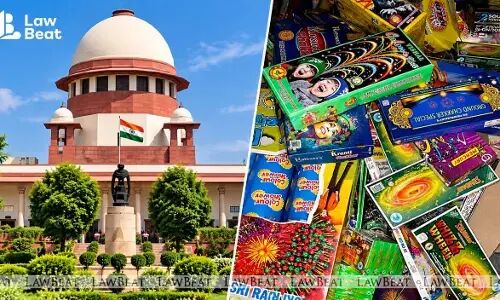
Supreme Court: Delhi Diwali Firecracker Ban Left to CAQM
Summary
- The Supreme Court heard a suo motu case concerning air pollution and firecrackers in Delhi-NCR, but issued no immediate directives.
- The court instructed the Commission for Air Quality Management (CAQM) to provide its view on the matter, with the next hearing scheduled for October 15.
- A ban on firecrackers is currently in force, and the court did not change this position on Monday.
- Chief Justice of India Surya Kant suggested public awareness campaigns and promoting diyas as alternatives to restrictive orders.
- Any potential relaxation of the ban will depend on the CAQM's recommendations and the Supreme Court's decision at the October 15 hearing.
Supreme Court Deliberates on Diwali Firecracker Ban
Any potential relaxation of these India firecracker regulations will hinge critically on the view taken by the Commission for Air Quality Management firecrackers and the subsequent discussions during the October 15 Supreme Court hearing firecrackers.
The Supreme Court recently addressed the ongoing issue of air pollution and solid waste management within the Delhi-National Capital Region, a suo motu case that specifically includes considerations for permitting firecrackers during the upcoming Diwali festival. During its recent session, the apex court refrained from issuing any immediate directives regarding the firecracker situation. Instead, it instructed that all relevant suggestions be submitted to the Commission for Air Quality Management (CAQM), tasking the commission with formulating its official stance on the matter.
The court's decision underscores a cautious approach to the sensitive topic, which balances environmental concerns with cultural practices. The next hearing in this significant case is scheduled for October 15, a date that will likely bring more clarity following the CAQM's review. This development is particularly relevant for those involved in the firecracker trade across Delhi-NCR, as the outcome could significantly impact their operations and the broader India firecracker regulations.
Judicial Perspectives on Regulation and Public Awareness
Chief Justice of India Surya Kant articulated the judiciary's need for extreme prudence before issuing any orders that could have widespread implications. He suggested that a more effective strategy might involve educating the public about the environmental impact of harmful firecrackers and promoting alternative celebrations, such as lighting traditional diyas. The Chief Justice proposed that authorities could disseminate information encouraging minimal firecracker use, possibly within fixed timeframes, and also monitor market availability to restrict the sale of particularly damaging types.
Justice Surya Kant further observed that overly restrictive orders can sometimes be perceived as coercive by the public. He noted that there is ample time before the festival to engage in public appeals for celebrating within specified hours, which he believed could be more effective than outright bans. He also affirmed the court's commitment to not infringe upon religious sentiments. Echoing the court's underlying concerns, Justice Joymalya Bagchi emphasized that the primary motivation behind the court's involvement in the Diwali air pollution Supreme Court case is the protection of public health.
Current Ban Status and Future Implications
Senior Advocate J Sai Deepak, representing a federation of firework traders, informed the court that a comprehensive ban on firecrackers is currently in effect across the region. The Supreme Court bench, during its recent hearing, did not alter this existing prohibition, meaning the ban remains in place for now. Any potential relaxation of these India firecracker regulations will hinge critically on the view taken by the Commission for Air Quality Management firecrackers and the subsequent discussions during the October 15 Supreme Court hearing firecrackers.
This ongoing legal process creates a period of uncertainty for firework manufacturers, distributors, and retailers in Delhi-NCR. The CAQM's recommendations and the court's eventual decision will be pivotal in determining the scope of permissible firecracker activities, if any, for the upcoming Diwali celebrations. The outcome will shape not only environmental policy but also the commercial landscape for the firework industry in the capital region.
Practical Implications
Lawyers advising firework manufacturers, distributors, or retailers in Delhi-NCR must closely monitor the CAQM's recommendations and the Supreme Court's October 15 hearing for any potential changes to the existing firecracker ban or new guidelines on permissible types and usage, which could impact sales and compliance obligations.
Source
How does this affect you?
Get an AI analysis of this article grounded in your jurisdictions, practice areas, and any policy documents you've uploaded to Wansom.
Finish Reading the Full Story and the Expert Analysis.
Get the latest legal & regulatory intelligence in India
Wansom is AI and can make mistakes.