
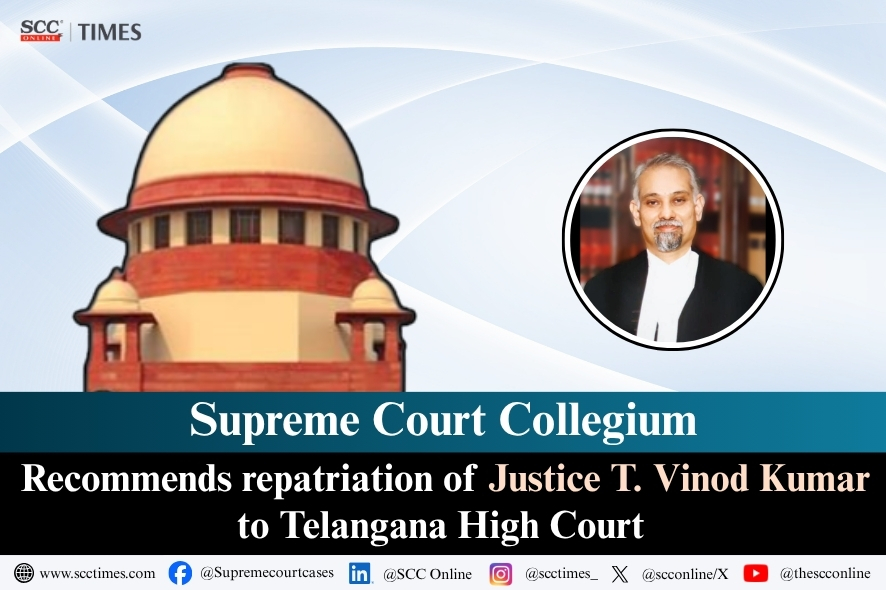
Supreme Court Collegium: Justice T Vinod Kumar Repatriation to Telangana
Summary
- The Supreme Court Collegium has recommended the repatriation of Justice T. Vinod Kumar.
- Justice T. Vinod Kumar is to be repatriated to the Telangana High Court.
- This decision is due to Justice T. Vinod Kumar's scheduled retirement in November 2026.
What Happened
The Supreme Court Collegium has formally recommended the repatriation of Justice T. Vinod Kumar to the Telangana High Court.
The Supreme Court Collegium has formally recommended the repatriation of Justice T. Vinod Kumar to the Telangana High Court. This administrative decision marks a significant development in the ongoing management of judicial postings within the Indian High Court system. The recommendation specifically concerns Justice T. Vinod Kumar's return to his parent High Court, a standard procedure often undertaken in anticipation of a judge's superannuation.
The primary rationale behind this particular recommendation by the Collegium is Justice T. Vinod Kumar's impending retirement. His superannuation date is set for November 2026, making this repatriation a forward-looking administrative measure. Such decisions are integral to ensuring a smooth transition in judicial benches and maintaining the operational efficiency of High Courts across the nation.
Judicial Administration and Collegium's Role
This recent recommendation by the Supreme Court Collegium regarding Justice T. Vinod Kumar underscores its pivotal role in the Indian judiciary's administrative framework. The Collegium, comprising the Chief Justice of India and the four senior-most judges of the Supreme Court, is responsible for making recommendations for the appointment and transfer of judges to the High Courts and the Supreme Court. Repatriation, in this context, refers to the process of a judge being sent back to their original High Court, often after a period of service in another High Court following a transfer. This falls squarely within the Collegium's purview for overseeing judicial personnel movements.
The process of High Court judge repatriation in India is a critical component of judicial governance, ensuring that judicial resources are appropriately allocated and managed. Decisions like the one concerning Justice T. Vinod Kumar are part of the broader Indian judiciary appointments news, reflecting the continuous administrative adjustments made to optimize judicial functioning. These recommendations are typically made after careful consideration of various factors, including the judge's tenure, the needs of the respective High Courts, and impending retirements, as is the case here with Justice T. Vinod Kumar's retirement in November 2026.
Significance for Telangana High Court
The recommendation for Justice T. Vinod Kumar's repatriation to the Telangana High Court holds administrative significance for the institution. While not a new appointment, such a move impacts the composition and experience pool of the High Court, particularly as it anticipates a judge's eventual departure. The return of a judge, especially one nearing the end of their tenure, allows for a planned transition and ensures that the court's judicial strength remains robust.
This specific decision, focusing on Justice T. Vinod Kumar's return ahead of his November 2026 retirement, highlights the proactive approach taken by the Supreme Court Collegium Justice Vinod Kumar in managing judicial transitions. It is a routine yet essential aspect of maintaining the structural integrity and operational continuity of the High Courts. Such administrative actions, while not directly impacting legal precedents, are crucial for the efficient functioning of the judicial system and are closely watched in the realm of Indian judiciary appointments news. The movement of a Telangana High Court judge, even through repatriation, is a key administrative event.
Practical Implications
This news concerns an administrative decision regarding a judicial posting. It does not present a direct, actionable legal or compliance implication for practicing lawyers or compliance officers, serving primarily as an informational update on judicial personnel changes.
Source
Source: Original reporting via SCC Times
How does this affect you?
Get an AI analysis of this article grounded in your jurisdictions, practice areas, and any policy documents you've uploaded to Wansom.
Finish Reading the Full Story and the Expert Analysis.
Get the latest legal & regulatory intelligence in India
Wansom is AI and can make mistakes.