
Sudan Loses OPCW Council Seat Amid Chemical Weapons Allegations
Summary
- Sudan has lost its seat on the Organisation for the Prohibition of Chemical Weapons (OPCW) Executive Council.
- This decision follows mounting international pressure and allegations of chemical weapons use by the Sudanese Armed Forces.
- The United States concluded in April 2025 that Sudan used chemical weapons, imposing sanctions.
- OPCW Director-General Sabrina Dallafior has urged member states to share evidence and offered technical assistance for Sudan's investigation.
- The UK has called for a thorough and transparent national investigation into the increasingly systematic chemical weapons allegations.
Diplomatic Repercussions at the OPCW
The loss of this influential seat underscores the severe diplomatic consequences that can arise from non-compliance with international chemical weapons prohibitions.
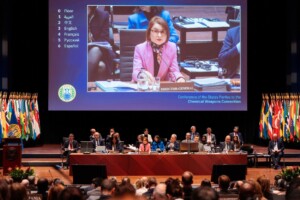
Sudan has been removed from its position on the Executive Council of the Organisation for the Prohibition of Chemical Weapons (OPCW), a significant development amidst escalating international scrutiny regarding allegations of chemical weapons deployment during the ongoing conflict within the nation. This decision was finalized during the 31st Conference of the States Parties, which recently concluded in The Hague, Netherlands. The loss of this influential seat underscores the severe diplomatic consequences that can arise from non-compliance with international chemical weapons prohibitions.
The vacancy created by Sudan's departure will be filled by new representatives from the African continent. Morocco, Angola, Cameroon, Tanzania, and Tunisia were elected on Tuesday to serve on the 41-member council, with their terms commencing in 2027. This shift in representation highlights the global body's commitment to upholding the Chemical Weapons Convention, even as it navigates complex geopolitical situations and allegations of violations. The move signals a clear message regarding the international community's expectations for adherence to established norms against chemical warfare.
Escalating International Scrutiny and Evidence
The removal of Sudan from the OPCW Executive Council follows a period of intense international pressure and a series of detailed reports concerning the alleged use of chemical weapons by the Sudanese Armed Forces (SAF). In April 2025, the United States formally concluded that the SAF had indeed utilized chemical weapons, a direct contravention of international law. This finding led to immediate sanctions imposed by Washington against Sudan, marking a significant escalation in the international response to the conflict.
Further pressure was applied by the United States in March 2026, when it explicitly warned that Sudan's continued presence on the Executive Council would be re-evaluated unless the chemical weapons allegations were promptly and thoroughly addressed. This diplomatic threat was reinforced by subsequent investigative journalism. In September 2026, both The New York Times and The Washington Post published extensive reports, building upon earlier coverage by France 24 from the previous year, which detailed additional evidence regarding Sudan's alleged production and deployment of chemical weapons. These reports collectively painted a concerning picture of the situation on the ground.
Calls for Investigation and Technical Assistance
During the recent conference, Sabrina Dallafior, the Director-General of the OPCW, confirmed that the case involving Sudan remains an active concern for the Executive Council. She issued a public appeal for member states possessing relevant evidence to come forward and share it, even if confidentially, to aid the ongoing assessment. Dallafior expressed disappointment that, despite widespread media reporting and internal OPCW discussions, the Secretariat had yet to receive detailed information regarding the allegations.
The United Kingdom also reiterated its demand for a credible and comprehensive investigation into the claims. In a statement delivered to the conference on November 24, London emphasized that reports indicated an increasingly systematic pattern of chemical weapons use. The UK warned that if these allegations were substantiated, they would pose a severe threat not only to the Sudanese population but also to the stability of the broader region. Britain urged Sudan to conduct a thorough, transparent, impartial, and credible national investigation, and to fully disclose its findings to the OPCW, while the Director-General has offered technical assistance to support Sudan's own national inquiry, hoping its conclusions will be shared with all member states.
Practical Implications
Lawyers and compliance officers advising clients with interests in Sudan should note the severe international repercussions for alleged chemical weapons use, including loss of diplomatic standing and potential for further sanctions. This development underscores the critical need to monitor international investigations and ensure robust compliance frameworks to mitigate exposure to international legal and financial penalties.
Source
How does this affect you?
Get an AI analysis of this article grounded in your jurisdictions, practice areas, and any policy documents you've uploaded to Wansom.
Finish Reading the Full Story and the Expert Analysis.
Get the latest legal & regulatory intelligence in Sudan
Wansom is AI and can make mistakes.