
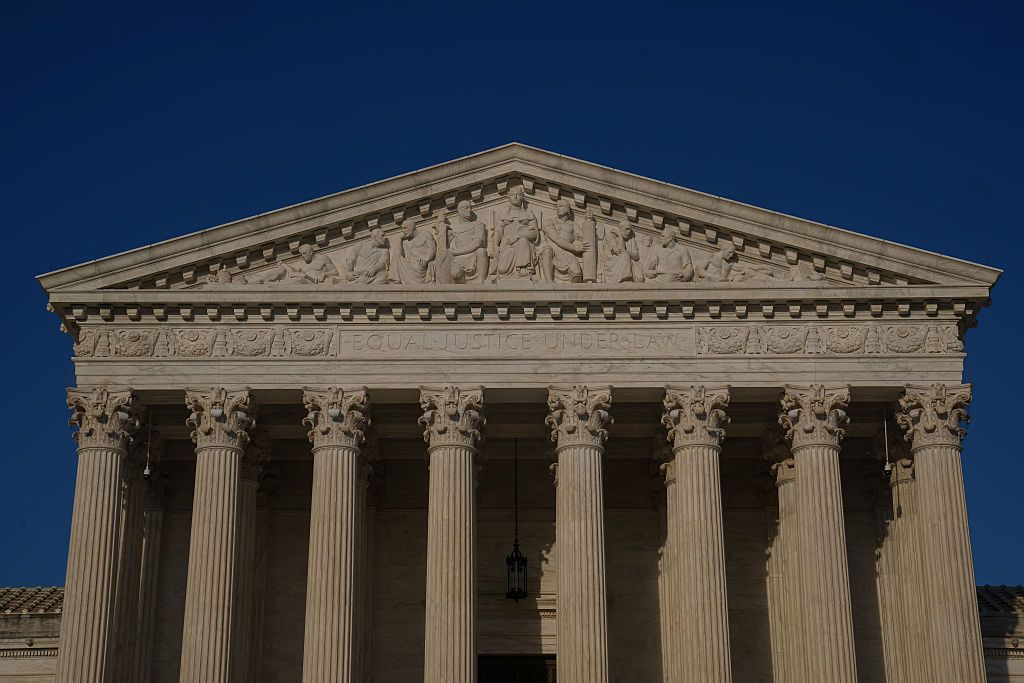
SCOTUS Hears St. Mary Catholic Parish v. Roy: Free Exercise Standard Shift?
Summary
- The Supreme Court heard arguments in St. Mary Catholic Parish v. Roy regarding conditions for religious organizations participating in Colorado's universal preschool program.
- Colorado's program requires participating schools to ensure equal enrollment opportunities regardless of various protected characteristics, including sexual orientation and gender identity.
- St. Mary Catholic Parish and two parents challenged this anti-discrimination clause, arguing it infringes on religious freedom.
- Conservative justices indicated a potential willingness to consider a law's discriminatory effect against religion as sufficient for a Free Exercise violation.
- This approach, termed "Roberts court free exercise exceptionalism," would differ significantly from the Equal Protection standard, where disparate impact alone is usually insufficient to prove discrimination.
What Happened
If the Supreme Court adopts a standard where discriminatory effect alone is sufficient to prove a Free Exercise violation, it could fundamentally alter how religious institutions engage with public funding and operate within state regulatory frameworks.
The Supreme Court recently heard oral arguments in St. Mary Catholic Parish v. Roy, a case that scrutinizes the conditions under which religious organizations can participate in state-funded programs. The dispute centers on Colorado's universal preschool program, launched in 2024, which offers financial support for children to attend various preschools, including public, secular private, and faith-based institutions. However, a key stipulation for receiving these public funds requires participating schools to guarantee equal enrollment opportunities and services to all eligible children, irrespective of their race, ethnicity, religious affiliation, sexual orientation, gender identity, housing status, income level, or disability.
St. Mary Catholic Parish, located in Littleton, Colorado, operates a Catholic preschool and, along with two parents, challenged this condition. Their argument suggests that the anti-discrimination clause infringes upon their religious freedom. During the oral arguments on November 3, several conservative justices on the bench indicated a potential inclination towards a legal standard where a law's discriminatory effect against a religious group could be sufficient grounds for invalidation.
Legal Context
This case brings into sharp focus the interplay between two fundamental constitutional protections: the First Amendment's Free Exercise Clause and the 14th Amendment's Equal Protection Clause. Historically, proving discrimination under the Equal Protection Clause has been a high bar; courts have consistently held for over half a century that a disparate impact—where seemingly neutral policies disproportionately affect a particular group—is generally not enough to establish discrimination without evidence of discriminatory intent. The St. Mary Catholic Parish v. Roy case, however, introduces the possibility of a different standard for religious freedom claims.
The discussions at the Supreme Court hinted at what some observers term "Roberts court free exercise exceptionalism," suggesting that it might become easier to demonstrate discrimination under the Free Exercise Clause than under the Equal Protection Clause. This potential shift implies that a law's adverse effect on a religious practice, even without explicit discriminatory intent, could be deemed unconstitutional. Such an approach would mark a significant departure from established Equal Protection jurisprudence regarding disparate impact.
Why It Matters
The outcome of St. Mary Catholic Parish v. Roy carries substantial implications for religious organizations and the broader legal landscape concerning religious freedom and anti-discrimination policies. If the Supreme Court adopts a standard where discriminatory effect alone is sufficient to prove a Free Exercise violation, it could fundamentally alter how religious institutions engage with public funding and operate within state regulatory frameworks. This ruling could establish a precedent making it considerably easier for religious entities to challenge government regulations that, while neutral on their face, disproportionately impact their religious practices.
Such a decision could lead to a re-evaluation of compliance strategies for religious institutions, particularly those that receive public funds or wish to do so. It would necessitate a closer examination of the conditions attached to government programs and how they intersect with religious tenets. The potential for "free exercise exceptionalism" from the Roberts court could empower religious organizations to assert their rights more broadly, potentially impacting the scope of anti-discrimination protections in various public and private spheres.
Practical Implications
Lawyers and compliance officers should closely monitor the outcome of St. Mary Catholic Parish v. Roy, as a ruling favoring 'free exercise exceptionalism' could significantly alter the legal landscape for religious organizations, making it easier to prove discrimination under the Free Exercise Clause than under the Equal Protection Clause. This could impact how religious institutions operate, particularly concerning anti-discrimination policies and conditions for receiving public funding, requiring a re-evaluation of compliance strategies.
Source
How does this affect you?
Get an AI analysis of this article grounded in your jurisdictions, practice areas, and any policy documents you've uploaded to Wansom.
Finish Reading the Full Story and the Expert Analysis.
Get the latest legal & regulatory intelligence in United States
Wansom is AI and can make mistakes.