
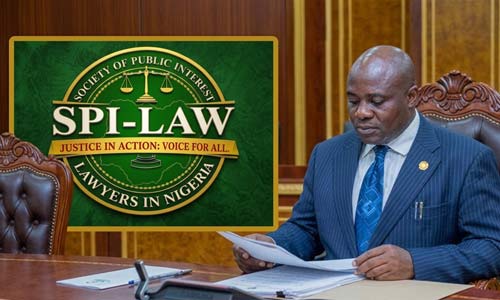
SPI-LAW Challenges Imo AG: NJC Directive on Chief Judge Appointment
Summary
- The Society of Public Interest Lawyers in Nigeria (SPI-LAW) has cautioned the Imo State Attorney-General, Hon. Paul Obinatu, over actions that could undermine the constitutional process for appointing a Chief Judge.
- This warning specifically concerns a National Judicial Council (NJC) directive related to Justice Agugua.
- SPI-LAW has threatened to file a petition with the Legal Practitioners Disciplinary Committee (LPDC) against the Attorney-General if professional misconduct is proven.
- The group emphasizes that the Judicial Service Commission (JSC) operates as an autonomous body, distinct from the Ministry of Justice.
- The dispute highlights the importance of judicial independence and adherence to constitutional protocols in judicial appointments.
The Dispute Unfolds
SPI-LAW's stance implicitly asserts that the JSC operates as an autonomous body, separate from the executive branch and specifically not as a subordinate department of the Ministry of Justice.
The Society of Public Interest Lawyers in Nigeria (SPI-LAW) has issued a stern warning to the Imo State Attorney-General and Commissioner for Justice, Hon. Paul Obinatu. This caution specifically addresses actions that SPI-LAW believes could compromise the established constitutional procedure for appointing a substantive Chief Judge within the state. The legal advocacy group underscored the gravity of any attempts to subvert this critical process.
At the heart of the contention is a directive from the National Judicial Council (NJC) concerning Justice Agugua. SPI-LAW's intervention signals a deep concern that the Attorney-General's conduct might be at odds with this directive, thereby potentially undermining the integrity of judicial appointments. The group has made it clear that it is closely monitoring the situation, prepared to act should their concerns prove valid.
Furthermore, SPI-LAW has not shied away from outlining potential repercussions for the Imo State Attorney-General, Paul Obinatu. The organization has explicitly threatened to file a petition with the Legal Practitioners Disciplinary Committee (LPDC) if it is conclusively demonstrated that professional misconduct has occurred. This threat highlights the serious nature of the allegations and the commitment of SPI-LAW to uphold ethical standards within the legal profession.
Upholding Judicial Independence
The core of SPI-LAW's challenge to the Imo State Attorney-General, Paul Obinatu, revolves around the fundamental principle of judicial independence, particularly as it pertains to the appointment of a Chief Judge. The constitutional framework for such appointments is designed to safeguard the judiciary from undue influence, ensuring that the process is merit-based and free from political interference. The National Judicial Council's directive concerning Justice Agugua is a crucial element in this framework, serving as a guiding principle for states in their judicial selection processes.
A key aspect of this independence is the distinct role of the Judicial Service Commission (JSC). SPI-LAW's stance implicitly asserts that the JSC operates as an autonomous body, separate from the executive branch and specifically not as a subordinate department of the Ministry of Justice. This distinction is vital for maintaining the integrity of judicial appointments and ensuring that the judiciary can function without external pressures. Any action perceived as blurring these lines or attempting to control the JSC's functions would be seen as a direct threat to the constitutional order.
The intervention by the Society of Public Interest Lawyers Nigeria underscores the importance of adhering strictly to these established legal and constitutional protocols. Their warning to the Imo State Attorney-General Paul Obinatu serves as a reminder that the process for appointing a substantive Chief Judge is not merely an administrative task but a cornerstone of democratic governance and the rule of law. Deviations from the National Judicial Council directive or attempts to circumvent the Judicial Service Commission's independence could set a dangerous precedent.
Implications for Professional Conduct
The dispute initiated by the Society of Public Interest Lawyers in Nigeria carries significant implications, particularly for the professional standing of the Imo State Attorney-General, Hon. Paul Obinatu. The explicit threat of an LPDC petition is not to be taken lightly, as such a petition can lead to severe disciplinary actions for legal practitioners, ranging from reprimands to disbarment, if professional misconduct is proven. This potential outcome places a spotlight on the ethical responsibilities of high-ranking legal officials in upholding the constitution and the integrity of the justice system.
Beyond the individual consequences for the Attorney-General, this challenge highlights broader concerns regarding the governance of the judiciary in Imo State. The resolution of this matter will inevitably clarify the boundaries of executive authority in judicial appointments and reinforce the constitutional safeguards designed to protect judicial independence. It serves as a critical test case for how directives from national judicial bodies, like the National Judicial Council, are respected and implemented at the state level.
The public nature of SPI-LAW's warning ensures that the actions of the Imo State Attorney-General Paul Obinatu will be subject to increased scrutiny. The outcome of this dispute, whether it leads to a formal LPDC petition or a clarification of roles, will undoubtedly influence public perception of judicial autonomy and the commitment of state actors to constitutional principles. This situation underscores the continuous need for vigilance in protecting the foundational elements of a fair and impartial justice system.
Practical Implications
Lawyers in Imo State should monitor the resolution of this dispute regarding the Chief Judge appointment process, as it may clarify constitutional boundaries for judicial independence and the role of the Attorney-General. It also signals potential professional conduct implications for the AG via the threatened LPDC petition.
Source
How does this affect you?
Get an AI analysis of this article grounded in your jurisdictions, practice areas, and any policy documents you've uploaded to Wansom.
Finish Reading the Full Story and the Expert Analysis.
Get the latest legal & regulatory intelligence in Nigeria
Wansom is AI and can make mistakes.