
South Africa Fuel Price Adjustment October 2026: Major Increases Set
Summary
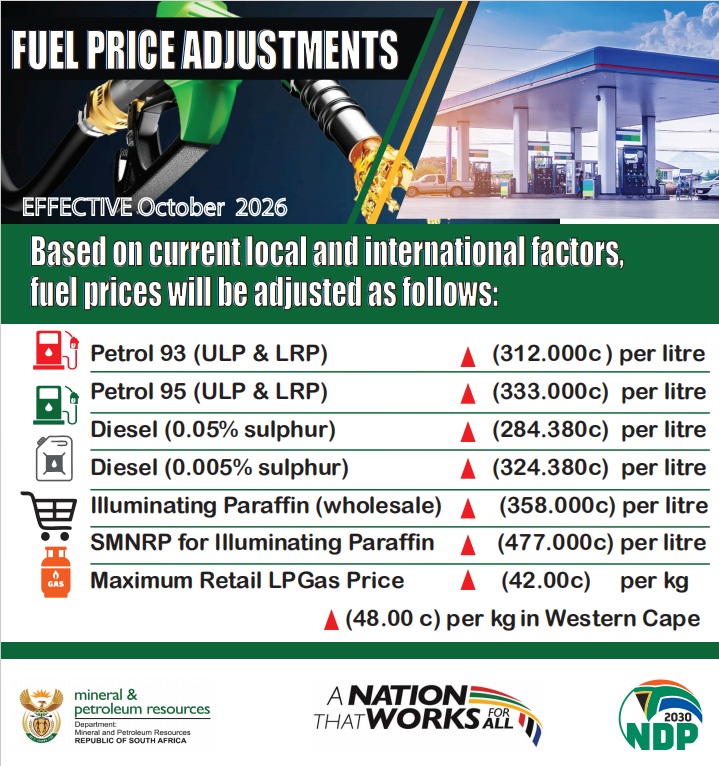
- South Africa's fuel prices will increase from October 7, 2026, with Petrol 93 rising by 312.000 c/l, Petrol 95 by 333.000 c/l, and Diesel by 284.000 c/l.
- The Minister of Mineral and Petroleum Resources announced these adjustments, citing a surge in Brent Crude oil prices to $101 USD due to geopolitical tensions and supply concerns.
- International petroleum product prices for petrol, diesel, and illuminating paraffin also increased due to global supply shortages and lower inventories.
- A cumulative negative slate balance of R10.45 billion led to a slate levy of 87.66 cents per litre being implemented for petrol and diesel, effective September 2, 2026.
- LPGas prices were set, with the Maximum Refinery Gate Price for Saldanha Bay imports at R15,525.62 per metric ton and the Maximum Retail Price at R37.08 per kilogram.
South Africa Fuel Prices Set for October 2026 Adjustment
The recurring implementation of the slate levy, designed to manage under-recovery of fuel costs, necessitates continuous monitoring by businesses with significant transport or energy dependencies.
South Africa is poised for a significant fuel price adjustment effective October 7, 2026, as announced by the Minister of Mineral and Petroleum Resources, Msizi Nyalungu. The forthcoming changes reflect a complex interplay of both international and domestic market dynamics. Consumers of Petrol 93 (ULP & LRP) will see an increase of 312.000 cents per litre, while Petrol 95 (ULP & LRP) is set to rise by 333.000 cents per litre. Diesel with 0.05% sulphur content will also experience an upward adjustment of 284.000 cents per litre.
These adjustments are part of the country's regular monthly fuel price regulation South Africa mechanism, which takes into account a range of factors influencing the Basic Fuel Price South Africa. Beyond petrol and diesel, the Maximum Refinery Gate Price (MRGP) for LPGas imported through the Port of Saldanha Bay in the Western Cape province has been set at R15,525.62 per metric ton, with the Maximum Retail Price (MRP) at R37.08 per kilogram, also effective from October 7, 2026. This comprehensive South Africa fuel price adjustment October 2026 underscores the volatility inherent in global energy markets.
Key Drivers Behind the Price Hikes
Several critical factors contributed to the substantial petrol diesel price increase ZA. Internationally, the average Brent Crude oil price surged from 87.89 US Dollars (USD) to 101 USD during the review period. This escalation is primarily attributed to ongoing US/Iran tensions, persistent uncertainty surrounding oil flow through the Strait of Hormuz, elevated shipping costs, and a general decline in global inventories. As South Africa imports both crude oil and finished petroleum products, these international price movements directly impact local costs, including associated importation expenses.
Furthermore, international petroleum product prices for petrol, diesel, and illuminating paraffin all saw increases, driven by supply shortages stemming from reduced global product inventories. These factors significantly boosted the Basic Fuel Price (BFP) contributions: petrol by 329.07 cents per litre, diesel by 280.17 cents per litre, and illuminating paraffin by 357.23 cents per litre. Prices for Propane and Butane also climbed due to prevailing supply uncertainties. A slight appreciation of the Rand against the US Dollar, moving from 16.213 to 16.212 Rand per USD, offered a marginal offset, reducing BFP contributions by 0.17 c/l for petrol, 0.22 c/l for diesel, and 0.21 c/l for illuminating paraffin.
The Impact of the ZA Slate Levy Increase 2026 and Octane Differentials
A significant domestic factor influencing the October 2026 fuel prices is the implementation of the slate levy. By the end of August 2026, the cumulative slate reflected a negative balance of R10.45 billion specifically for petrol and diesel. In response to this, and in accordance with the Self-Adjusting Slate Levy Mechanism, a slate levy of 87.66 cents per litre was implemented in the price structures of petrol and diesel, effective from September 2, 2026. This represents a 4.38 cents per litre increase from the previous levy of 83.28 cents per litre, highlighting the ongoing financial pressures on the fuel industry.
Another regulatory adjustment concerns the octane differentials between 95 and 93 petrol grades. Under the Working Rules for determining the Basic Fuel Prices, 95 Octane (unleaded) serves as the price-marker grade. The BFP-differential between 95 and 93 Octanes is adjusted quarterly, specifically on the first Wednesday of each quarter. Given a change in this differential during the preceding quarter, the retail prices for 95 and 93 petrol octanes will now vary across different fuel-pricing zones throughout the country, commencing October 7, 2026. This nuanced approach to fuel price regulation South Africa ensures that specific product characteristics are accounted for in the final pricing structure.
Broader Implications for Businesses and Consumers
The latest South Africa fuel price adjustment October 2026, announced by the Minister Mineral Petroleum Resources fuel, carries substantial implications for both businesses and individual consumers. For companies, particularly those in logistics, manufacturing, and agriculture, these increases will directly impact operational budgets and supply chain costs. The recurring implementation of the slate levy, designed to manage under-recovery of fuel costs, necessitates continuous monitoring by businesses with significant transport or energy dependencies.
These monthly adjustments, driven by a combination of global geopolitical events, international supply and demand dynamics, and domestic regulatory mechanisms like the ZA slate levy increase 2026, underscore the persistent volatility in the energy sector. Stakeholders must remain vigilant regarding these changes, as they ripple through the economy, affecting everything from commodity prices to consumer spending power. The LPGas price adjustment South Africa also adds to the overall cost of living and doing business, particularly for sectors reliant on this energy source.
Practical Implications
Lawyers and compliance officers should advise clients on the direct cost implications of these fuel price adjustments for operational budgets and review existing contracts with fuel escalation clauses. The recurring slate levy mechanism requires ongoing monitoring for businesses with significant transport or energy dependencies.
Source
How does this affect you?
Get an AI analysis of this article grounded in your jurisdictions, practice areas, and any policy documents you've uploaded to Wansom.
Finish Reading the Full Story and the Expert Analysis.
Get the latest legal & regulatory intelligence in South Africa
Wansom is AI and can make mistakes.