
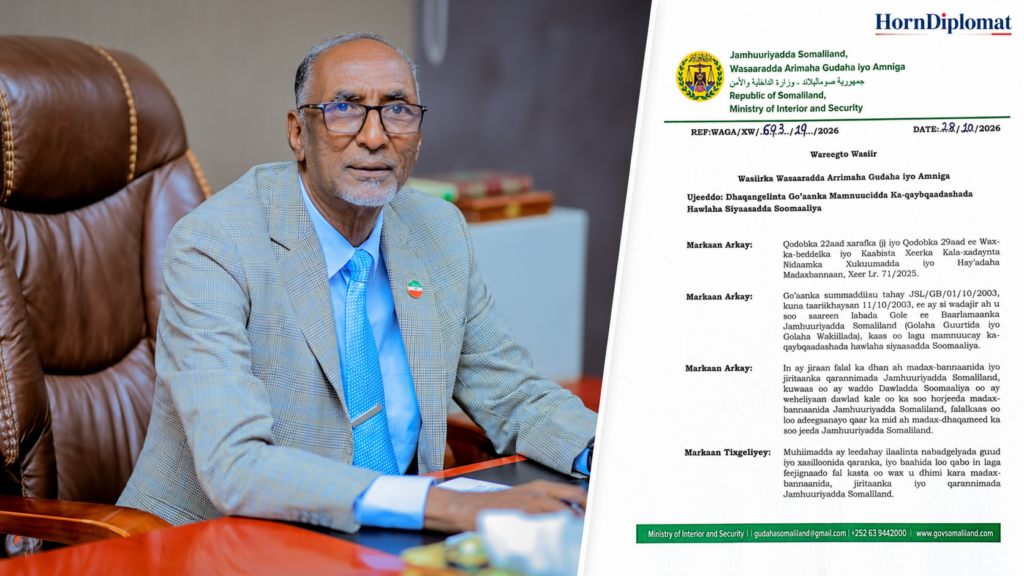
Somaliland Interior Minister: Somalia Politics Ban Now Treason
Summary
- Somaliland's Interior Minister Abdalle Mohamed Arab has ordered security agencies to enforce a ban on participation in Somalia's political activities.
- The directive, issued on October 28, warns that violating this ban constitutes treason.
- Any individual found in violation will face prosecution under Somaliland law.
- This order implements a decision previously adopted by Somaliland's authorities.
Recent Directive on Political Activities
By explicitly linking participation in Somalia's political life to treason, Somaliland is drawing a firm line, reinforcing its claim to independent statehood and rejecting any actions that might suggest otherwise.
Somaliland's Interior Minister, Abdalle Mohamed Arab, has recently issued a stern directive to the nation's security agencies, mandating the rigorous enforcement of a long-standing prohibition against engaging in Somalia's political affairs. This order, dated October 28 and bearing the minister's signature, explicitly warns that any contravention of this ban will be classified as treason. The directive underscores that such violations will inevitably lead to legal prosecution, signaling a significant escalation in how Somaliland intends to manage its distinct political identity.
The ministerial decree serves as the implementation of a decision previously adopted by Somaliland's authorities, reinforcing the government's firm stance on maintaining a clear distinction from Somalia's internal political landscape. This move by Somaliland Interior Minister Abdalle Mohamed Arab is a clear signal to both its citizens and the international community about the non-negotiable nature of its sovereignty. The instruction to security forces highlights the seriousness with which Somaliland views any perceived interference or participation in the political processes of its southern neighbor, emphasizing a zero-tolerance policy.
This enforcement action is not merely a reiteration of an old rule but a forceful activation of security mechanisms to ensure compliance. The directive specifically targets the involvement of individuals in any form of political activity related to Somalia, thereby seeking to prevent any actions that could be interpreted as undermining Somaliland's self-declared independence. The emphasis on prosecution for Somaliland treason charges Somalia politics engagement underscores the severe legal consequences awaiting those who disregard the directive.
Legal Ramifications and Context
The directive from Somaliland Interior Minister Abdalle Mohamed Arab carries significant legal weight, particularly due to its explicit classification of participation in Somalia's political activities as treason. Treason charges in Somaliland, as in many jurisdictions, are among the most severe legal accusations an individual can face, often carrying substantial penalties, including lengthy imprisonment or even the death penalty, depending on the specific statutes. This move signals a heightened commitment by Somaliland to uphold its sovereignty and deter any actions that could be interpreted as undermining its independent status, framing such political engagement as a direct threat to national security.
The ban itself is not new; it is described as a "longstanding" prohibition, indicating a consistent policy from Somaliland's government regarding its relationship with Somalia. While the Somaliland political activities ban has been in place, the recent directive from the Interior Minister elevates both the visibility and the severity of its enforcement. It makes it unequivocally clear that Somaliland security agencies are now under direct orders to actively pursue and prosecute individuals who disregard this established rule, transforming a policy into an actionable mandate with criminal implications.
This legal framework underscores the delicate and often contentious Somaliland Somalia relations, where Somaliland asserts its independence while Somalia maintains its claim over the territory. The formalization of the Somaliland political activities ban through this directive provides a clear legal basis for security forces to act, ensuring that any engagement with Somalia's political system is met with the full force of Somaliland's legal apparatus. The explicit mention of treason charges for Somalia politics involvement serves as a powerful deterrent.
Broader Implications and Enforcement
The re-emphasis on the Somaliland political activities ban, coupled with the threat of treason charges for engaging in Somalia politics, has profound implications for the already complex relationship between Hargeisa and Mogadishu. By explicitly linking participation in Somalia's political life to treason, Somaliland is drawing a firm line, reinforcing its claim to independent statehood and rejecting any actions that might suggest otherwise. This directive effectively criminalizes political engagement with a state that Somaliland does not recognize as having jurisdiction over its territory, thereby solidifying its internal and external posture.
This development means that individuals residing in Somaliland, including those who might have dual loyalties or business interests spanning both regions, now face severe legal risks if they involve themselves in Somalia's political processes. The directive from Minister Abdalle Mohamed Arab ensures that Somaliland security agencies will be vigilant in monitoring and acting upon any perceived breaches of this ban, potentially leading to increased scrutiny and enforcement actions against those suspected of violating the Somaliland Somalia politics ban. The October 28 directive serves as a critical update for anyone operating within or interacting with Somaliland.
The directive's explicit instruction to security agencies to enforce the ban indicates a proactive approach to preventing any perceived erosion of Somaliland's sovereignty. This could lead to a more stringent environment for political discourse and engagement, particularly concerning cross-border interactions. The potential for treason charges for Somalia politics involvement highlights the high stakes involved and the government's determination to protect its self-declared independence through robust legal and security measures.
Practical Implications
Lawyers advising clients operating in Somaliland must inform them of the severe legal consequences, including potential treason charges, for participating in Somalia's political activities, as per the Interior Minister's directive. Compliance officers should review and update internal policies to ensure adherence and mitigate criminal liability risks for their organizations and personnel.
Source
How does this affect you?
Get an AI analysis of this article grounded in your jurisdictions, practice areas, and any policy documents you've uploaded to Wansom.
Finish Reading the Full Story and the Expert Analysis.
Wansom is AI and can make mistakes.