
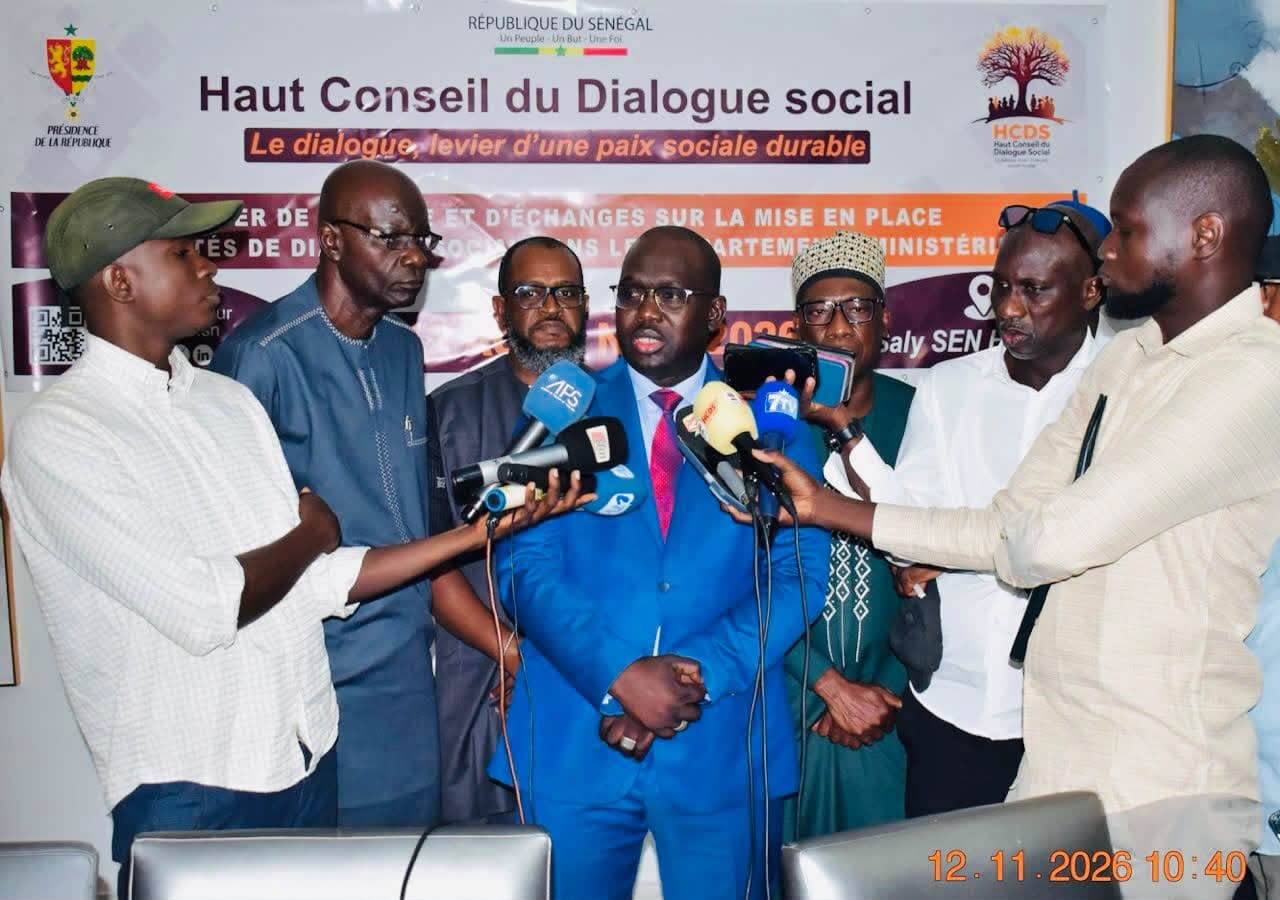
SN: Dialogue Social: Le Premier Ministre Avait Fixé la Fin d'An
Summary
- A workshop organized by the HCDS focused on creating social dialogue committees in ministries.
- This initiative follows a presidential directive from June 4, 2025, linking social stability to Vision Senegal 2050 goals.
- The Prime Minister mandated the installation of these committees by year-end during an October 15, 2025, evaluation of the Social Stability Pact.
- The HCDS, which replaced the National Social Dialogue Committee, has mediated social issues for a decade and promotes dialogue in both public and private sectors.
- These new ministerial committees aim to facilitate exchanges closer to administrations to prevent tensions and preserve social stability.
What Happened
The Prime Minister had, during an assessment of the Social Stability Pact on October 15, 2025, stressed the imperative for these committees to be fully operational before the close of the current year.
A recent workshop in Saly Niakh Niakhal, convened by the High Council for Social Dialogue (HCDS) and presided over by Fally Seck, focused on the establishment of social dialogue committees within government ministries. The primary goal of this gathering was to elucidate the significance of these new bodies to public sector stakeholders and to streamline both their implementation and subsequent operation. This initiative directly stems from a directive issued to government members during a Council of Ministers meeting held on June 4, 2025.
The President of the Republic had specifically called for the creation of these committees, underscoring the critical role of social stability in achieving the ambitious objectives outlined in the National Transformation Strategy, known as Vision Senegal 2050. Reinforcing this mandate, the Prime Minister had, during an assessment of the Social Stability Pact on October 15, 2025, stressed the imperative for these committees to be fully operational before the close of the current year. This highlights the urgency placed on the dialogue social : le Premier ministre avait fixé la fin d’année as a critical deadline for these new structures.
The Mandate for Enhanced Dialogue
The presidential instruction for establishing these committees is rooted in a fundamental belief that enduring social stability is an indispensable prerequisite for realizing the nation's long-term strategic goals. The Vision Senegal 2050 framework, which guides the country's developmental trajectory, relies heavily on a harmonious social environment to ensure its successful execution. Therefore, the formation of these dialogue platforms is seen as a proactive measure to cultivate and maintain such stability across the public administration.
The Prime Minister's subsequent emphasis on an end-of-year deadline for their installation further underscores the high priority assigned to this endeavor. This timeline was articulated during a specific review of the Social Stability Pact, indicating that the government views these committees not merely as administrative additions, but as essential components for ongoing social cohesion and progress. The urgency reflects a commitment to embedding structured dialogue mechanisms deeply within the governmental apparatus.
The High Council's Enduring Role
The High Council for Social Dialogue (HCDS), the organizing body for the recent workshop, plays a central role in fostering harmonious labor relations. Established to succeed the former National Social Dialogue Committee, the HCDS is composed of approximately thirty members. These individuals are appointed by the President of the Republic for a renewable three-year term, ensuring a consistent and experienced leadership in social mediation. Innocence Ntap Ndiaye was appointed as the inaugural president when the institution was first constituted.
Over the past decade, the HCDS has dedicated its efforts to social mediation, facilitating constructive dialogue, and enhancing the capabilities of representatives from various stakeholder groups. Fally Seck reiterated the HCDS's overarching mission, which encompasses promoting social dialogue across both the public and private sectors. Beyond its facilitative role, the institution actively intervenes in the prevention and resolution of conflicts and is also responsible for publishing an annual report detailing the state of social dialogue within the nation. Its mandate also extends to addressing issues within the informal economy, showcasing its comprehensive approach to social cohesion.
Proactive Conflict Resolution
The strategic implementation of these new social dialogue committees within individual ministries is designed to embed mechanisms for communication and negotiation directly within administrative structures. This localized approach aims to foster exchanges at the closest possible level to daily operations, thereby addressing potential tensions proactively and upstream, before they escalate into full-blown conflicts. By decentralizing dialogue, the government seeks to create more responsive and effective channels for addressing workplace concerns.
As previously highlighted by the HCDS president, Innocence Ntap Ndiaye, during a plenary assembly, continuous dialogue between workers and employers is paramount for safeguarding social stability. These new ministerial committees are intended to embody this principle, serving as vital conduits for ongoing communication. Their establishment reflects a commitment to institutionalizing dialogue as a foundational element for maintaining peace and productivity across the public service, ultimately contributing to the broader national development agenda.
Source
Source: Original reporting via EMedia
How does this affect you?
Get an AI analysis of this article grounded in your jurisdictions, practice areas, and any policy documents you've uploaded to Wansom.
Finish Reading the Full Story and the Expert Analysis.
Get the latest legal & regulatory intelligence in Senegal
Wansom is AI and can make mistakes.