
Seven Months Late, Congo Puts a Task Force Behind Its US Minerals Pact, but the Glencore–Orion Deal Is Still Unsigned
Summary
The task force: created by cabinet on 11 September 2026 to accelerate the December 2025 US–Congo strategic minerals partnership. It was originally due in February; membership and priority projects are undisclosed.
Mining investment: Virtus Minerals bought Chemaf's Congolese copper-cobalt assets in March 2026 for about US$30 million plus about US$900 million of assumed debt, the first physical mining investment under the pact.
Offtake: Gécamines' Mercuria-backed trading venture committed 100,000 tonnes of copper to the US in January, then 500,000 tonnes in April; Reuters also reports expanded arrangements with Glencore.
Logistics: Lobito Atlantic Railway drew about US$300 million of its US$753 million DFC and DBSA financing and expects to double international cargo from about 400,000 tonnes in 2026 to about 800,000 in 2027.
Exploration: KoBold is spending more than US$50 million through early 2027 on AI-driven lithium exploration across 13 licences around Manono.
The gap: the Glencore–Orion CMC deal for 40% of KCC and Mutanda, valuing the mines at about US$9 billion, remains a non-binding MOU, while the same assets face a tax dispute and ARSP local-content orders.
The law: the pact's right of first offer for US firms, change-of-control approvals and overlap with Congo's quotas and local-content rules shape every deal.
The Pact and the Task Force
The partnership. In December 2025, Congo and the United States signed a strategic minerals partnership designed to deepen cooperation on mining, investment and security, and to channel more of Congo's copper, cobalt and other critical minerals towards US and allied supply chains. Key features reported from the agreement include:
Element | What it provides |
|---|---|
Joint steering committee | A bilateral body to set offtake targets and guidelines |
Right of first offer | Priority for US firms on designated assets and on marketed minerals destined for export |
Logistics | Routing via the Sakania–Lobito corridor to the Atlantic where appropriate |
Strategic projects | A pipeline of Congolese projects offered for US investment |
Implementation so far. Prime Minister Judith Suminwa chaired a first meeting of the implementation mechanism in June 2026. The government said then that a joint steering committee was already in place, that Kinshasa had submitted about 50 strategic projects to the US side, and that it had received an initial list of strategic mineral assets covered by the partnership.
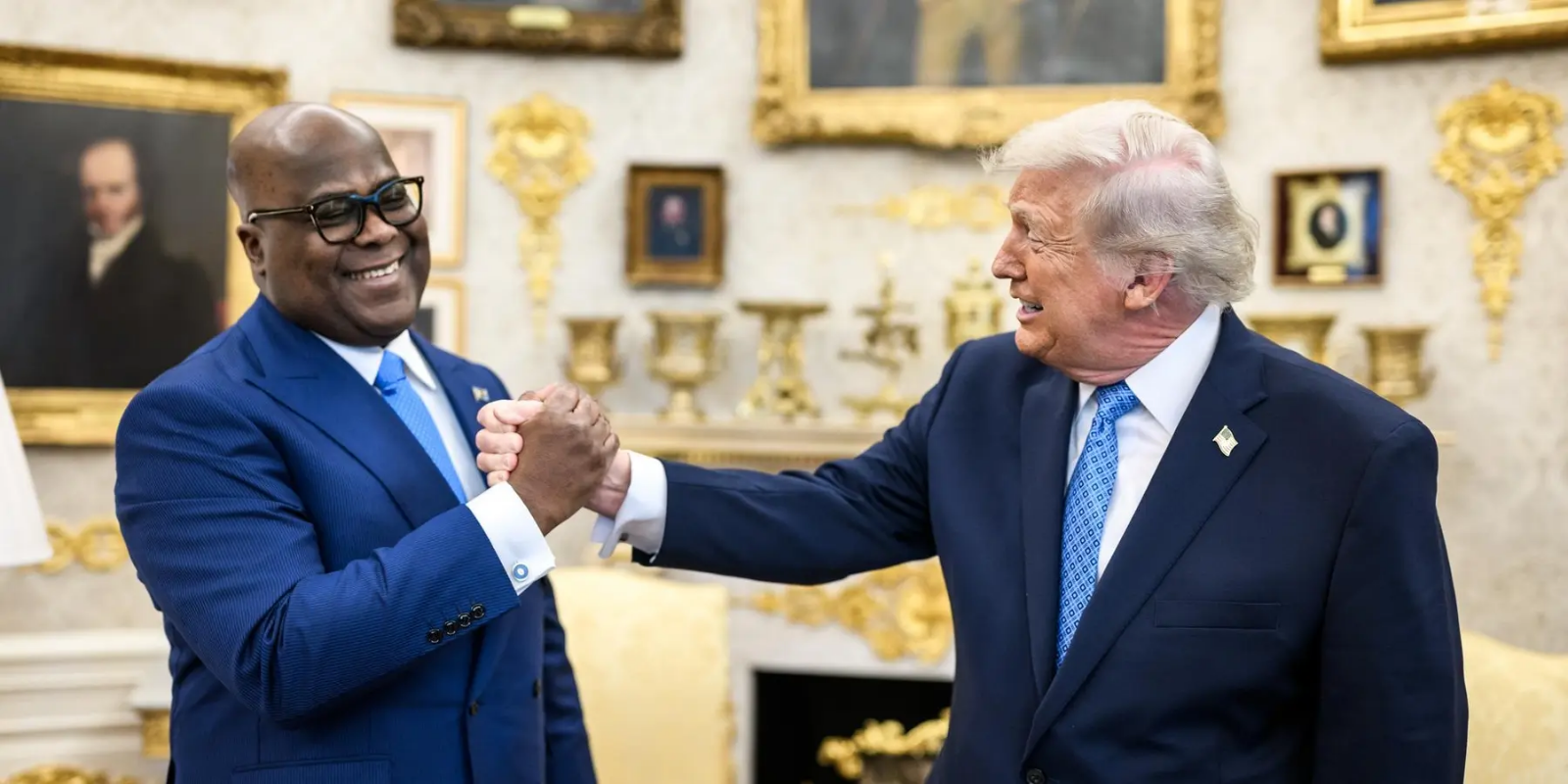
The task force, seven months late. On 11 September 2026, Congo's cabinet formally created a "DRC-USA Task Force" to accelerate execution of the partnership. According to the government's account of the meeting, Economy Minister Daniel Mukoko Samba said the body would help translate commitments into "concrete economic and security results" for Congolese citizens. A government official told Reuters the task force had been due to start in February but was delayed by administrative hurdles, while implementation continued in the meantime.
What is still missing. The cabinet minutes did not disclose:
who sits on the task force;
which priority projects it will oversee; or
how it relates to the joint steering committee and the existing implementation mechanism.
Those answers will show whether the task force is a real delivery unit or another layer of coordination.
What the Pact Has Delivered So Far
Even before the task force existed, the partnership produced concrete deals across mining, marketing and exploration.
1. Virtus Minerals and Chemaf: the first US mining investment
Virtus Minerals, a US company, bought the Congolese copper and cobalt assets of Chemaf for about US$30 million in March 2026, and agreed to assume about US$900 million of debt. Cabinet minutes describe it as a US-backed mining investment under the partnership, and it is widely reported as the first physical mining investment made under it. Chemaf, which had been financially distressed, owns copper-cobalt operations in Haut-Katanga and Lualaba.
2. Copper offtake: Gécamines, Mercuria and Glencore
The state miner Gécamines is turning its minority stakes in major mines into physical copper it can market itself, with US buyers a priority:
Date | Development |
|---|---|
October 2025 | Gécamines and Mercuria set up a trading partnership; Gécamines fully owns Gécamines Trading, with Mercuria providing financial, logistical and technical support |
January 2026 | First commitment: 100,000 tonnes of copper from Gécamines' share of CMOC's Tenke Fungurume output, offered to the US market |
April 2026 | Pledge raised to 500,000 tonnes for the US, disclosed in a Gécamines sovereign-debt prospectus, drawing on stakes including Glencore's Kamoto Copper Company and Tenke Fungurume |
2026 | Reuters reports expanded copper offtake arrangements between Gécamines and both Mercuria and Glencore under the partnership |
Mercuria remains the seller of record while Gécamines builds its own trading capability. The arrangement shifts the direction of Congo's copper sales, long dominated by Chinese buyers, without changing who owns the mines.
3. KoBold Metals: AI-driven lithium exploration
US explorer KoBold Metals, backed by Bill Gates and Jeff Bezos, launched what it calls an unprecedented lithium exploration campaign in April 2026:
more than US$50 million committed through early 2027;
13 exploration licences covering more than 3,000 km², focused on the Manono region, with plans to reach 5,000 km²;
30,000 km² of airborne surveys, thousands of drill holes and more than 30,000 geochemical samples; and
more than US$20 million already paid to Congo's treasury, according to its chief executive.
On 25 September 2026, an AFP report from Manono described KoBold's teams using an AI system, trained on colonial-era drill logs, geological maps and satellite images, to target drilling in real time. KoBold remains at the exploration stage. In the same area, China's Zijin Mining has been preparing Congo's first lithium production, a reminder of the competition the US partnership faces.
Logistics: The Lobito Corridor Gets Moving
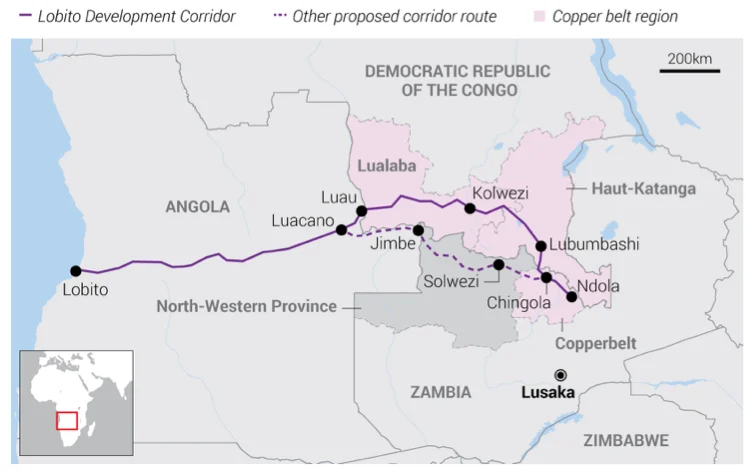
Why it matters. A minerals partnership with the US is only as useful as the route that gets copper and cobalt out of Congo's landlocked Copperbelt. The Lobito Corridor runs by rail from the Congo border through Angola to the Atlantic port of Lobito. It is the Western-backed alternative to routes running east to Dar es Salaam and south to Durban, and the partnership specifically envisages routing exports via the Sakania–Lobito corridor where appropriate.
The financing.
Element | Detail |
|---|---|
Operator | Lobito Atlantic Railway (LAR), a concession held by a consortium of Trafigura, Mota-Engil and Vecturis |
Route | About 1,300 km of railway from the Port of Lobito to Luau on the Angola–Congo border |
Package | US$753 million: US$553 million senior debt from the US International Development Finance Corporation (DFC) and US$200 million from the Development Bank of Southern Africa |
Signed / closed | Loans signed in December 2025; financial close announced by the Africa Finance Corporation in July 2026 |
First drawdown | About US$300 million, in June 2026, for new wagons, track repairs and closer Angola–Congo coordination |
Second drawdown | Being prepared |
The cargo plan. On 11 September 2026, LAR chief executive Nicolas Fournier said the railway expects to:
Period | International cargo |
|---|---|
2025 | About 265,000 tonnes |
2026 (target) | About 400,000 tonnes, including about 200,000 tonnes of Congolese copper and cobalt westbound and a similar amount eastbound |
2027 (target) | About 800,000 tonnes, roughly double |
2030 (ambition) | About 1 million tonnes a year |
July 2026 was LAR's best month on record, with about 27,000 tonnes of international cargo, after recovering from floods that forced it to truck around a 1.5 km damaged section for two months. The DFC expects the upgrade to raise the corridor's capacity tenfold, to about 4.6 million tonnes a year, and cut critical-mineral logistics costs by up to 30%.
The Congolese link. EGC, the state's artisanal cobalt buyer, made its maiden shipment via Lobito in 2026: 587 tonnes of cobalt and 500 tonnes of copper cathode. Each such shipment shows the corridor working as a Western-aligned export route.
The Biggest Deal Is Still Unsigned: Glencore and Orion
The proposal. On 3 February 2026, Glencore and the Orion Critical Mineral Consortium (Orion CMC) signed a non-binding memorandum of understanding for Orion CMC to acquire a 40% stake in Glencore's interests in its two Congolese copper-cobalt operations:
Asset | Ownership | 2025 output (combined) |
|---|---|---|
Kamoto Copper Company (KCC) | Glencore 75%, alongside state miner Gécamines and local partner SIMCO | About 247,800 tonnes of copper and 33,500 tonnes of cobalt across both mines |
Mutanda Mining (Mumi) | Glencore 100% |
The deal implies a combined enterprise value of about US$9 billion for the two mines.
Who Orion CMC is. The consortium was established in October 2025 by the US International Development Finance Corporation, New York-based Orion Resource Partners and Abu Dhabi's ADQ, with an initial capital commitment of US$1.8 billion and a target of US$5 billion. Its purpose is to secure critical-mineral supply for the US and its allies.
What Orion would get.
the right to appoint non-executive directors;
control over the sale of its share of production to designated buyers; and
with Glencore, a joint search for expansion and other critical-mineral assets across Congo and the African Copperbelt.
Glencore would keep managing both mines.
Still non-binding. The MOU is conditional on due diligence, binding agreements and regulatory approvals. Eight months on, it remains non-binding. No reason has been given publicly, but several complications have surfaced around the same assets in 2026:
Tax dispute. In mid-2026, Congo's tax authority sealed Kamoto Copper's offices in a dispute over amounts it says Glencore owes. Glencore disputes the claims.
Local content. In September, ARSP ordered KCC and Mutanda to drop 1,540 ineligible suppliers and submit remediation plans.
State interests. Gécamines is building its own trading arm and drawing on its KCC stake for US-bound copper sales, and any change in ownership of KCC involves the state partner.
Why it matters. The Orion deal is the partnership's flagship: a US-backed investor taking a direct governance and marketing stake in Western-operated Congolese copper and cobalt. Until it becomes binding, the partnership's largest promised investment remains on paper.
The Trade and Investment Law Analysis
1. A framework, not a treaty of rights
The partnership is a government-to-government framework. It sets priorities, committees and preferences, but most of its results depend on separate commercial contracts: the Virtus–Chemaf acquisition, Gécamines' offtake arrangements, KoBold's exploration licences and the Glencore–Orion MOU. Each of those is governed by Congolese mining and company law, contract law and, where relevant, investment treaties. The task force's job is to move those transactions through Congo's approval system, not to change the law that governs them.
2. Right of first offer and non-discrimination
A right of first offer for US firms on designated assets and exported minerals is a preference for one country's investors and buyers. Three legal questions follow:
Whose minerals? Where the right applies to production Congo or Gécamines owns, such as Gécamines' share of Tenke Fungurume output, the state is choosing whom to sell its own product to, which is generally within its discretion.
Other investors' assets. Applying preferences to assets owned by Chinese or other foreign investors could raise claims under their mining conventions and bilateral investment treaties, which often include national-treatment and most-favoured-nation protections.
Trade rules. GATT Article XVII asks state trading enterprises to act on commercial considerations. A politically directed allocation of exports by a state miner could be questioned on that basis, although such challenges are rare.
3. Change of control and state consent
The Glencore–Orion deal would transfer an indirect interest in mining rights. Under Congo's Mining Code, transfers affecting control of mining title holders typically require regulatory approval. At KCC, the state partner Gécamines has its own shareholder rights. Those approvals are where government priorities, including tax settlements, local-content compliance and the 5% employee-equity rule, can be brought into the negotiation.
4. Overlap with Congo's own controls
US-aligned investment does not exempt operators from Congolese rules. KCC and Mutanda remain subject to cobalt export quotas set by ARECOMS, local-content enforcement by ARSP, and tax claims by the tax authority. Investors entering through the partnership take on the same regulatory exposure as everyone else, and arguably more scrutiny.
5. Responsible sourcing and logistics
The US partnership emphasises secure, responsible supply chains. Buyers will expect traceability and due diligence across copper, cobalt and lithium. The Lobito Corridor offers a route under Western-backed financing, and the DFC's loan terms bring their own environmental, social and governance requirements for the operator.
What It Means for Each Stakeholder
US and allied investors
The task force should, in principle, provide a single channel for moving projects through Kinshasa's approval system. Investors should find out who sits on it, which of the roughly 50 strategic projects are priorities, and how the right of first offer will apply to the assets they target. They should also expect the same regulatory exposure as other operators: export quotas, local-content audits and tax scrutiny.
Glencore and Orion CMC
The February MOU remains non-binding. Converting it requires due diligence, binding documents and approvals at a time when the same assets face a tax dispute and ARSP local-content orders. Those issues may well become part of the negotiation over approvals. Watch for signs that the task force treats the deal as a priority.
Gécamines
The state miner gains leverage: it markets its own copper share to US buyers through Gécamines Trading, holds shareholder rights at KCC, and sits at the centre of the partnership's offtake strategy. Its challenge is building a trading capability that can eventually stand without Mercuria as seller of record.
Commodity traders (Mercuria, Glencore, Trafigura and others)
Traders are central to turning the partnership into physical flows, through offtake, logistics and finance. Trafigura is also a shareholder in the Lobito railway concession. Traders should expect more US-directed volume, more scrutiny of routing and traceability, and competition from state-linked trading arms.
Chinese operators and buyers
Chinese companies control a large share of Congo's mining output. A US right of first offer and US-bound offtakes from Gécamines' stakes could redirect some volumes away from China. Chinese investors will watch closely for any attempt to apply preferences to assets they own, and may rely on their own conventions and treaty protections.
Logistics and infrastructure players
LAR's plan to double cargo in 2027 creates opportunities for wagon suppliers, maintenance contractors, freight forwarders and border-service providers along the corridor, and sets up competition with eastern and southern routes.
Explorers and juniors
KoBold's licences around Manono show that frontier exploration under the partnership is possible. Other explorers should note the importance of early engagement with the government, payment of exploration fees, and community investment.
Congolese government and citizens
The test is whether the partnership produces Congolese value, in revenue, jobs, local suppliers and processing, rather than only redirecting exports. The Economy Minister's stated goal of concrete economic and security results sets the benchmark for the task force.
Lawyers and advisers
The work spans M&A and change-of-control approvals, offtake and marketing agreements, investment-treaty and stability-clause analysis, project finance under DFC terms, and compliance with Congo's quota, local-content and tax regimes.
Key Dates
Date | Event |
|---|---|
December 2025 | US–Congo strategic minerals partnership signed; Lobito railway loans signed |
January 2026 | First Gécamines copper commitment to the US market (100,000 tonnes) |
3 February 2026 | Glencore–Orion CMC non-binding MOU on a 40% stake in KCC and Mutanda |
February 2026 | Original target date for the DRC-USA Task Force |
March 2026 | Virtus Minerals acquires Chemaf's Congolese assets |
April 2026 | KoBold launches its lithium exploration campaign; Gécamines' US copper pledge raised to 500,000 tonnes |
June 2026 | First meeting of the implementation mechanism; about 50 projects submitted; LAR draws about US$300 million |
11 September 2026 | Cabinet creates the DRC-USA Task Force; LAR sets out its plan to double cargo in 2027 |
25 September 2026 | AFP reports on KoBold's AI-driven exploration in Manono |
What to Watch
Milestone | Why it matters |
|---|---|
Task force membership and priority projects | Shows whether it will be a delivery unit with authority |
Glencore–Orion binding agreements | The partnership's flagship investment |
Resolution of the Kamoto tax dispute and ARSP orders | Possible preconditions for the Orion deal |
LAR's second drawdown and 2027 cargo | Whether the Western export route scales |
KoBold drilling results | Whether US-backed exploration turns into a lithium discovery |
Use of the right of first offer | How preferences for US firms are applied in practice |
Frequently Asked Questions
What is the DRC-USA Task Force? A body created by Congo's cabinet on 11 September 2026 to accelerate implementation of the December 2025 strategic minerals partnership with the United States. Its membership and priority projects have not been disclosed.
Why was it late? A government official said it was due to start in February 2026 but was delayed by administrative hurdles.
What has the partnership delivered? Virtus Minerals' acquisition of Chemaf's assets, US-bound copper offtakes from Gécamines through its Mercuria-backed trading venture, KoBold's lithium exploration around Manono, and progress on the US-financed Lobito railway.
Is the Glencore–Orion deal done? No. The February 2026 memorandum of understanding for a 40% stake in KCC and Mutanda remains non-binding and subject to due diligence, binding agreements and regulatory approvals.
How much financing does the Lobito railway have? US$753 million: US$553 million from the US DFC and US$200 million from the Development Bank of Southern Africa. About US$300 million had been drawn by June 2026.
Citations
- 1.• Congo creates task force for US minerals deal, cabinet minutes say, Reuters via Investing.com (15 September 2026)
- 2.• DR Congo deepens US minerals ties as copper sales to West expand, bne IntelliNews (16 September 2026)
- 3.• Lobito corridor to double minerals cargo after $300 million draw, Bloomberg via Mining.com (11 September 2026)
- 4.• Lobito Railway records monthly cargo record as corridor targets 400,000 tonnes, FMDRC-Zambia (24 September 2026)
- 5.• Lobito Corridor Railway reaches $753m financial close, Africa Private Equity News (July 2026)
- 6.• DBSA and US close $753 million financing for Lobito Atlantic Railway upgrade, Green Building Africa
- 7.• Proposed acquisition by US-backed Orion Critical Mineral Consortium of a strategic stake in Glencore's DRC assets, PR Newswire (3 February 2026)
- 8.• Orion eyes stake in Glencore DRC mines, Metal Tech News
- 9.• DRC locks down Glencore's Kamoto offices in tax clash, Mining.com.au
- 10.• DR Congo miner commits more copper to US, Semafor (15 April 2026)
- 11.• DR Congo to send US first copper shipments, Semafor (14 January 2026)
- 12.• KoBold Metals uses AI to search for critical minerals in Congo, AFP via Africanews (25 September 2026)
- 13.• US-backed KoBold launches $50m lithium exploration drive in Congo, Engineering News (13 April 2026)
Finish Reading the Full Story and Expert Analysis.
Get the latest legal & regulatory intelligence in DR Congo
Wansom is AI and can make mistakes.