
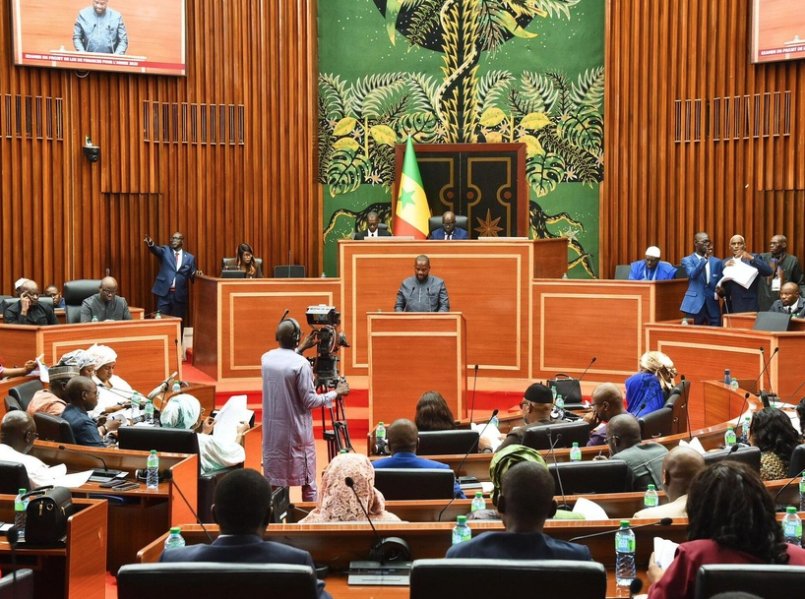
Tafsir Thioye: Questions LFI 2027 Withdrawal Procedure Legitimacy
Summary
- Deputy Tafsir Thioye is challenging the procedural regularity of the withdrawal of Senegal's Initial Finance Law (LFI 2027).
- Thioye argues that only the National Assembly's plenary session, not its Finance Committee, can decide to withdraw such a bill.
- He contends the withdrawal request should have been addressed to the Assembly's president, given the bill's origin via presidential decree.
- The LFI 2027 involves 2,505 billion FCFA, and a prolonged blockage is warned to threaten the national economy.
- Thioye views the alleged procedural breach by the Finance Committee as an 'extremely serious' disregard for institutional rules.
Procedural Challenge to LFI 2027 Withdrawal
He contends that the committee lacks the authority to commit the entire Assembly, asserting that such a significant resolution is reserved solely for the plenary session.
Deputy Tafsir Thioye, an unaffiliated member of Sopi Sénégal, has initiated a challenge regarding the process used to withdraw the contentious Initial Finance Law (LFI 2027). Thioye has publicly questioned the legitimacy of the steps taken, particularly those attributed to the National Assembly's Finance Committee, suggesting that the established parliamentary protocols were not properly observed in this instance. His concerns center on the appropriate channels for such a significant legislative action, especially concerning the `Tafsir Thioye LFI 2027 withdrawal procedure`.
During an interview on TFM matin, broadcast on Wednesday, October 4, 2026, and subsequently reported by Rewmi, Thioye revealed that he had seen a letter from the president of the Finance Committee addressed to the Minister of Finance, requesting the withdrawal of the Initial Finance Law. He emphasized that the original bill was introduced via a presidential decree, implying that any correspondence related to its withdrawal should have followed a similar high-level channel, specifically through the President of the Assembly. This highlights a critical aspect of the `Retrait LFI 2027 Sénégal`.
Parliamentary Authority and Due Process
Thioye's primary argument revolves around the scope of authority held by the Finance Committee. He firmly asserts that this committee lacks the power to bind the entire National Assembly, contending that only a full plenary session of the Assembly possesses the prerogative to make such a pivotal decision as withdrawing a finance bill. This perspective underscores the importance of the `Rôle Commission des Finances Assemblée nationale` within the broader legislative framework.
He further elaborated that the formal request for the `Procédure retrait loi finances rectificative` should have been directed to the President of the Assembly, rather than originating from the Finance Committee and being sent directly to the Finance Minister. This procedural misstep, in Thioye's view, represents a significant departure from established parliamentary norms and raises serious questions about the integrity of the legislative process. His stance on the `Tafsir Thioye procédure parlementaire` is clear: adherence to institutional rules is paramount.
Economic Stakes and Political Accusations
The financial implications of the `Loi de finances rectificative 2027` are substantial, with the bill encompassing a total of 2,505 billion FCFA, which includes 1,590 billion in payment credits. Aminata Touré has issued a stark warning that any prolonged impasse over this legislation could directly jeopardize the national economy and inflict damage upon the private sector, highlighting the urgency of resolving the procedural dispute.
Beyond the procedural arguments, Thioye has accused the parliamentary majority of leveraging its political influence to bypass institutional regulations. He suggests that the majority is prioritizing its numerical strength over adherence to established legal and parliamentary procedures. Aminata Touré also criticized the Finance Committee's rejection of the bill and the opposition from Pastef deputies, pointing out that these same deputies had previously approved the rectifying budget when they were in power, only to now oppose it.
Gravity of the Alleged Breach
Tafsir Thioye reserves his most severe criticism for the potential confirmation of the letter's existence and its stated objective. He views the act of the Finance Committee requesting the withdrawal of the finance law as a matter of extreme gravity, should it be definitively confirmed. This sentiment reflects a deep concern over the potential erosion of parliamentary due process and the implications for future legislative actions.
His strong reaction underscores the perceived seriousness of the alleged procedural irregularity, suggesting that it could set a dangerous precedent for how significant financial legislation is handled within the National Assembly. The outcome of this challenge could therefore have lasting effects on the interpretation and enforcement of parliamentary rules in Senegal.
Practical Implications
Lawyers and compliance officers should monitor the procedural challenge to the withdrawal of Senegal's LFI 2027, as it underscores the critical importance of adhering to proper parliamentary channels for legislative actions. This case could set a precedent for challenging the validity of future legislative decisions based on procedural irregularities, particularly concerning significant financial legislation.
Source
Source: Original reporting via Rewmi
How does this affect you?
Get an AI analysis of this article grounded in your jurisdictions, practice areas, and any policy documents you've uploaded to Wansom.
Wansom is AI and can make mistakes.